

Ultimately, we all want status. Prestigious jobs and desirable partners are badges of success, proving we’ve made it to the top. Working class men have certainly struggled -automation and globalisation eroded their earnings and marriage market appeal, fuelling conservative backlash.
As Generative AI advances, it could also threaten graduates - potentially disrupting their pathways to respect and romance. Netflix couldn’t introduce Suits in 2025; it wouldn’t be credible. Why would Harvey (a senior partner) be wowed by a guy who can memorise when he already has Grok? Mike’s wits might fail to impress, or even charm beautiful Rachel.
Moving on from my dated references, let’s review the latest economics research, and try to forecast the future.

Automation Hurt Working Class Men
From 1980 to 2019, US manufacturing shed 6.5 million jobs (Abrahams and Levy 2025). Globalisation and automation tanked demand, disproportionately affecting less-educated men, who then tended to vote Republican.
Hard hit areas saw steeper drops in employment and working hours, particularly post-2000 (Charles et al 2019). Remaining manufacturing jobs increasingly demanded higher skills, leaving less-educated male workers particularly vulnerable. While both men and women in automation-affected areas were more likely to pursue college education, the effect varied by gender - men often remained in declining sectors.
Blue-collar men’s earnings plummeted, reducing their role as breadwinners. Marriage rates simultaneously dropped, as we know from Autor.
Opioid use spiked, alongside substance abuse. Novosad and colleagues document that for white men in the bottom 10% of education, mortality rose 47-67% between 1992-2018.
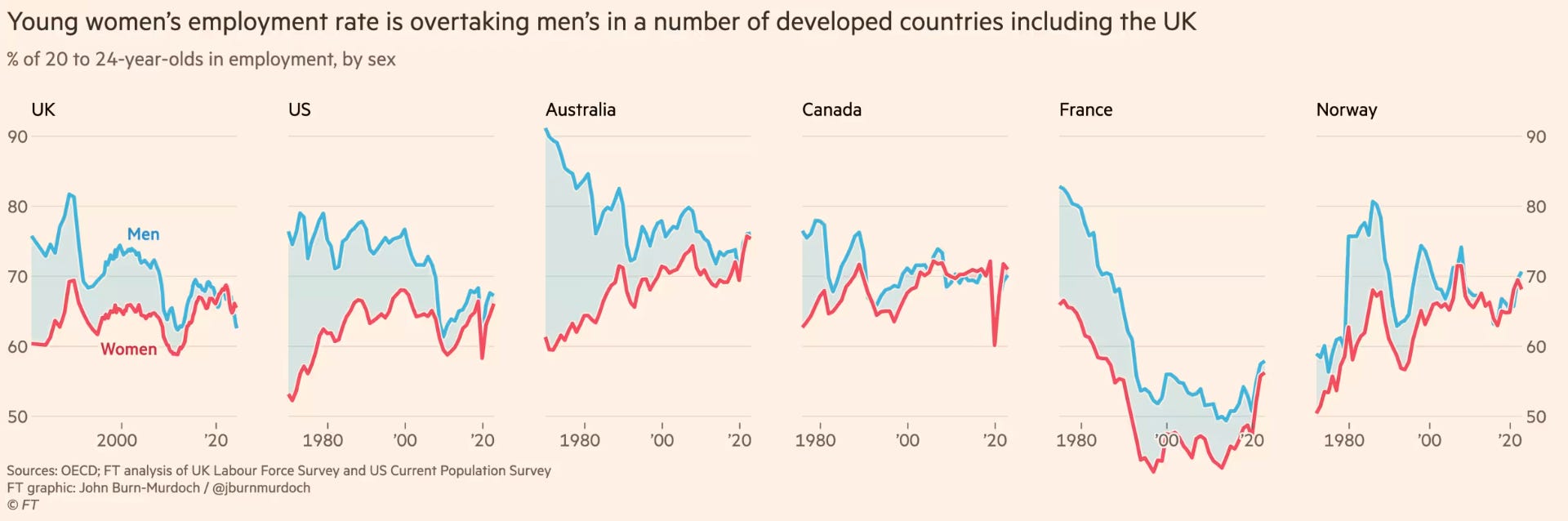
These economic trends are not unique to the US. Across advanced economies. John Burn-Murdoch highlights a rising share of young men not in education, work or looking for a job.

Sadness, Frustration & Backlash
When men lose relative economic status - whether through industrial decline, recession, or women’s increasing workforce participation - they often try to reassert their status.
In the United States, when local industries feminised and blue-collar men lost relative economic status, they became more likely to endorse conservatism. As the gender gap in workforce participation closed, more people voted Republican.
American men who lost work also show increased rates of sexual harassment, sharing abusive porn, opposition to abortion, gun purchases and rejection of female politicians. Backlash is most severe in communities where unemployment has disproportionately hit men. Men who feel unfairly disadvantaged also tend to endorse hostile sexism.
This pattern repeats worldwide:
Across Europe, young men in areas with rising long-term unemployment express stronger opposition to women’s rights. (This could be a direct effect of joblessness, or difficulties in dating).
In the UK, people who are born into areas with high unemployment are now more likely to say ‘“Husband should earn, wife stay at home”.
In Brazil, regions where unemployment disproportionately affected men showed stronger support for Bolsonaro. Male job loss also exacerbated domestic violence.
When Zambian mines closed and men were retrenched, their wives bore the brunt of ‘icifukushi’ (angry frustration).
British research indicates that people born in high-unemployment areas increasingly favour ideas of the male breadwinner.
In China, economic slowdown and tough marriage markets create intense pressure on men to succeed, while social media platforms like Baidu Tieba channel frustrations into misogyny.
When male status or core values are threatened, they often trigger organised resistance - ranging from harassment to political mobilisation.

Adaptation!
You may interject: but the US has seen massive economic growth! Yes, workers do adapt, but which sectors are seeing job growth?
When manufacturing collapsed, workers adapted:
In response to a rising college wage premium, many pursued higher education;
College graduates migrated to cities with thriving, high-skill industries, like tech and finance hubs.
Today, women are adapting especially well, increasingly pursuing college. Many are moving into professional and technical fields, leveraging social skills that complement non-routine tasks.



Booming Healthcare
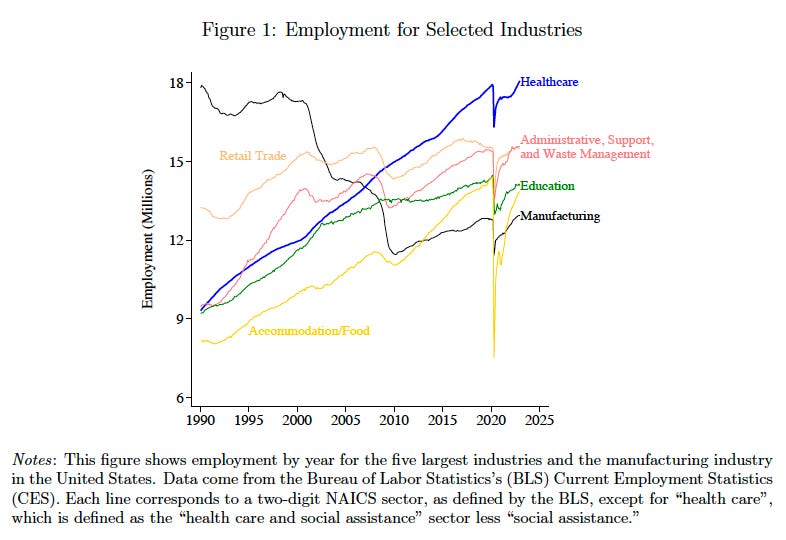
A brilliant new paper by Mahoney et al shows that healthcare has been a powerhouse for women, creating new pathways to status. From 1980 to 2022, jobs in healthcare surged from 7.1 million to 18.1 million, growing at 2.1% per year - twice the pace of non-healthcare sectors (Mahoney et al, 2025: Figure 1).
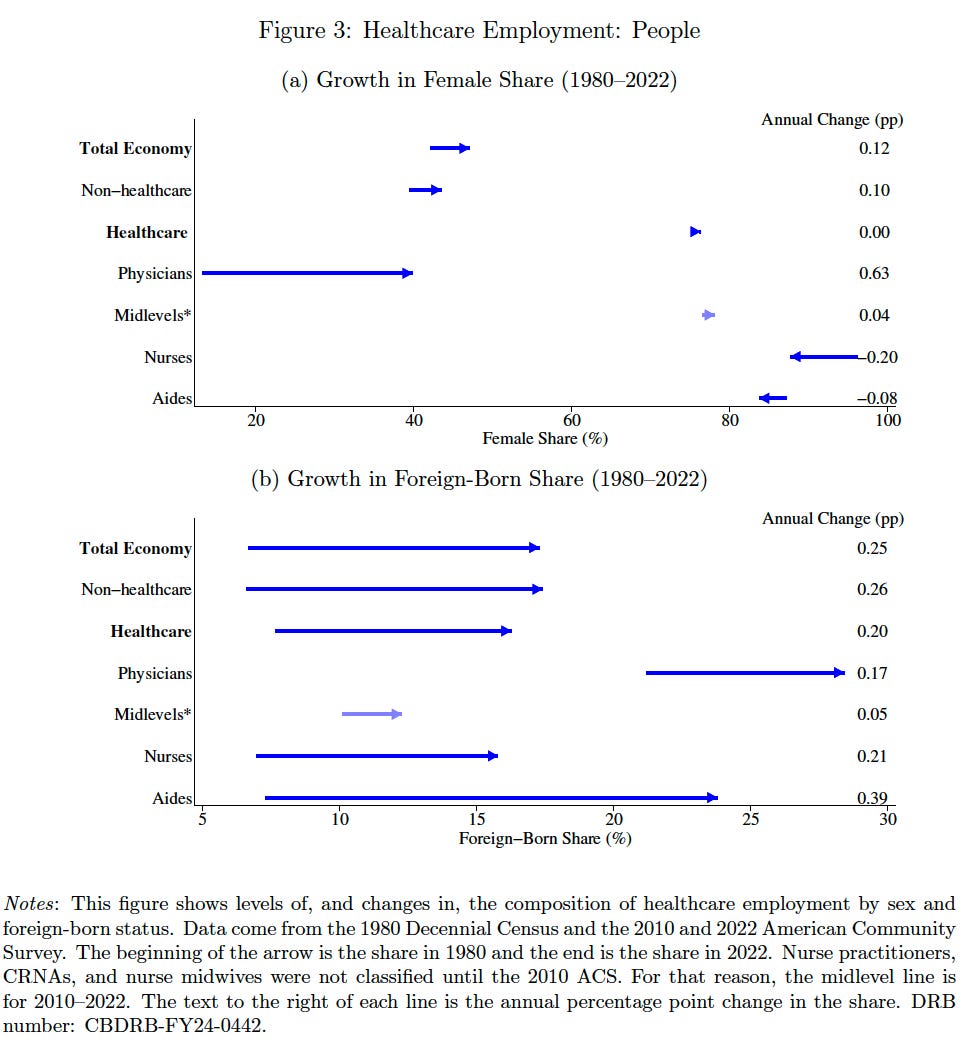
Women’s share of healthcare workers has stayed constant; what’s changed is industry growth and their own rising share of clinical roles. Between 1980 and 2022, women’s share of physicians nearly tripled, from 13% to 40%, breaking open a male-dominated field (Figure 3). Even more striking, healthcare drove a QUARTER of women’s job gains over this period. That’s a massive lift to women’s economic and social standing, driven by nurses, aids and mid-level roles.
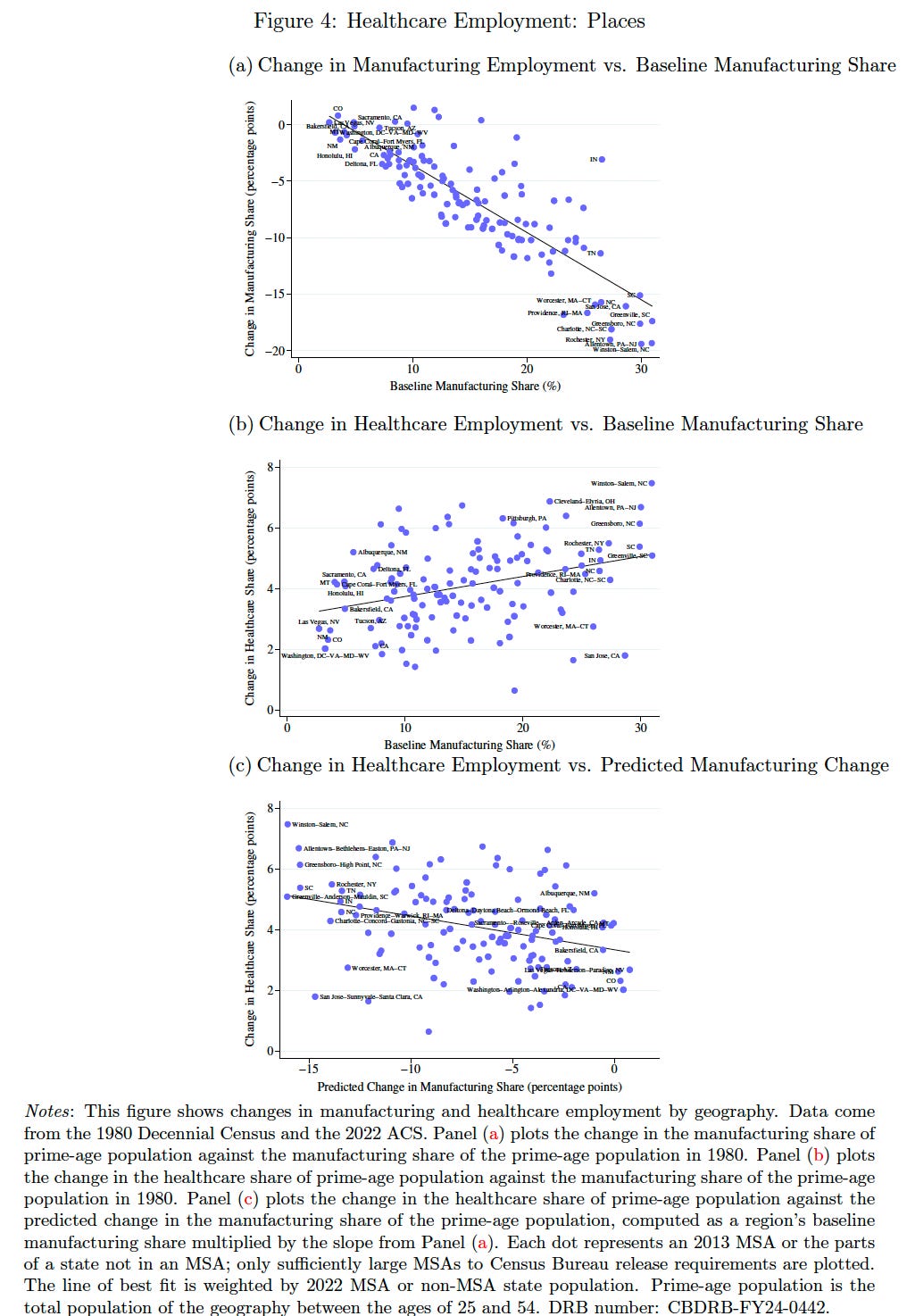
But healthcare did not save the Rust Belt. Figure 4 shows that it only offset 11% of manufacturing job losses nationwide. Very few cities pivoted from manufacturing to medicine. Less-educated men rarely made in-roads. As I’ve written before, masculinity can impose a restrictive straitjacket.
What’s the Future for Generative AI?
Whereas factory robots replaced brawn, generative AI targets brains and it’s getting seriously smart. Here are two key facts:
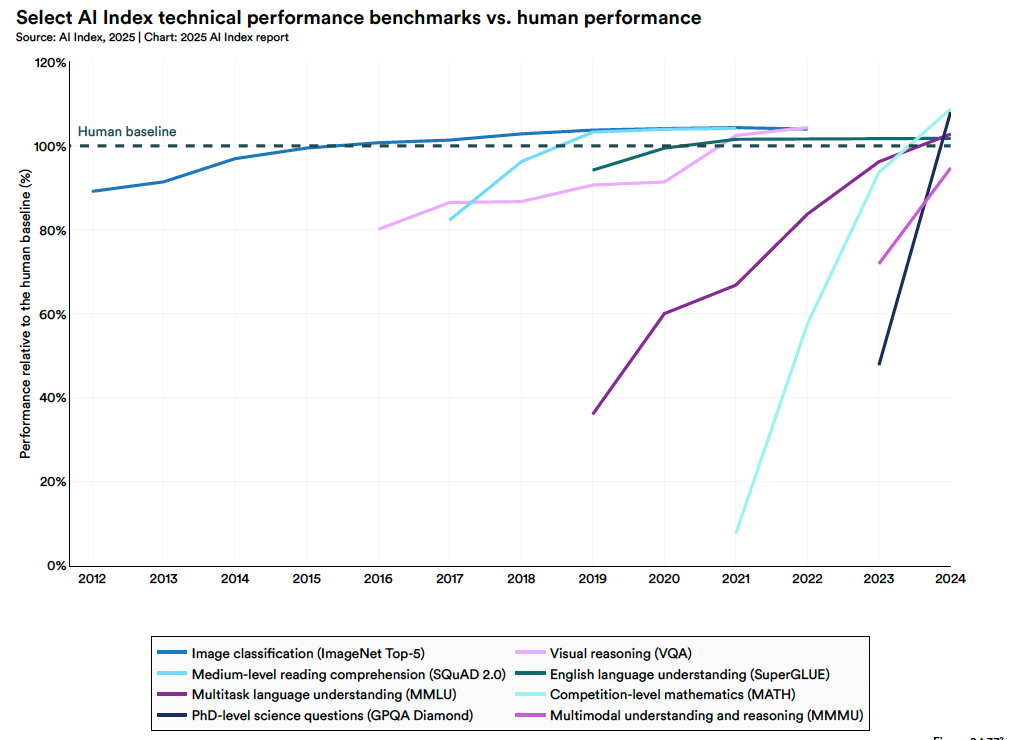
AI is crushing technical benchmarks: making astounding progress within the last few years, acing PhD-level science questions and visual reasoning.
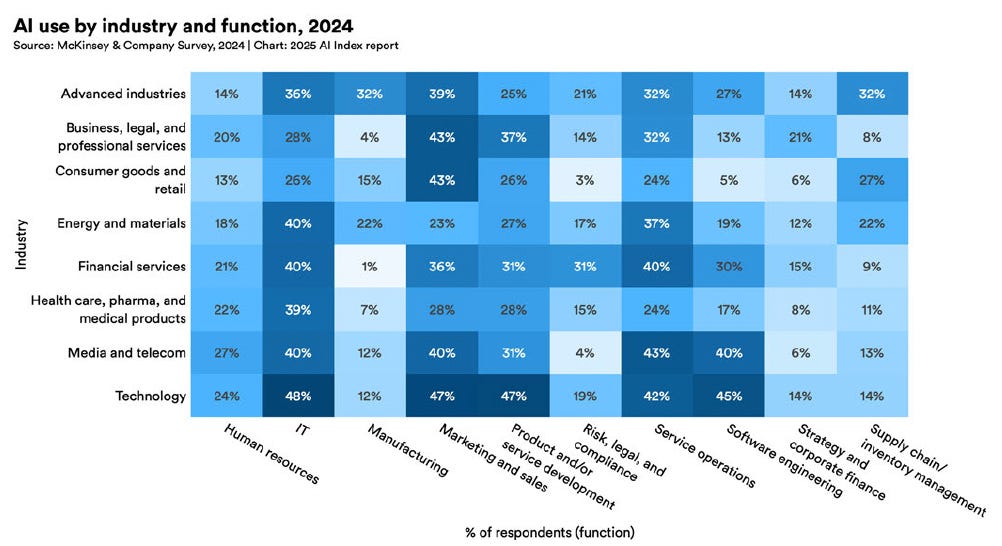
Companies are integrating AI across sectors, but this is uneven. Adoption may increase with continuous improvement.
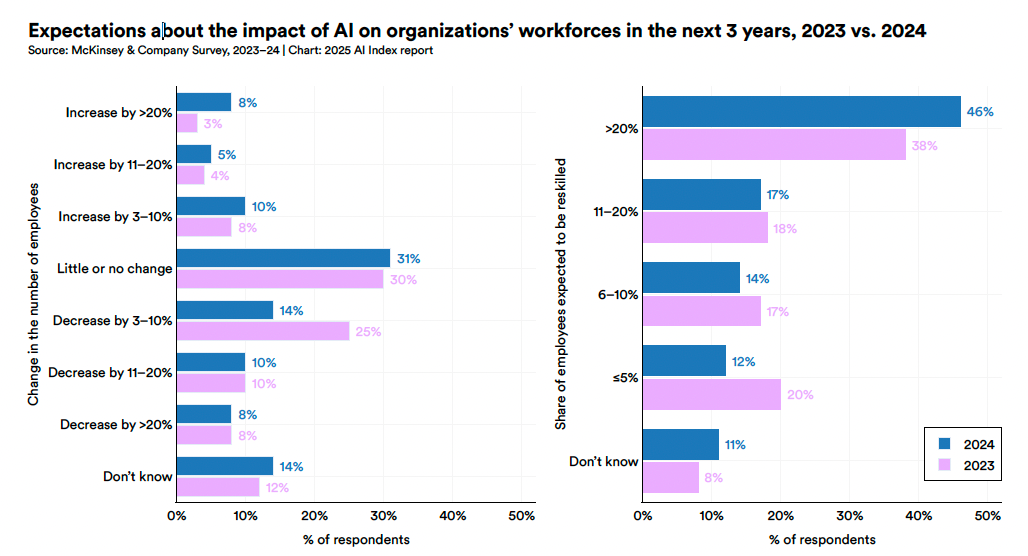
But what does this mean for humans? Companies themselves are uncertain: when surveyed, many are unsure how it will affect labour demand. LLMs are not necessarily a threat; they may become helpful companions boosting productivity!
Companies may also fumble with adoption, while mistakes could spur social backlash, and regulators could slam the breaks. In liberal democracies, we all have the power to organise politically, pushing governments to redirect technology so that it creates new tasks (rather than replace existing ones). As citizens, we can rally, redefine prestige, and use state power to reshape our future. Forecasting is a dangerous sport, fraught with uncertainty.
Does AI Threaten College Graduates?
AI’s cognitive power could come for our jobs. Studying these risks, Eloundou et al (2023) calculated the fraction of tasks within an occupation that could be completed by a Large Language Model (LLM). They estimate that 19% of US workers are in occupations where at least 50% of tasks could be automated or significantly accelerated by AI. Caveat: this does not distinguish between complementarity and substitutability. Claude could make lawyers more productive and substituted or more productive and in demand!
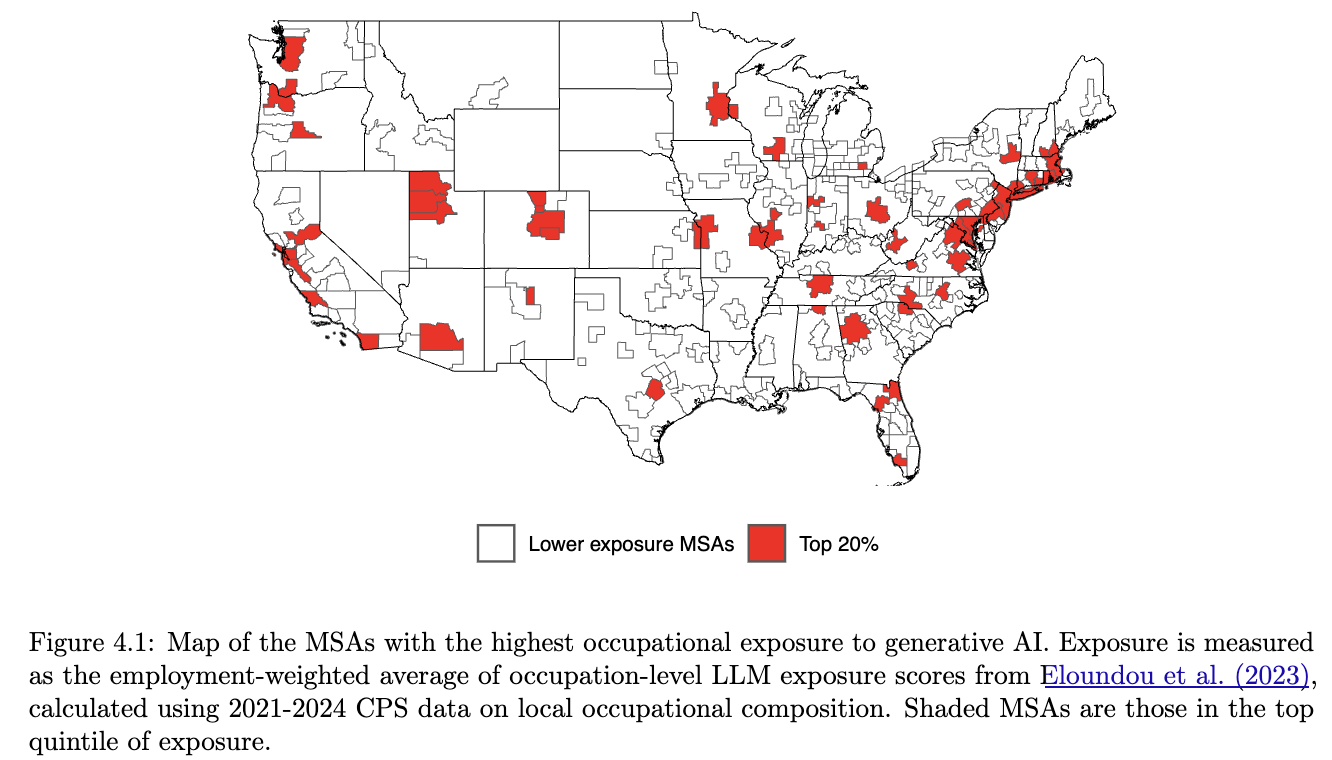
Using this measure of AI exposure, Abrahams and Levy (2025) seek to understand potential regional impacts. By aggregating occupational data from the Current Population Survey (2021–2024) to metropolitan statistical areas, they identify urban, highly educated regions like San Francisco, New York, DC, and Austin as especially vulnerable. They warn that AI dissemination could be especially rapid, more so than past shocks, spreading through web and cloud apps.
Currently, AI is good at coding, data analysis and legal drafting - tasks which are core to entry-level roles in finance, marketing, law and academia. Generative AI can crunch through data, draft reports and dig through case law. Molly Kinder and colleagues at the Brookings Institute estimate that 67% of sales representative tasks could be automated, compared to just 9% for marketing managers. In law, AI tools can zip through contract reviews, trimming the need for newbies and paralegals.
My economist pals are already using Large Language Models for everything - cutting the need for costly Research Assistants.
If Generative AI does displace cognitive tasks, then we should anticipate falling labour demand and falling wages for college graduates. Abrahams and Levy project migration to cheaper cities and declining college enrolment. (Uhoh for academia).
Learning from the China shock (Autor et al 2016), governments could insulate people from AI. But a Universal Basic Income won’t actually give status - since this requires differentiation.
Now, how else might it affect their lives?
What about Women?
Western labour markets are occupationally segregated by gender, so we might anticipate heterogenous effects. If women specialise in more AI-proof occupations, like healthcare or rewarding social skills, they may have some immunity.
Desire for families is also down. If fertility declines, then fewer women would be exposed to the ‘motherhood penalty’ - a major driver of the gender pay gap. Instead of pursuing stepping back, women may redouble their commitment to careers.
Even if both men and women are equally affected by shocks from generative AI, men have historically gained status from being breadwinners and reacted badly to this loss.
The Romance Demand Shock
Gen Z podcasts are obsessed with “high value men”, while TikTok memes cheer for a tall guy in finance. Rocking all our priors, high-earning men get more female attention. So, IF AI hurts some college graduates’ wages, it may dent their dating prospects.
Cultural and technological shifts are simultaneously reshaping romance. As women’s earnings rise and singledom loses stigma, they can afford to be more selective - dismissing lacklustre chat like “Hey, how’s your day?”. As a New Yorker told me,
“Women only want men who are entertaining!”.

Yet if you really want amusement, there are many other options! Back when I was a teenager, games were extremely basic: N64 Mario or Diddy Kong. Cross-legged on the carpet, my friends and I raced in 2D. I never struggled for social invitations, but the truth is that I merely beat rudimentary tech. ;-)
Fast-forward to 2025, video games, Tiktok, Netflix, sports gambling, pornography and AI companions provide hyper-engaging vortexes of entertainment. Smartphones ping us with tantalising excitement - keeping us snug on the sofa rather than getting dressed and hauling ourselves across town. Between 2010 and 2023, young Americans quadrupled their gaming hours. Loneliness is spiking, with 65% of young American men saying “no one knows me well”. More people are scrolling alone.
How does online entertainment affect coupling? Already, over 50% of young Americans are currently single or non-cohabiting. Looking ahead, I see several possible avenues. First, tech outcompetes real-world connections, making the guy/ girl next door appear ‘mid’. Second, mastering charm requires years of playful banter, but those who spend their evenings scrolling may struggle to get a laugh. Third, as men and women spend less time together in bars and clubs, they may drift further apart. Basically, I think it’s possible that both sexes could simultaneously become both fussier and more disappointing.
AI isn’t just impacting labour markets, it’s also reshaping the market for companionship. Recognising unmet demand for affection and wanting to attract customers in a competitive marketplace, firms are constantly innovating and increasingly delivering adoring AI companions. Just like an LLM can write complex code, it can also create a compassionate partner, tailored to your unique desires. Once hooked on chatbots, people may struggle to quit - especially if they haemorrhaged social skills and networks.

How will AI affect your status?
As AI companions offer affection on demand, real-world romance may face a double squeeze: economic disruption and digital distraction. Here’s one possible future: AI rips through entry-level law, finance, and marketing, slashing wages for graduates.
Women workers aren’t bullet-proof, but they may have more options. Unconstrained by a masculine straitjacket, many have specialised in social skills and healthcare, which will continue to prosper with an ageing population. If women also rethink motherhood, they should rocket up the career ladder just like men. As the economic playing field levels, women may become romantically pickier.
Online entertainment also affects the dating game, since it provides alternative amusement. Cue ghosting: unread texts and a chill wind of feeling unwanted, hurting deeper than any pay cut.
In short, the labour demand shock could amplify the online entertainment shock - potentially hurting graduates’ earnings, status and romance.
Clearly this is an evolving game, I merely highlight one pessimistic scenario. For those keen to think about this more deeply, I recommend my podcast with my great pal Daron Acemoglu, discussing his latest book “Power and Progress”.
Related Essays
Ghosting the Patriarchy: Female Empowerment and the Crisis of Masculinity
What Prevents & What Drives Gendered Ideological Polarisation?
The Great Splintering: How Digital Tech Shattered Cultural Control
Power and Progress: A Conversation with Daron Acemoglu (podcast on automation); see also his co-authored paper “Tasks At Work: Comparative Advantage, Technology and Labor Demand”.
Very interesting read, as always!! As a small business owner in the software industry I am constantly thinking about the advent of AI and how it is changing/ will change things. As a example, my main activity is sales and marketing, and it's making me so much more efficient and effective! And it's just the beginning.
I hadn't considered it from the pov of status.
After reading your article, I keep thinking about the fact that men tend t be more extreme in its distribution: more CEOs and world leaders, but also more "unmotivated-I-just-want-to-play-videogames-hikkomori". The problem is social media presents this evil feedback loop, in which the incredible success of a few men, is shown to the rest as proof of their lack of masculinity, etc.
Of course I don't have any magic solution, I can only do what I can do at a micro level, as a dad of 3 boys. Making sure I'm a good role model, that they see me cooking, cleaning toilets (and are forced to help!), but also, working out, spending time togetehr and talking about our day, enjoying face-to-face conversations with friends, or busy at work.
Maybe we men have to learn to be more multifaceted?
But then, this is easier in upper-education, liberal families than in the ones you describe, which generates it's own feedback loop.
A great read. I think this was the post that Emily Bazelon recommended on last week's Slate Political Gabfest, as part of a much-deserved plug for all of Alice's writing