

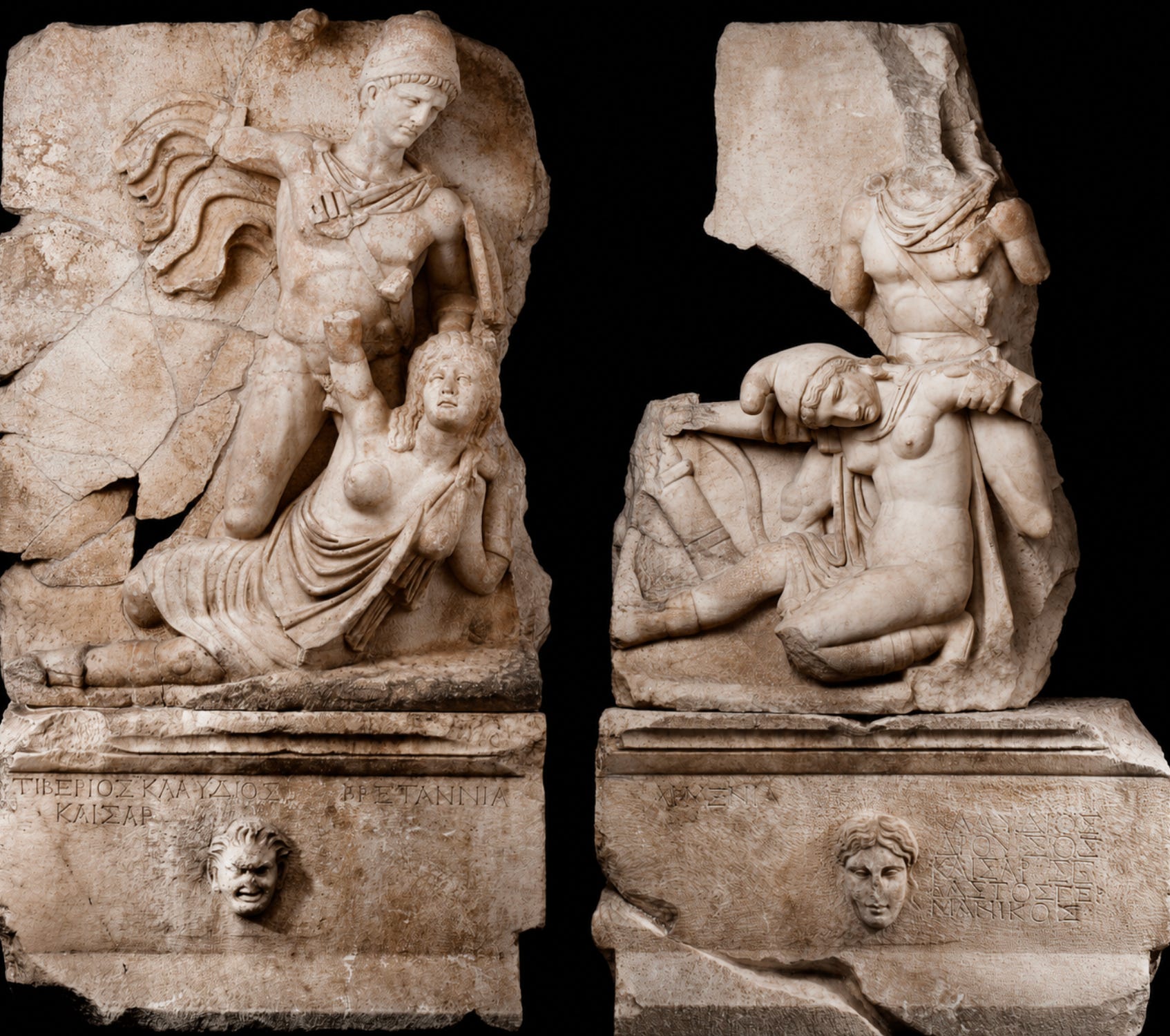
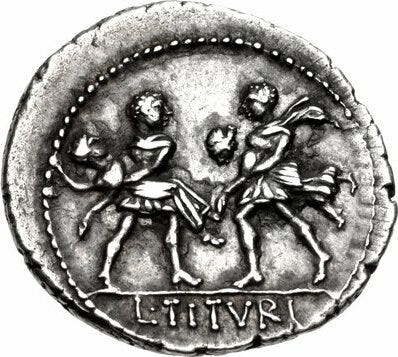
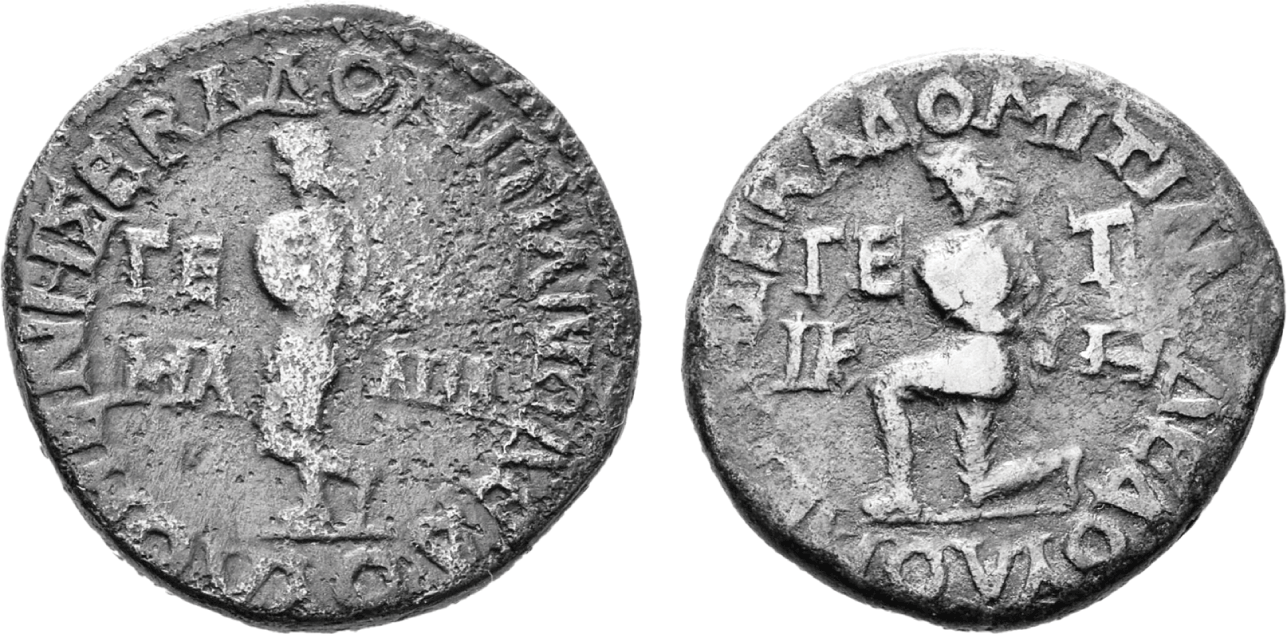
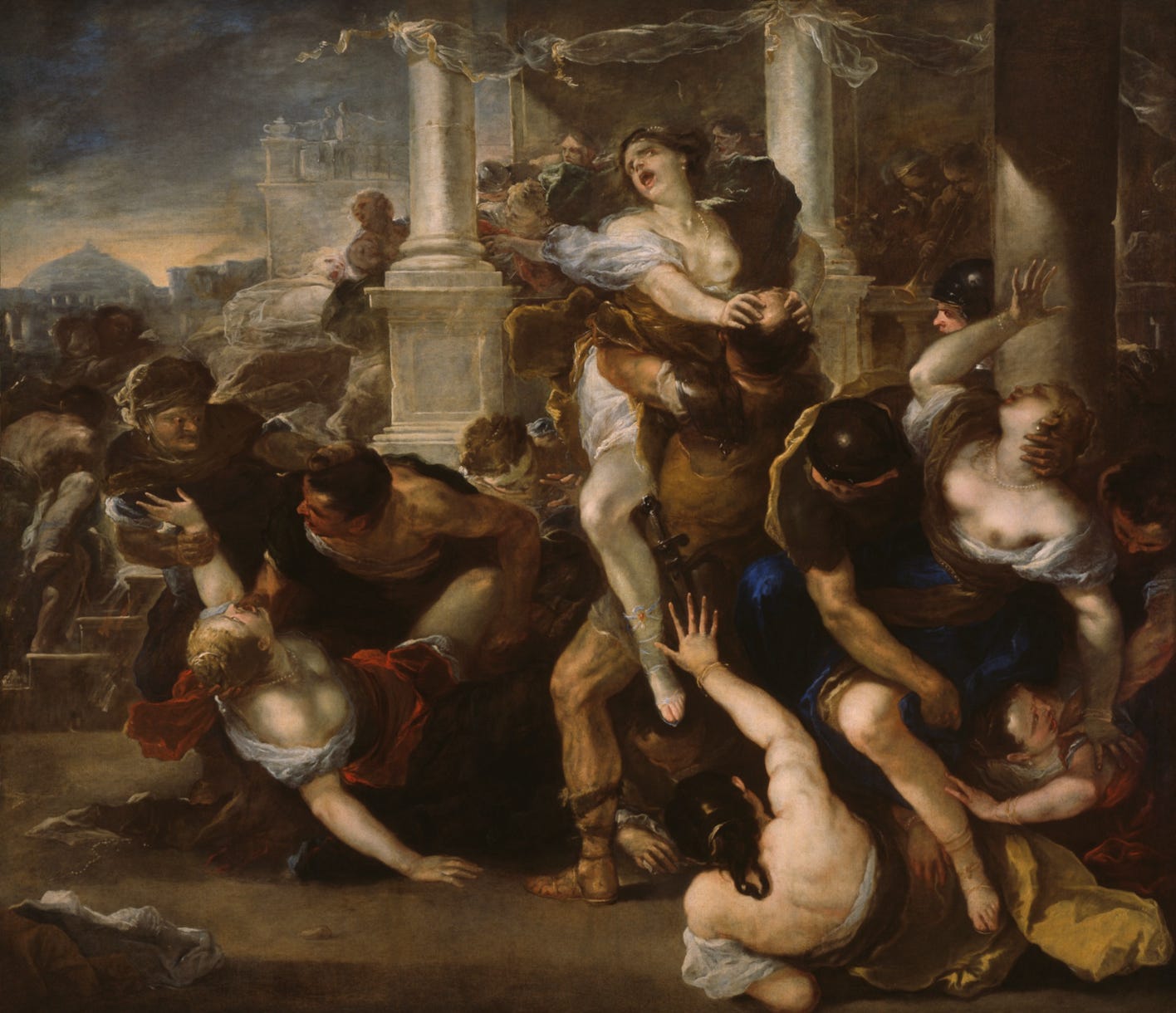
The earliest surviving personification of Britannia casts her as a sexual captive. On a marble relief, Emperor Claudius seizes bare-breasted, defenceless woman labeled Bretannia. Tacitus similarly records that when Rome took the Iceni kingdom, Boudicca was flogged and her daughters ‘violated’. Nero’s victory over Armenia was similarly imagined as sexualised violence, while Rome’s origin myth told of soldiers abducting Sabine virgins and making them mothers. Imperial expansion was celebrated as masculine domination.
At home, Roman freemen maintained honour by keeping their own wives and daughters under strict surveillance. Moralists praised respectable wives and daughters for pudicitia: sexual virtue. “Casta fuit, domum servavit, lanam fecit” (she was chaste, kept the house and made wool”) declares Claudia’s epigraph. Valerius Maximus preserves stories of husbands repudiating wives for going out unveiled, speaking to unsuitable women, or attending public games without permission. By guarding their own women, patriarchs excluded rivals and monopolised public institutions for themselves.
Roman moralists thus sanctified two distinct patriarchal rents - the guarded chastity of female insiders, and the celebrated conquest of outsiders. Julius Caesar famously encapsulated imperialism as veni, vidi, vici, but that is perhaps too benign. Veni, rapui, genui may be more accurate: I came, I seized, I begot.
Throughout the historical record, militarised male coalitions have seized territories, slaughtered rivals, captured women and achieved disproportionate reproductive success. Yet elite women still struggled to exert public influence because they often gained respect through silence, submission and self-erasure. The commanding institutions of state power - armies, assemblies, courts, and temples - were overwhelmingly run by men, who legitimised their own authority and impunity.
This essay explores the rape and abduction of female outsiders in Spanish colonialism, Papua New Guinea, the Indian caste system, Islamic State and modern Britain.
Cross-cultural differences and similarities
While Eurasian empires tended to idealise female seclusion (or at least modesty), small-scale societies in the Americas, Sub-Saharan Africa and Oceania permitted far greater female visibility and mobility. However, many of these societies were nevertheless violent, so often raiding against female outsiders.
Militarised male coalitions have tended to elevate religions and ideologies that sanctify their own dominance, praise female self-erasure as virtuous, while ostracising out-groups as infidels, slaves, or untouchables. This dehumanisation has often served to sanctify men’s sexual violence against female outsiders. And when rape becomes morally permissible, it may continue even during peacetime.
The Mongol Empire
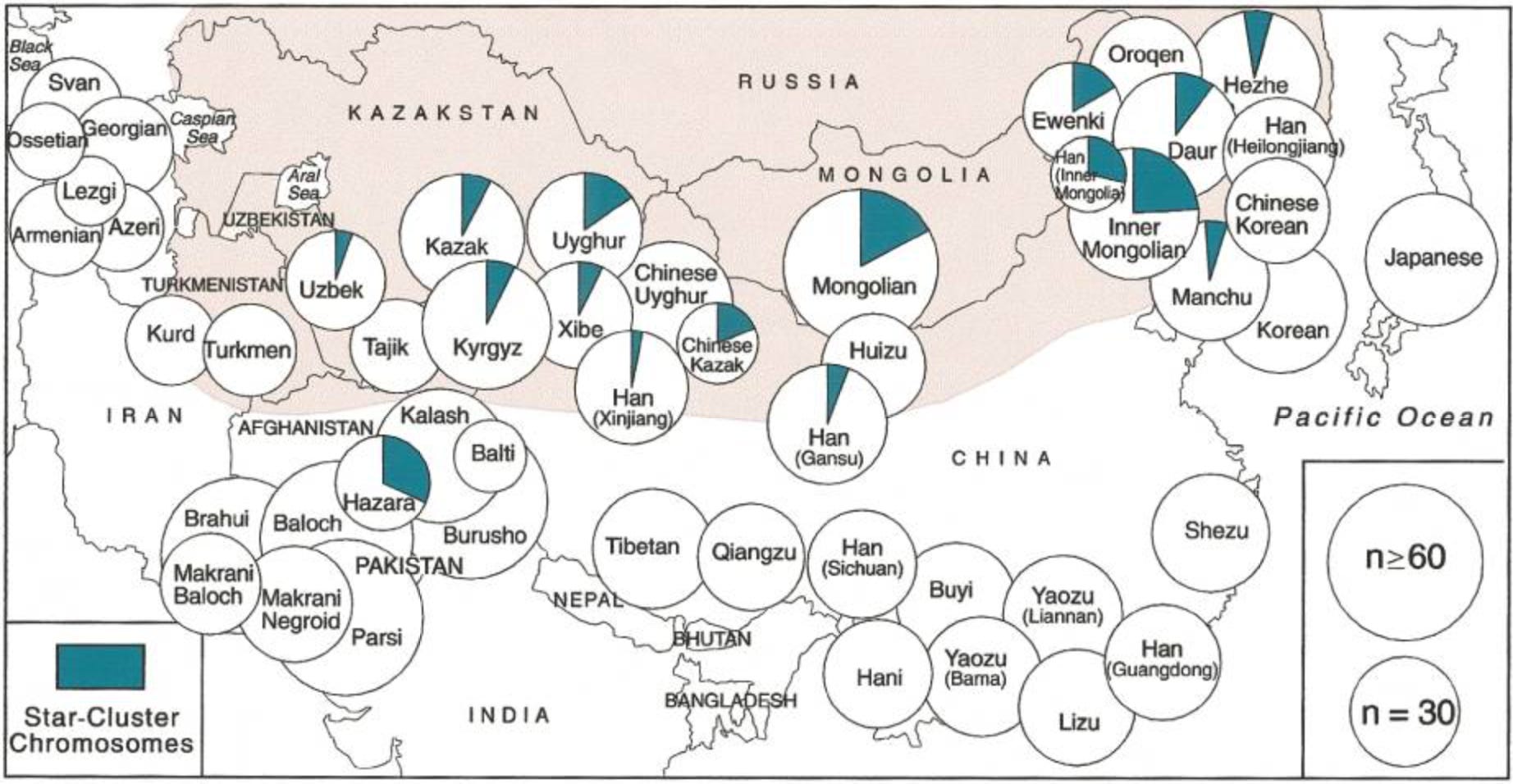
As Mongol armies stormed across Eurasia - from northern China, Central Asia, Iran and Rus’ - they slaughtered men, seized female captives and received concubines as part of diplomatic marriage alliances.
This left a trace in DNA! The Y chromosome passes from father to son, so when one paternal lineage becomes common across diverse populations, it implies that one closely related group achieved disproportionate reproductive success. Zerjal and colleagues have identified one such Y-chromosomal “star cluster”. It is only found in 0.5% of men worldwide, but shows up across 16 populations from the Pacific to the Caspian Sea. The lineage appears to have originated in Mongolia roughly a thousand years ago - precisely the era of Genghis Khan and his descendants.
One conquering lineage is now carried by 16 million men.
Iberian Conquistadors
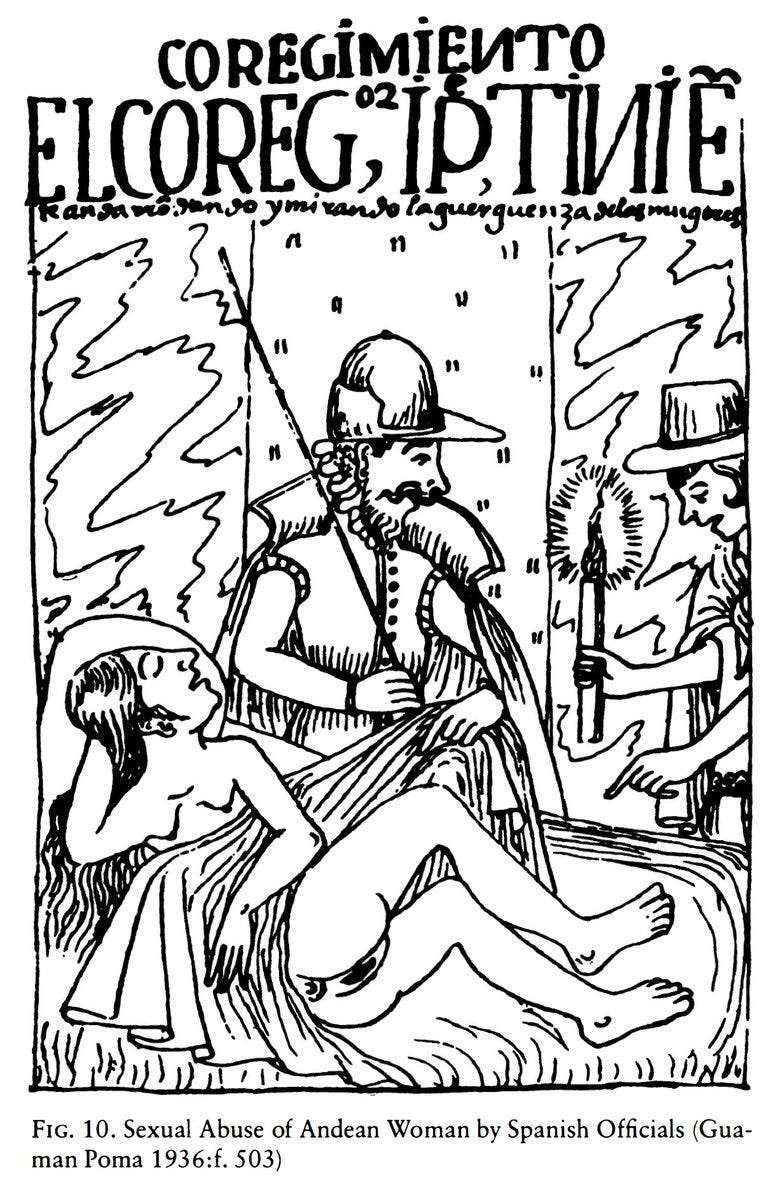
In the 16th century, when Iberian men colonized the Caribbean, Central and South America, they not only seized land, minerals, and labour, but also gained an extraordinary reproductive advantage. Today’s Latin American populations exhibit sharply sex-biased ancestry: paternal lineages are disproportionately European, while maternal lineages are primarily Indigenous. In countries with long histories of African slavery, the maternal line is often substantially African.
DNA tells us something profound: indigenous men not only died from disease, but were also demographically displaced, while Iberian conquistadors, landowners and friars reproduced at far higher rates.
Reading the wealth of literature on colonial Latin America, I realise a pervasive dichotomy: elite Catholic landowners kept their own wives cloistered, while abusing black and indigenous women with impunity. Abuse, harassment and concubinage was repeatedly sanctified: slave-origins were associated with illegitimate birth and thus dishonour - she was already fair game.
Latin American elites thus extracted two patriarchal rents: (1) elite honour and inheritance from guarding their wives’ chastity, alongside (2) sexual pleasure from disadvantaged women
Did Small-Scale Societies also Rape Outgroups?
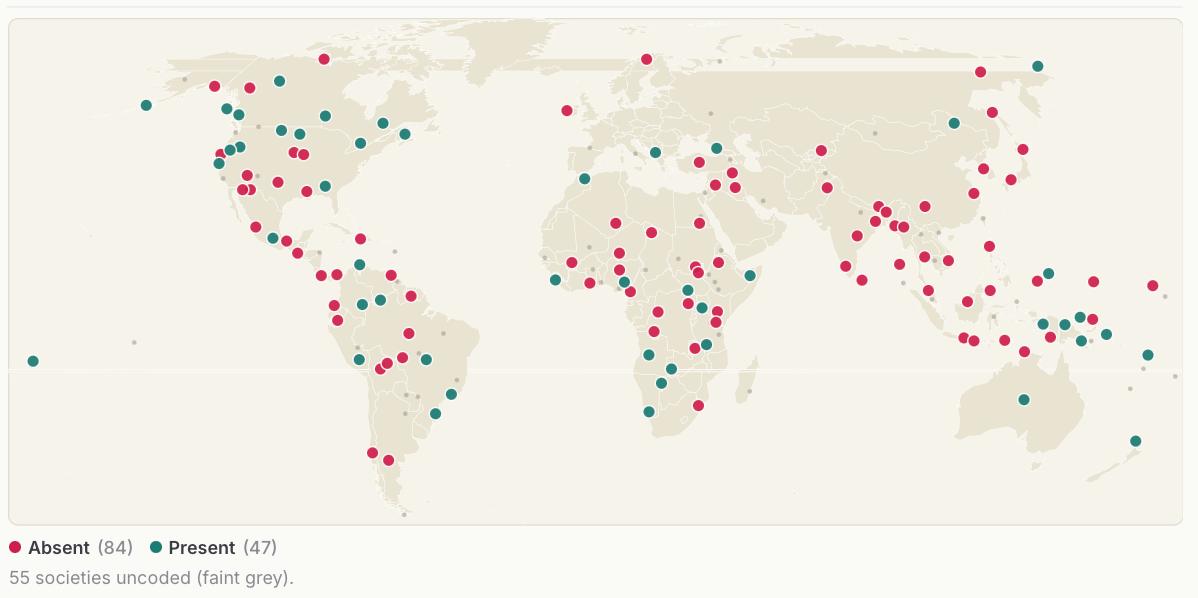
Ethnographies from the 19th to early 20th centuries attest that across many small-scale societies, male warriors would embark on out-bound raiding for slaves, who they would drag back, kicking and screaming, so as to enlarge their own group as wives and concubines. Visualising the Standard Cross Cultural Sample, it was widespread.
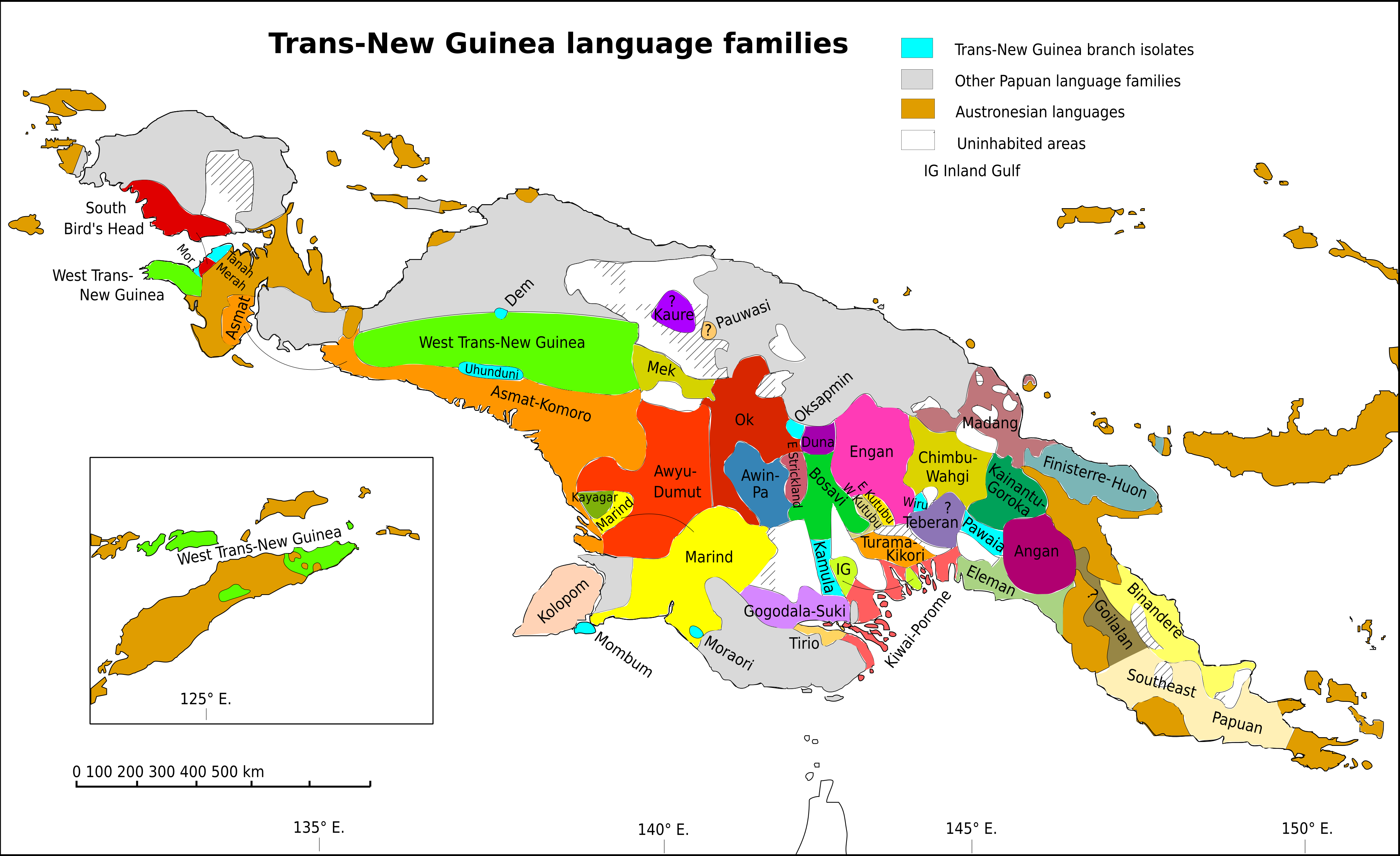
Over in Oceania, Papua New Guinea has over 840 living languages. That one fact alone is hugely informative. It effectively tells us that no army or bureaucratic state has exerted power and forced the rugged highlands into one cohesive community. Instead, distinct communities maintained loyalty to insiders, while raiding outsiders. Classic ethnographies of the Kapauku, Dani and Maring describe warfare as an arena of male competition and revenge, often abducting enemy women.
Francesca Merlan undertook ethnographic research in the 1980s and 2000s. Jakelin, a mother of three interviewed, shared observations of female captives:
“One young woman was surrounded while she was collecting peanuts. She couldn't run away. They caught her and gave her to an old man (to take her as his wife). They were married; the woman had no strength (todul) to resist, Jakelin said, so the enemy kept her”.
In-group loyalty prohibited open expression of sympathy. A woman from the Tambul range shared that although she wanted to mourn the loss of two young men from a sister clan, she felt restricted. “To cry for people who were regarded as the collective enemy would have earned her rough treatment at home, she said; and so she said nothing”.
While the government does not maintain reliable data, some estimates suggest that 70% of women experience rape or assault over their lifetime.
20th Century Conflicts
In 1937, when Japanese soldiers seized the Chinese city of Nanking, they embarked on extensive sexual violence - raping between 20,000 and 80,000 girls and women. Subsequently, during World War II, the imperial military institutionalised an extensive system of brothels, in which thousands upon thousands of Korean women into sexual enslavement. That is, rather than permit rape at random, the Japanese Army created ordered institutions. Enslaved comfort women were mostly aged between 14 and 18.
In 1945, as the Soviet army moves into East Prussian villages, “it was not untypical for Soviet troops to rape every female over the age of twelve or thirteen”. In Berlin’s two main hospitals, staff estimated between 95,000 and 130,000 rape victims.
In 1971, when Pakistan’s army invaded East Pakistan, around 200,000 Bengali women were raped. One teacher regarded Pakistani rapists as invoking scriptural justification to mal-e-gonemat (booty during the war). Further east, Myanmar’s army has committed gang rapes against the Rohingya minority, while in the former Yugoslavia, Bosnian Serbs committed mass rapes against Muslim girls.
Throughout Sub-Saharan Africa’s civil wars - like Rwanda’s genocide, Uganda’s Lords Resistance Army and Sudan’s contemporary strife, rape remains a weapon of war - humiliating the enemy. Across the Sahelian-Sudan belt, interviewed combatants have often shared that they joined because they were promised women as booty:
“We were told we will get money and wives when we join the group” Goroma, 23 years old, Nigeria.
In 2014, Islamic State fighters attacked the Yazidi minority in northern Iraq, executed several thousand men, and captured several thousand more girls and women. Enslaved captives were sexually abused, sold into slavery, and redistributed to fighters as “spoils of war”. ISIS repeatedly justified the enslavement and rape of Yazidi women by invoking the legal category of ‘sabaya’ (female captives) and the doctrine of mā malakat aymānukum, “those whom your right hands possess”.
As part of the UK parliament’s inquiry into sexual violence, Yazidi women shared their experiences:
Were these horrendous attacks perpetrated for personal gratification, or were they political?
Woman #1: They were doing this to them because they were Yazidis. They saw it as a religious motive.. The Amir was talking through a microphone saying “Whoever becomes a Muslim can stay in this village. Whoever doesn’t become a Muslim will be killed”.
Were any Yazidi men raped?
Woman #3: They [the men] were killed immediately.
Did you have the opportunity to ask them “why are you doing this?”
Woman #1: She did and she was told that they were implementing the Prophet Mohammed’s law.
Militants repeatedly invoked scripture to legitimise the rape of infidels.
Upper-caste Impunity
Caste is a distinctive form of hierarchy. Historically, dominant-castes preserved their own prestige through endogamous marriage, often before the girl reached puberty. Dalits (literally the ‘broken’), meanwhile, were cast derided as polluting ‘untouchables’ - sinning in past lives, fated to degrading roles. By cloistering their own women, while branding Dalits as impure, dominant-castes maintained their own supremacy and extracted cheap, dependent labour.
As late as 2014, Human Rights Watch reports that some Dalit women do not want to clean open defecation sites, but are subject to bullying. In Uttar Pradesh, Gangashri shared that she and other women had stopped cleaning toilets, and men from the dominant Thakur caste came to their homes, threatening to deny them grazing rights:
“They called our men and said “If you don’t start sending your women to clean our toilets, we will beat them up. We will beat you up.” They said, “We will not let you live in peace.” We were afraid”.
Although caste hierarchy resembles racial oppression, it is much less visible. Instead, dominant castes might note more subtle cues - asking someone’s surname, observing their eating habits, or tapping their shoulder, seeing if they wear the sacred thread (which marks the ‘twice-born’ upper castes).
Dominant caste men’s impunity is reinforced by four interacting mechanisms.
An over-stretched criminal justice system - police are seriously under-staffed, cases languish waiting for trial.
Elite capture of institutions. Dominant caste men are over-represented in positions of power and persuasion - sometimes ensuring that state institutions shield their peers, and disregard abuse against ‘impure’, ‘dishonoured’ Dalits.
Shame lies with the victim and is reinforced by Jati economy. ‘Good girls’ are praised for staying close to the home and safeguarding their purity. When rape is seen as worse than death, victims stay silent.
Economic marginalisation means that Dalit communities may be reluctant to challenge upper-castes. In Haryana, Uttar Pradesh, Punjab, and Rajasthan, village councils (khap panchayats) may pressure lower-caste survivors to stay quiet (‘chup’).
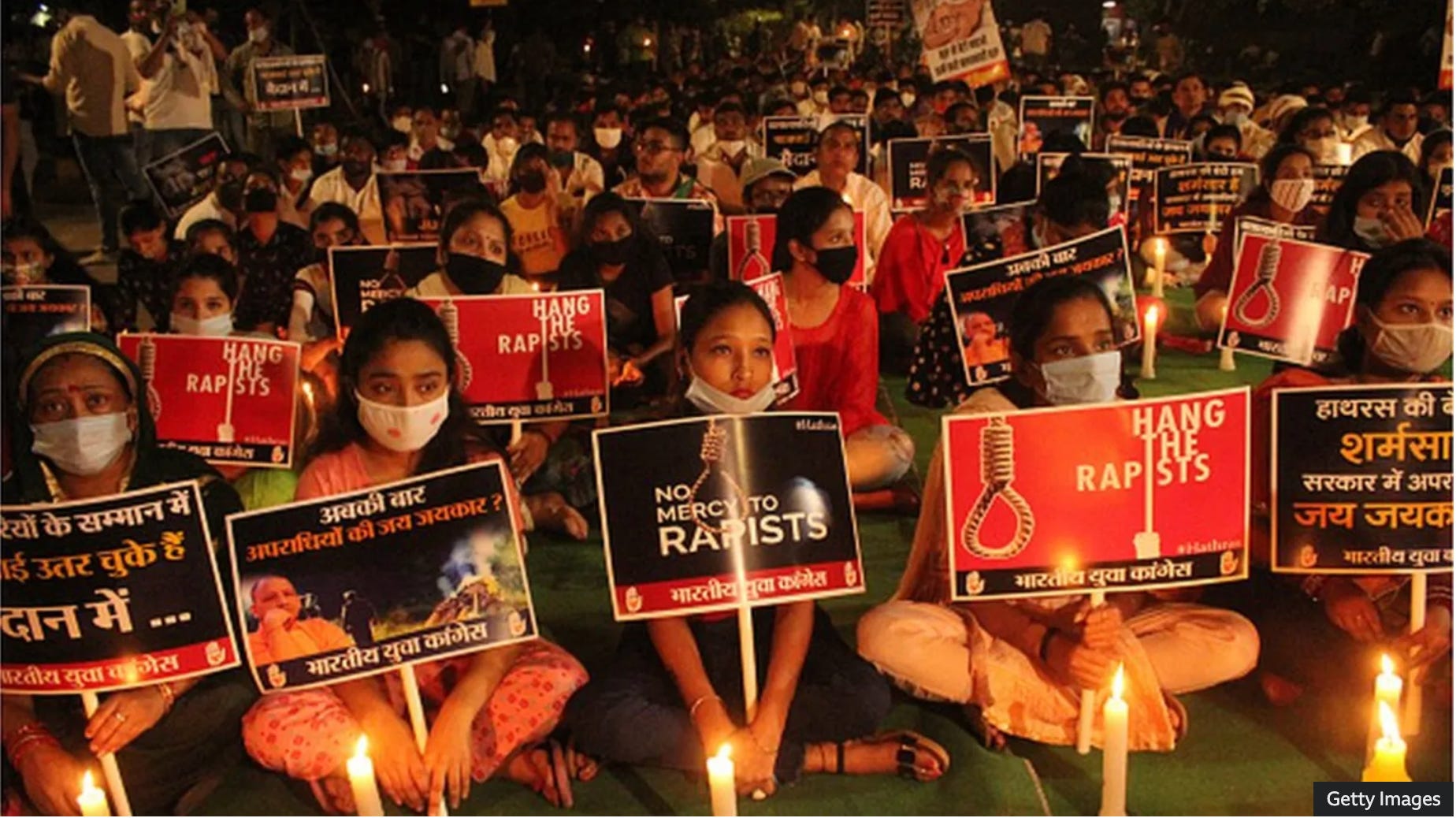
In 2020, these dynamics came to a head in Hathras, Uttar Pradesh. A 19 year old Dalit woman said she was attacked by four men, who tried to strangle her as she resisted their rape. Subsequently, she went to the police but the officer allegedly refused to register the case. Two weeks later, she died from ‘injury to the cervical spine by blunt force trauma’. At 2:30am, the police burnt her body without her family’s consent. When the case circulated on social media, it was dismissed by the government of Uttar Pradesh. In 2023, three of the accused were acquitted, a fourth was convicted of culpable homicide.
.jpg)
Europe’s 21st Century Challenge
While the entire world was incredibly violent, Europe and North America ultimately diverged. Thanks to more professional policing, effective criminal justice, advanced technology and feminist activism, they ultimately became more peaceful, safer, and constrained male violence.
European countries are increasingly diverse, welcoming migrants from more patriarchal cultures, but without investing in policies that would promote integration, such that all women can achieve economic inclusion, while being protected from violence. This failure is manifest in employment, attitudes, and honour-based abuse.
In World Values Surveys, Pakistan, Afghanistan and Nigeria register extreme sexism. As European Muslims expand, imams remind believers to ‘lower their gaze’, and castigate ‘free-mixing’ (men chatting to unrelated women). In recent surveys, 40% of British Muslims agreed that ‘girls and boys should be taught separately’, including 36% of university graduates. Since men’s honour rests on female seclusion, British Muslim women tend to remain outside the labour force.

European politicians have generally been reluctant to recognise these cultural differences, and have even suppressed investigations into rapes. Taking advantage of this impunity, organised groups of men have sexually abused vulnerable (often white) working-class girls - showering them with gifts and affection, plying them with drink and drugs, then proceeding to bully, rape and traffic them as part of large criminal networks. Yet when victims, journalists and researchers sought help or pressed charges, they were dismissed and derided. Where suspect ethnicity was recorded, such as in Greater Manchester, men of Pakistani heritage are over-represented (relative to their population share) as perpetrators of group-based child-sexual exploitation. Going beyond unsubstantiated claims on social media, we urgently need an empirical inquiry to make sure all girls and women are safe.
In Baroness Casey’s National Audit on Group-based Child Sexual Exploitation and Abuse (CSE) (2025), she documents chronic failures by political parties, local councils, social services and police: many repeatedly denied abuse; dismissed victims; suppressed whistleblowers; failed to record basic offender characteristics; cited fear of community tensions and accusations of racism as reasons for inaction; and resisted external scrutiny by obstructing public access to data.
Although the UK Government has launched a national inquiry, progress has been slow. Going forwards, the Government could easily track the full extent of abuse and the likely ethnic distribution, by using police case notes with suspects’ names. But this has not yet occurred. As long as politicians, judges and journalists turn a blind eye, violent men reoffend with impunity.
Progressive politicians like to champion ‘gender equality’ rhetoric, but safety isn’t secured with slogans. What women - worldwide - need is state protection from violent men. That requires effective policing, punishment to ensure credible deterrence, and a full inquiry to identify institutional failures, so that everyone can walk home safely.

This is horrifying, and also not surprising, which is somehow worse to me in 2026. What gets me isn't any single atrocity. It's the pattern that keeps repeating across disconnected eras and political systems: institutions protecting their own reputation over protecting women (about half of the global population), EVERY. SINGLE. TIME. Rome did it. Colonial Latin America did it. Village councils in India do it. And the Casey audit shows British institutions doing the same thing in real time, not through some coordinated design, but through fear, avoidance, and self-protection, which somehow makes it more disturbing, not less.Sadly this VENI, RAPUI, GENUI doesn't belong to any single culture, one era, or one government. It just keeps morphing into what unrestrained coalitions of men do when impunity is available.
"Europe and North America ultimately diverged. Thanks to more professional policing, effective criminal justice, advanced technology and feminist activism, they ultimately became more peaceful, safer, and constrained male violence." Do we perhaps also have Christianity to thank? Very much like the abolition of slavery, the idea that women have inherent, individual rights over their own bodies is an historical anomaly. You can't walk through the Uffizi museum or many others in Europe without being bombarded with images of the Madonna and child, surely a kind of veneration of the female as mother, at least, which reflects a higher status for women than we are afforded in many other cultures. Ave Maria, gratia plena. Was it the Enlightenment or Christianity that lead to emancipation for women in the West, or is that a chicken and egg question since the two are inseparable? Honest question.