


Contemporary histories of Sub-Saharan Africa often stress women’s power and prominence. Indeed, Ashanti Queen Mothers helped select chiefs and exercised political influence, priestesses led rituals, women traded independently, and in matrilineal societies royal blood passed through women. The Standard Cross-Cultural Sample (SCCS) thus accords the Ashanti, Amhara and Kikuyu the maximum score for ‘female power’.
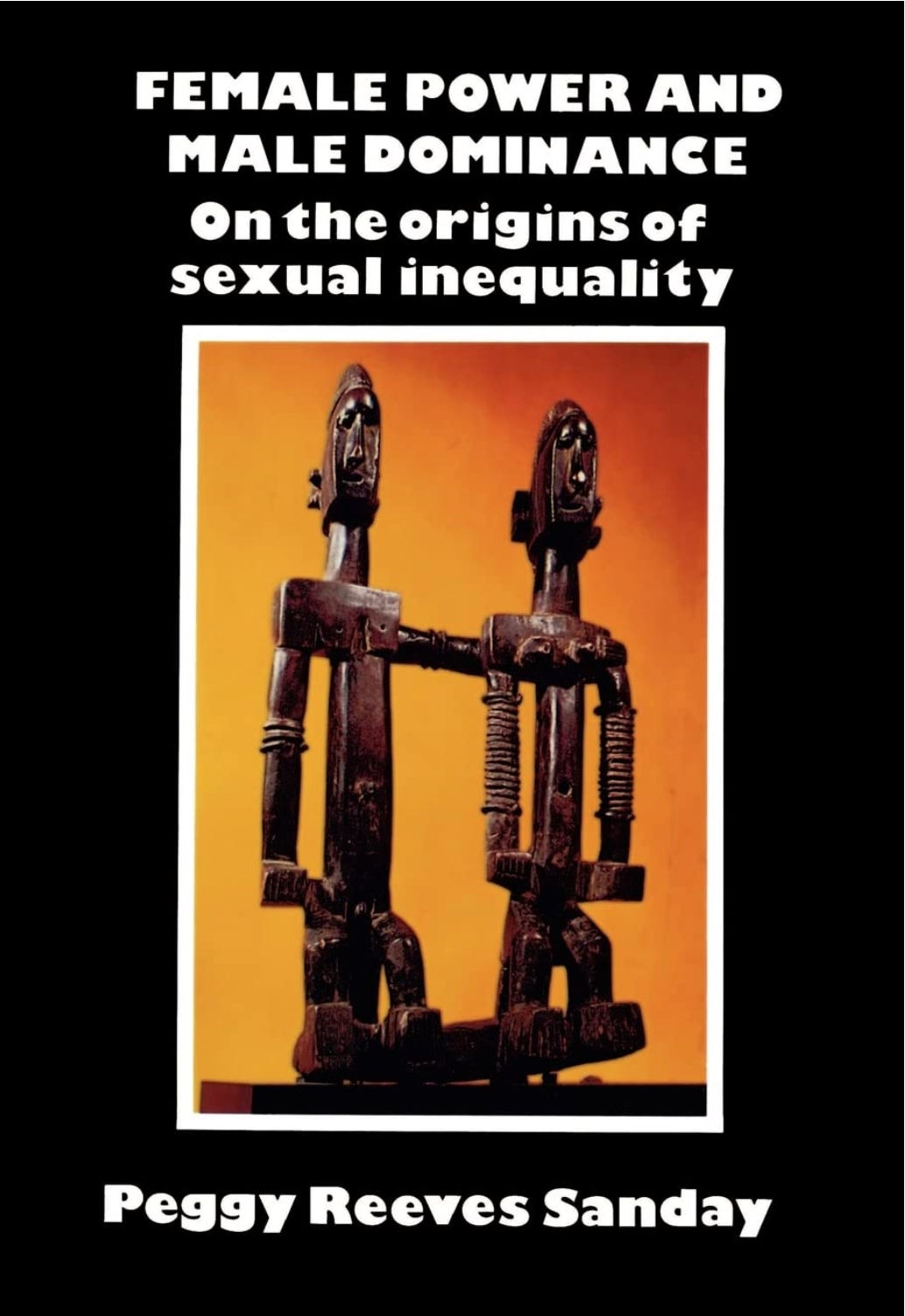
This SCCS index - widely used by social scientists - is largely based on Peggy Sanday’s Female Power and Male Dominance. Collating ethnographic records for more than 150 societies, Sanday tracked flexible marriage mores (the permissibility of divorce, punishment of adultery), whether women produce goods for markets, demand for those goods, female political participation, and collective organising. On these measures, the Ashanti and many other pre-colonial African societies score highly for ‘female power’.
Large Language Models repeat these same narratives, since they are trained on the existing quantitative and qualitative corpus.
But there’s one hitch.
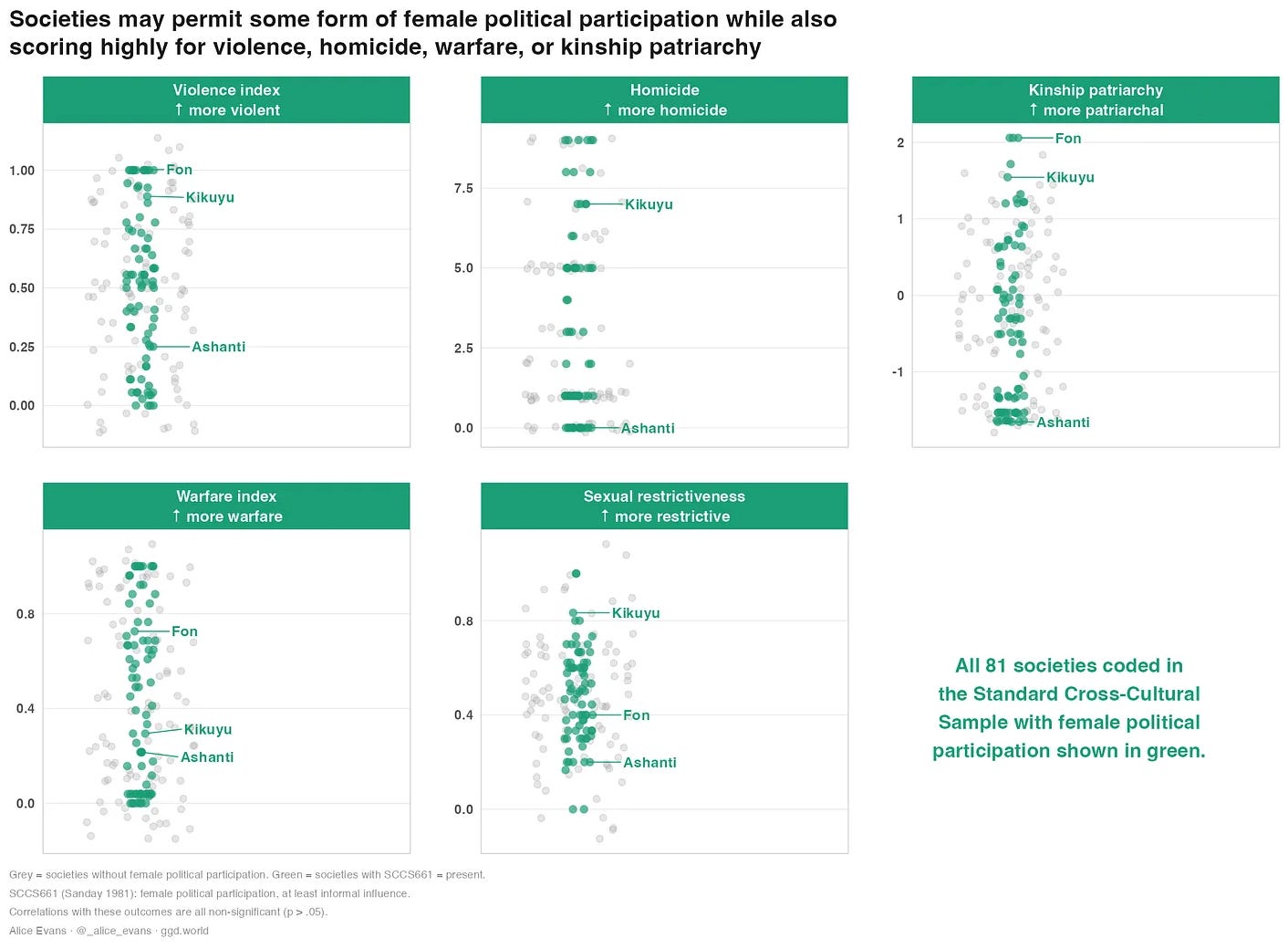
Trawling through the primary sources, I realise that even when societies are given the maximum score for ‘female power’, they may still be extremely violent and patriarchal, whereby girls may be pawned, enslaved, genitally cut or otherwise expected to submit.
It’s time for a corrective.
The Ashanti
Sanday details that Ashanti queen mothers helped select chiefs and exercised political influence, priestesses led rituals, women traded independently, and in matrilineal societies royal blood passed through women. Her account of the Ashanti draws heavily on Rattray, a colonial officer stationed in the Gold Coast in the 1920s.
Curiously, she omits his repeated descriptions of pervasive labour coercion. While female elites commanded authority, ordinary women were constrained by obligations of servitude, or even slavery.
Servitude
‘Voluntary servitude was the essential basis of the [Ashanti] social system. There existed no person without a master”, writes Rattray (1929). An Ashanti proverb elevates submission to elders, “wu nni wura, aboa kye wo” (If you have no master, a beast will catch you”.
An uncle stood in a position of authority over his niece and nephew, entitled to pawn them as collateral on a debt. If a woman was pawned to a man, the creditor could claim sexual access, or give her in marriage. Rattray records that a female pawn could become “the wife of one man while still the pawn of another”. As a pawn, she was obliged “to rise up when called upon and accompany the husband to his farm, to cook for him, and to perform the household duties”.
Economic historian Gareth Austin provides the broader political economy. 19th century Ashanti was characterised by land abundance and labour scarcity. Since free people could usually work on their own farms, regular wage labour was prohibitively expensive. Slavery and pawnship lowered the cost of labour, enabling commercial expansion. After colonisers suppressed slavery, elders told Rattray that gold mining was no longer profitable because it depended on slave labour.
In a society where land was abundant, people were used as collateral. The Ashanti used pawnship to supply both labour and capital. “No pawn, no loan”. These workers served an unrelated master, as part of their obligations to their own matrikin.
Men had far greater opportunities for self-enrichment. Austin notes that while male owners are routinely specified in the archives, female owners of slaves or holders of pawns are rare, though not non-existent. That’s certainly at odds with gender histories of the Atlantic coast that selectively emphasise exceptionally successful women.
Polygyny, Enslaved Wives and ‘Public Whores’
Pawns and slaves were also valued for reproduction. Since the Akan were matrilineal, a free wife’s children belonged to her abusua, limiting paternal control. But a man who married a slave could wield far greater authority - circumventing matriliny.
Wealthy men could also acquire multiple wives, pawns and slaves, while other men had none. In small south-western Akan communities, Akyeampong (1997) argues, polygyny by wealthy male elders risked conflict with unmarried young men. To prevent discontent, south-western Akan villages sometimes included sex slaves who were ritually installed by chiefs, obliged to service local bachelors, but denied any profits.
So the Ashanti get the maximum score for ‘female power’, but simultaneously had pawnship, enslaved wives, coercive kinship, and arranged child-marriage. Elite Queen Mothers appointed chiefs, while ordinary girls were raised to endure.
Africa’s internal Slave Market mostly absorbed Women
Within Africa, female slaves consistently commanded higher prices. Claude Meillassoux notes that African women performed the labour-intensive tasks of agriculture, food preparation, housework, carrying heavy loads, and producing crafts. Robertson and Klein further highlight sexual slavery and women’s capacity to expand lineages as concubines. Enslaved women were therefore valued, and forced to work.
Amhara
The Amhara also get the top score for female power. This is revealing because one of the major sources for the SCCS is Messing’s (1957) Highland-Plateau Amhara of Ethiopia. This same ethnography details an hierarchical Christian society, where spiritual authority, land, literacy were overwhelmingly male.
Elite women enjoyed several exemptions. Emperor Menelik’s wife, accompanied his northern campaign, leading her own troops into the Battle of Adua in 1896. When a noble woman approached a church, the priest would bow before her, even permitting her to stand just inside the door of the outermost enclosure. However, reinforcing patriarchal ideology, a noblewoman who takes on male roles was addressed as male. And these were prerogatives of wealth.
“The commoner or peasant woman is much more exposed to the inferior legal status of women”, writes Messing. “Woman and donkey (must be trained) with a stick” goes one proverb, reflecting men’s widely-assumed intellectual, moral and biological superiority. She could not swear the traditional oath, it had to be contracted by male kin. Women were not even allowed to enter Church buildings. In 1952, only 60,000 children attended modern elementary schools in Ethiopia, 90% were boys.
In some regions, female babies have their clitorises removed, so she will not become a ‘selfish’ wife, and reduce the egotistical part of her sensuality. A bride was given two protective ‘best men’, but these are the groom’s own kinsmen..
Girls are taught to sit ‘shyly and wordless’ when among men. Those who appear daring or enterprising are mocked as ‘gobba’. Meanwhile, an 18 year old man is called ‘kobale’ (powerful warrior).
A patrilocal family typically formed its own hamlet, farming communal land, as governed by a male council of elders. Shanqalla slaves were only freed in 1942, and were thereafter treated as racially inferior, experiencing little change in status.
Kikuyu
The Kikuyu are another top scorer for female power. Lambert’s (1956) Kikuyu Social and Political Institutions is a core source for the SCCS. Lambert was a military lieutenant, then district commissioner, linguist and anthropologist, fluent in Swahili and respected locally. He describes a society with patrilineal descent, patrilocal marriage, run by male age-sets.
Kikuyu boys were raised to be warriors - entering age sects for initiation, hunting and war. In these tight-knit groups, boys forged solidarity, discipline and leadership. After the guthiga ceremony, boys would start wearing warriors cloaks and perform the ceremonial rape. To prove their manhood, Lambert reports that warrior bands (sometimes comprising a hundred men) would scour the countryside to find a married woman of the enemy Kamba tribe. Hearing her screams, others would come to join the rape, or masturbate and ejaculate.
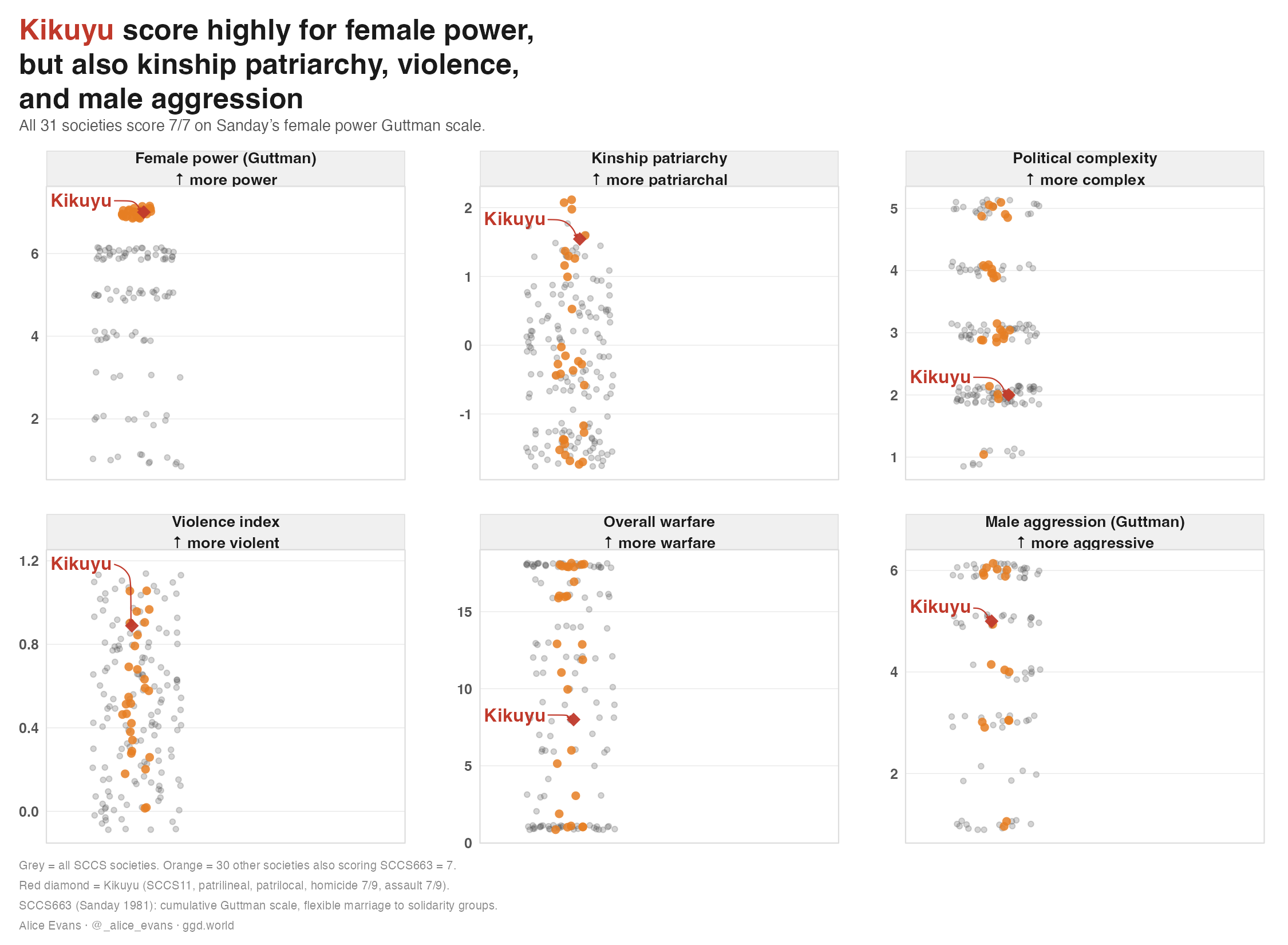
While Kikuyu women could meet as a group and thus get the SCCS’s top score, this was not a form of feminist solidarity. Lambert details that one of their tasks was to ‘bring pressure to bear on girls who do not conform to the standards of propriety’. Political power was organised by bands of male warriors, in a society scored highly for violence, aggression, warfare and kinship patriarchy.
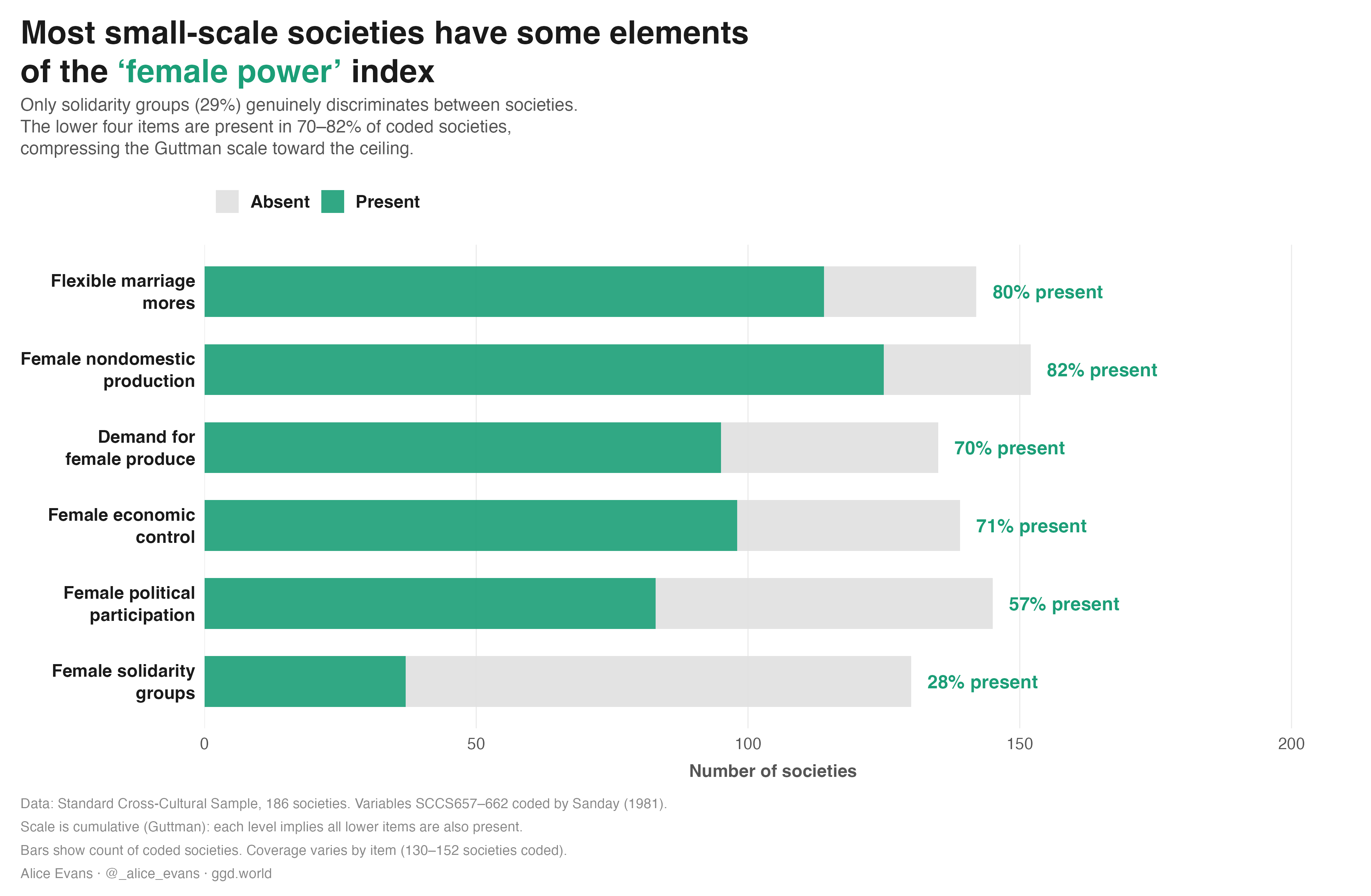
Most small-scale societies have some elements of the ‘Female Power’ index
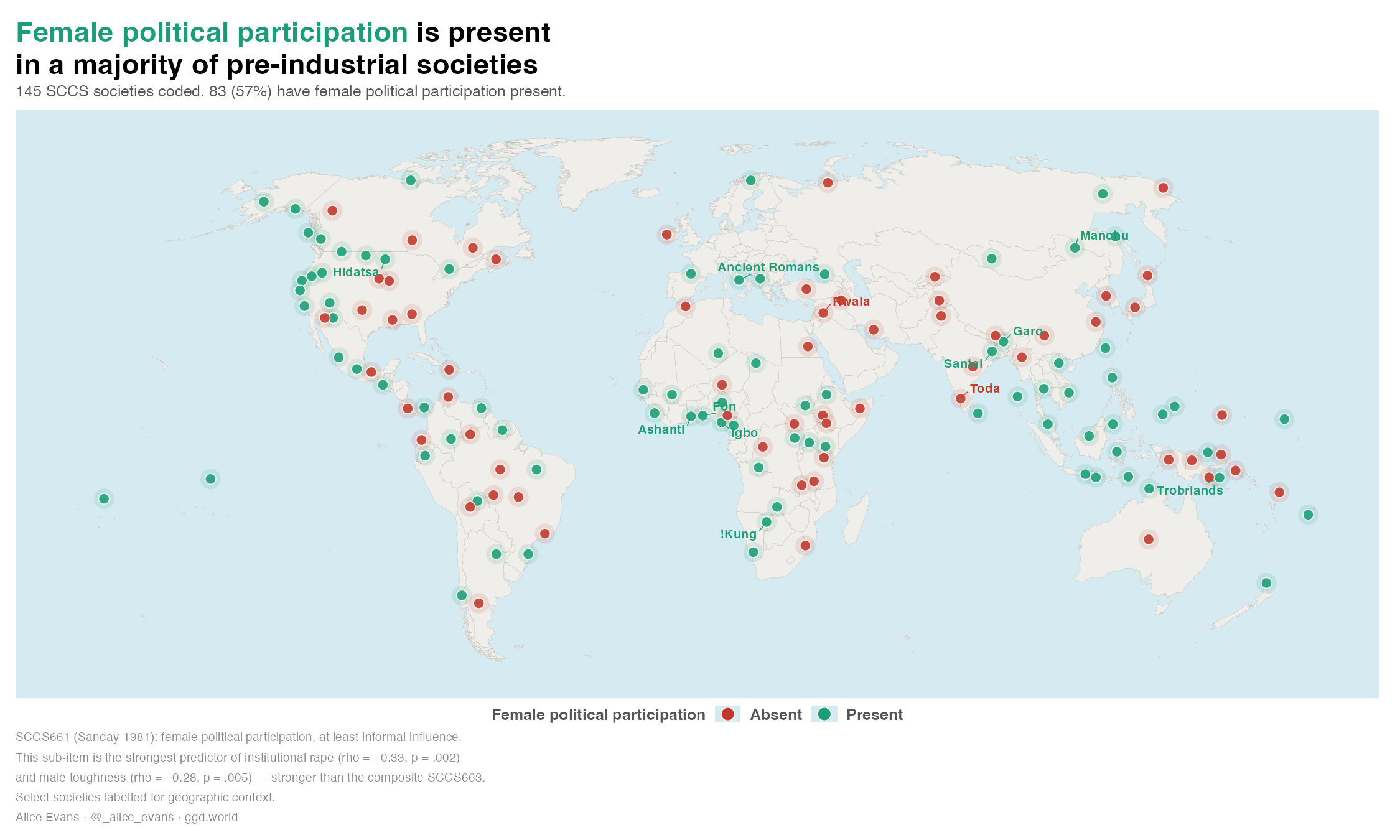
Roughly 57% of coded societies get the second highest score for female power. Most have some form of ‘female political participation’. But if we read the primary sources, we may realise that the bar has been set so low as to be uninformative.
The Igbo and Dahomey are given the highest scores for female power, while simultaneously being extremely violent slave-raiders.
From Powerful Elites to Protections from Predation
Peggy Sanday was a true pioneer, asking the big important questions about why some societies were more patriarchal than others. Building on her scholarship, I suggest one modification: if societies instilled obedience to elders, while permitting capture and coercion, it is difficult to see how ordinary women had ‘power’ over their own lives.
Why didn’t anyone make these objections before? It is surprising since I have only cited respected sources that are used to justify claims of ‘female power’. I suspect that some communities were eager to celebrate non-Western societies and didn’t look too closely.
Thinking ahead, LLMs can be tremendously useful in collating diverse materials, but only if humans, with in-depth understanding, know what to look for.
Let me close with a proposal: whether we are tracking gender relations in the past or present, we can only understand that entire society if we go beyond privileged elites and explore whether ordinary women can exercise pursue their own preferences, openly engage in ideological persuasion, contest authority, and are protected from male predation. Only then do they have power.
Clearing up muddy data to get a clearer picture of reality to work with really helps in understanding what’s going on with our species. Thank you, Alice for doing this work.
I wander what facia is almost universally holding this system in place. What tiny misconception did this globally evolve from and how do we flip a switch to deactivate it and let it wither and die.
I wonder, if like many seemingly complicated issues, it’s just one untrue misconception, then when adjusted, human kind grows straight again.
Just in case it’s that simple, I am panning for it. What are we missing? What’s possible?
As a Kikuyu, who speaks Kikuyu (unlike your quoted author who spoke Swahili- another bantu language which i also speak but very different language from kikuyu), I daresay there is a lot of nuance that is missed by the original author and now by you in your interpretation of Kikuyu culture. I can direct you to kikuyu historians but I feel your point was to confirm your understanding and not unearth the truth