

At the 1995 MTV Awards, Chris Isaak grabbed and kissed Cameron Diaz, in front of a global audience. She struggled briefly before composing herself for the cameras. A few years later, David Letterman leaned over and sucked Jennifer Aniston’s hair, much to her discomfort. In both moments, men treated female superstars as their playthings, yet faced no backlash. While such behaviour would now be condemned in Hollywood, in much of the world men continue to harass and assault with impunity. Across many societies, men anticipate that they can grope, molest, or rape, or without facing any repercussions. They have not been restrained by strong states or moral opprobrium.
When the UN compares countries’ progress towards gender equality, it usually focuses on women’s attainment in the public sphere: schooling, jobs and parliamentary seats. The World Values Survey similarly measures support for women’s paid work and leadership. This data is extremely useful, but omits a fundamental driver of patriarchy: violence.
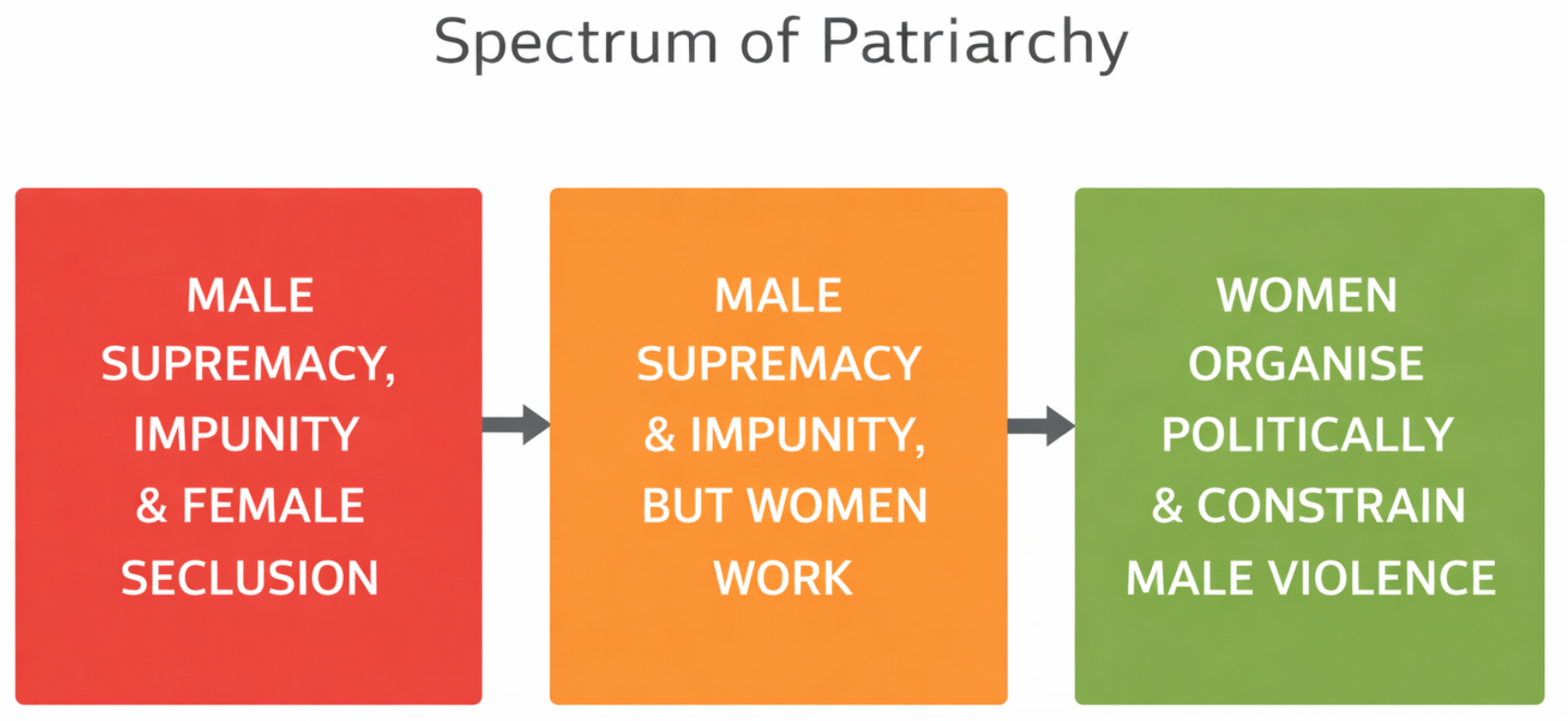
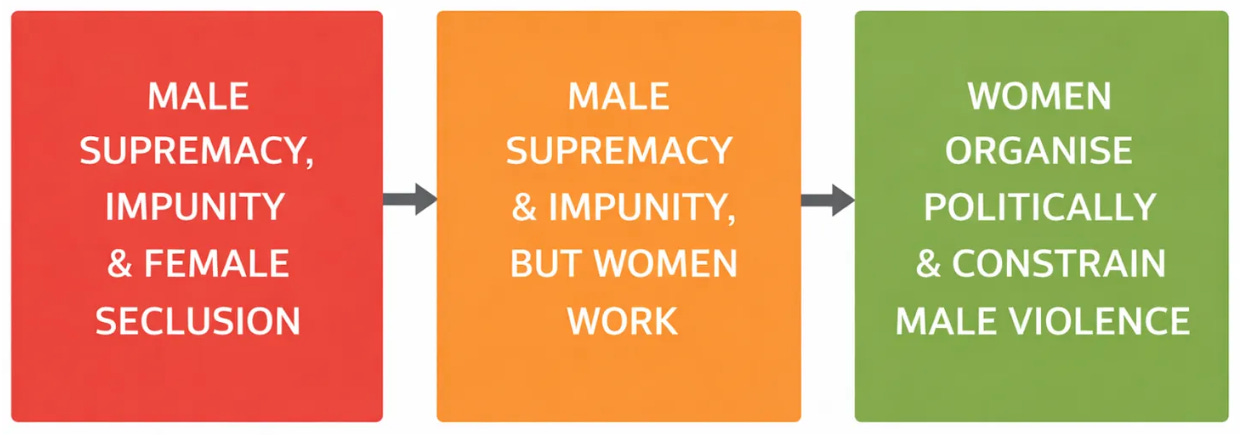
For most of human history, power has been won by militarised coalitions who conquered new territories, raided for slaves, patronised patriarchal religions, while expanding their populations by glorifying maternity. Over the past century, progress has been real, but regionally uneven. In the most patriarchal societies, male status is safeguarded through female seclusion - confining them to the home, preventing any possibility of resistance. In another set, women move freely in markets and public spaces, but men exercise impunity for harassment, assault, trafficking, and gang violence. She is either secluded or vulnerable. Only in a third set have women escaped family control and also walk down the streets feeling safe.
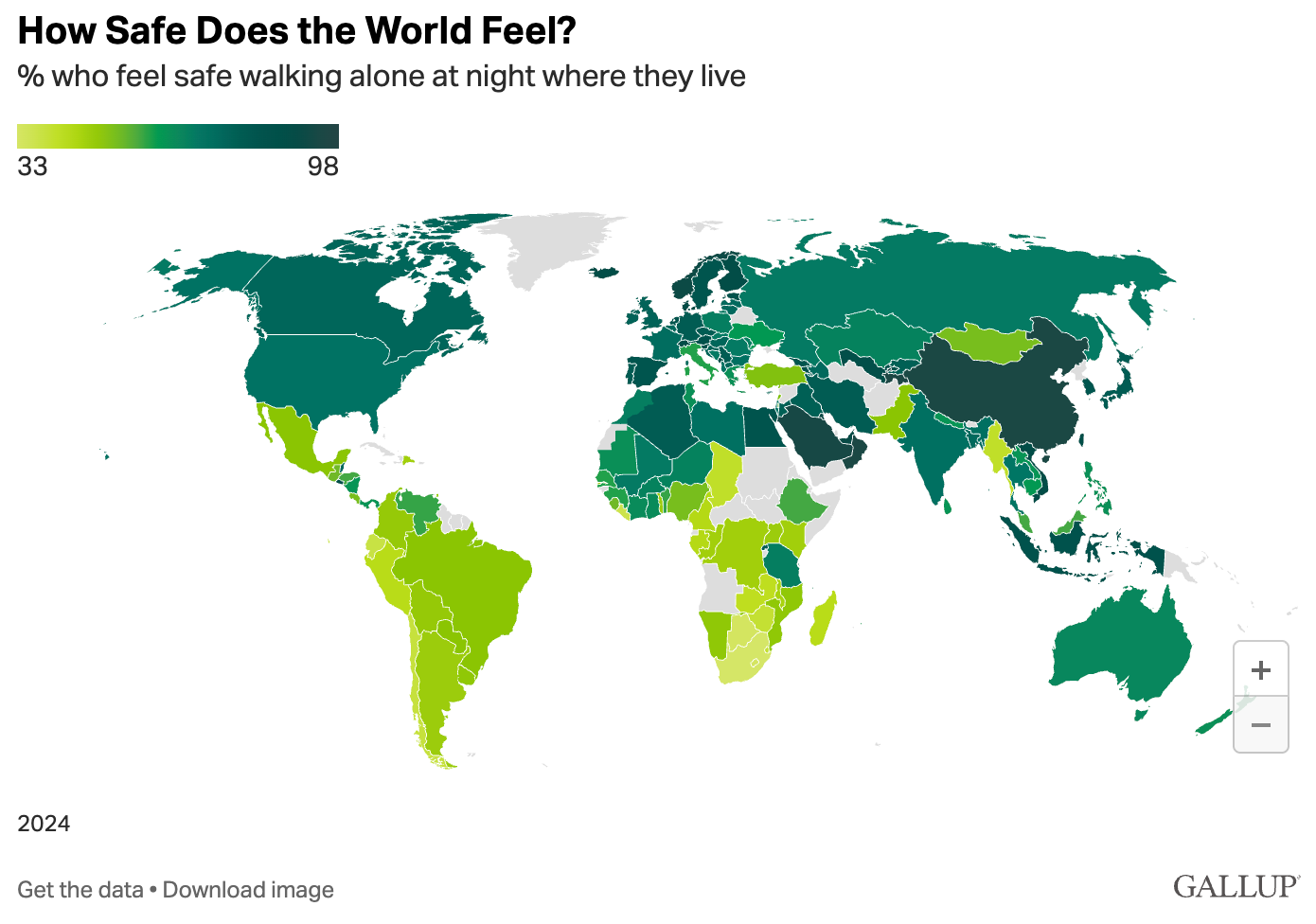
In 2024, 98% of Singaporean women reported feeling safe walking alone at night. In South Africa it is just 24%. That gap captures something fundamental about women’s lives, and surely merits greater attention?
If the state fails to constrain criminal networks or predatory officials, then violent male coalitions can accumulate power. Opportunists gain advantage through brute force, sustaining a premium for male aggression. Yes, most victims of homicides are usually male, but that does not signify female empowerment. This loss of life reflects male competition within violent hierarchies. Criminal gangs run rampant, exploiting others for forced work and sex, publicising brutal punishments. Everyone lives in fear, most especially the poorest. Recognising danger, people may ally with known thugs or stay silent for fear of reprisals. Trapped by violence, they struggle to build institutions that enforce ‘the better angels of our nature’.
So while it’s important to track women’s progress in employment and politics, such metrics can be misleading. They omit pervasive harassment, homicides, conflicts and coercion. And here we see a marked class divide, with the poorest girls being most vulnerable to male aggression.
Let me illustrate several different forms of impunity: Guatemala’s religious conservatism, Haiti’s criminal gangs, Nigeria’s ritual intimidation, as contrast with Europe’s recent divergence. These examples are clearly much more severe than Letterman’s hair sucking, but they capture the same underlying principle: male impunity.
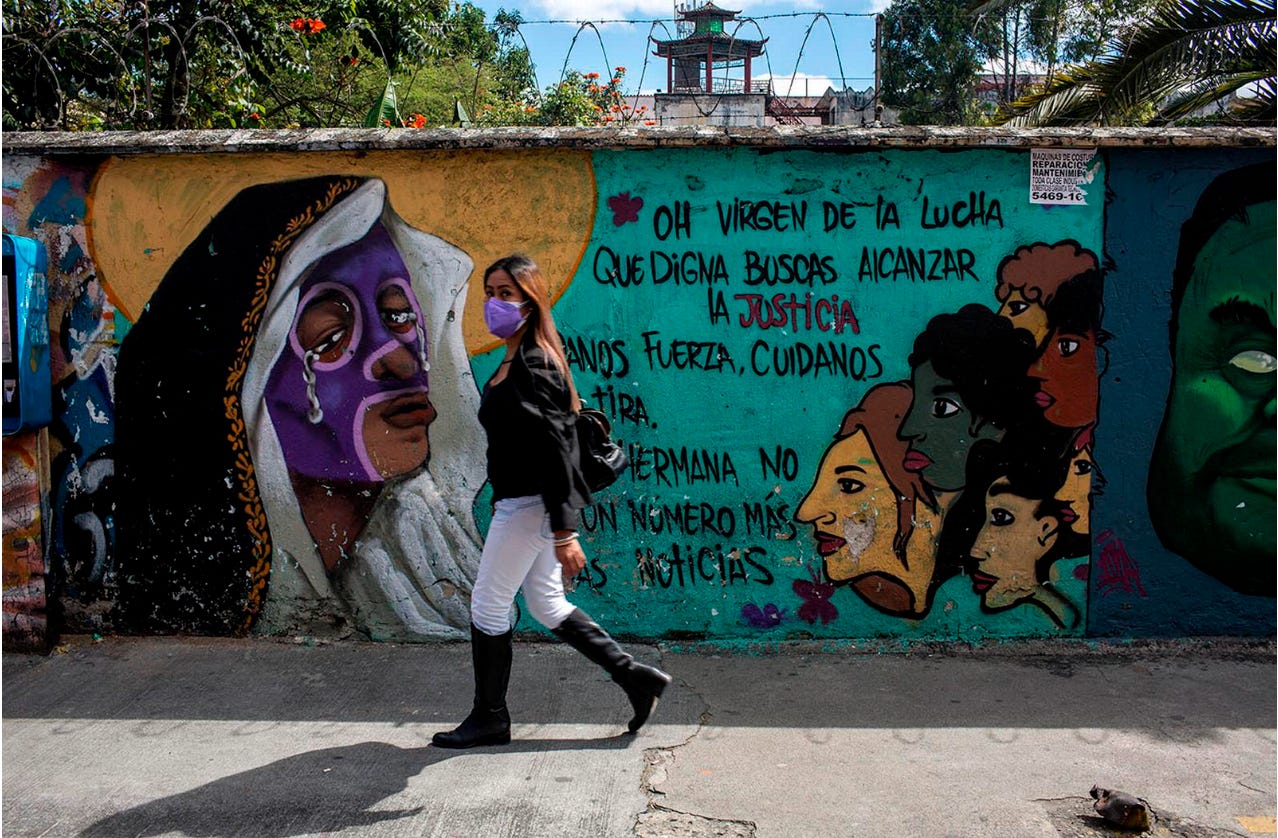
Impunity in Guatemala
Over a third of Guatemalan women experience sexual violence in their lifetime, yet the courts remain reluctant to impose punishment. From January 2018 to October 2023, prosecutors and judges dismissed 6,697 allegations of sexual violence against girls under 14. In that same period, there were just 102 rape convictions involving pregnant girls under 14.
Maria, age 12, was repeatedly abused by her grandfather and became pregnant. But instead of being supported by her family, they actually turned against her. “The whole family is against Maria because, as a good Christian, she should forgive,” shared a lawyer.
If you read Human Rights Watch’s report, you may feel puzzled. It rightly highlights prosecutory failures, fragmented data systems, lack of staffing and resources. But its recommendations are overwhelmingly technocratic - focusing on better laws, larger budgets and improved protocols. This omits religion, culture, and state weakness.
Guatemala is extremely socially conservative. Teenage fertility is high (68 per 1,000), while female labour force participation (40%) is well below the regional average. Only 74% of women make decisions concerning their own health care, while 80% of parliamentary seats are held by men. 81% of Guatemalans say religion is extremely important, 49% say religion is an important quality for children, while 60% emphasise children’s obedience.
As one female Guatemalan judge remarked,
“[In those regions] men still have the ingrained idea that they are in charge, not women.”
In societies that idealise obedience, hierarchy and the broader collective, then victims of assault are usually urged to reconcile, forgive and remain silent. Impunity isn’t just a function of administrative backlog, it reflects a social order that abets male abusers.
Criminal gangs in Haiti
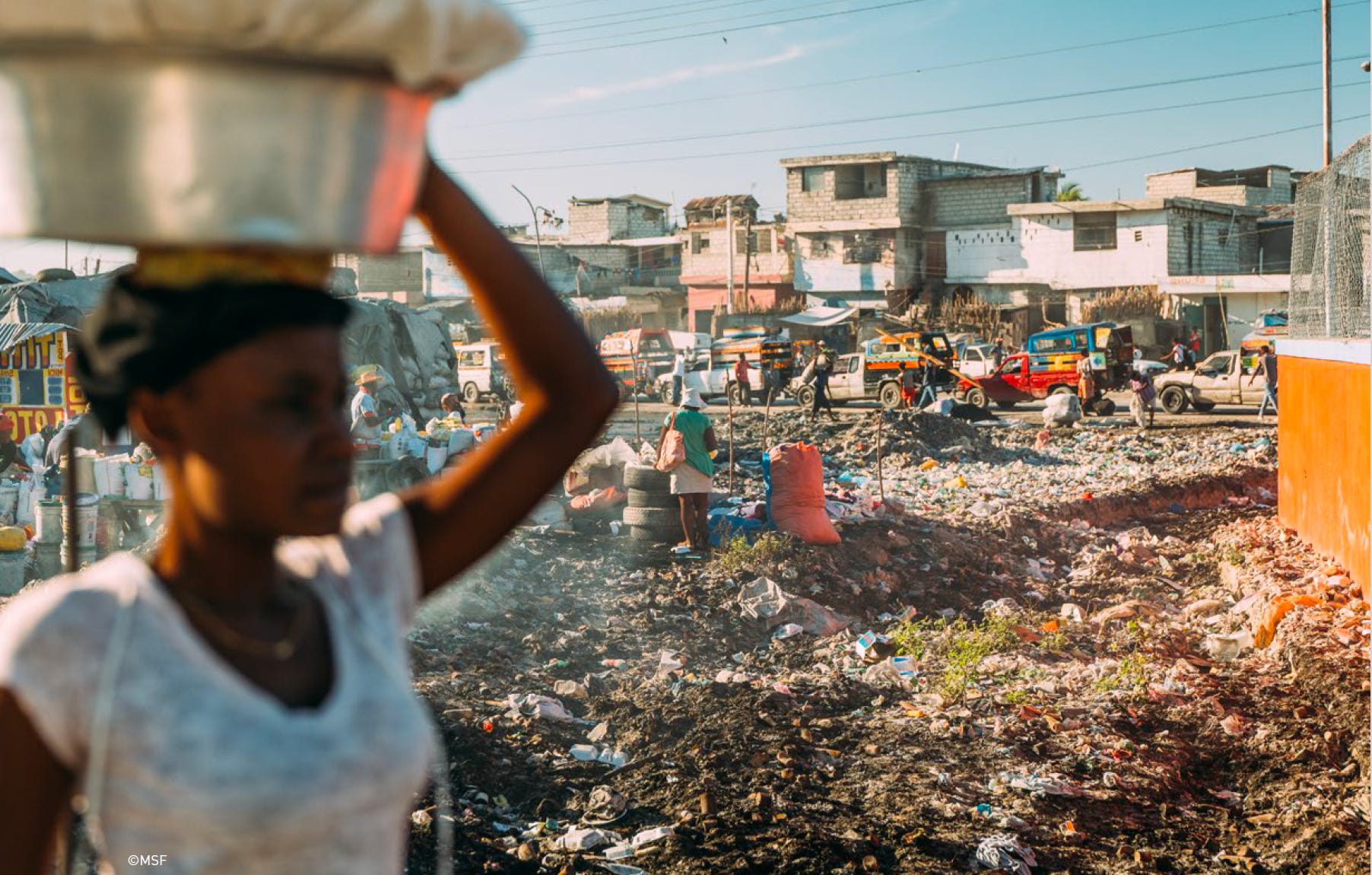
After Haiti’s President was assassinated in 2021, armed groups have struggled for control, causing pervasive violence, intimidation and fear. The UN estimates that 90% of Port-au-Prince is now controlled by criminal groups, who use rape as a ‘weapon of terror’ to ‘punish’ girls and women from territories controlled by their rivals. A Haitian security expert explained, “Leaders, mid-level members, and rank-and-file members all rape girls and women just because they can, and nobody stops them. At MSF’s clinic, 58% of survivors experienced a group assault, with an average of three perpetrators.
“I was raped by four men while walking down a street” said a 25-year-old woman who had been looking for water for her children. “They were Gabriel’s men [from the G-Pèp criminal group]. They didn’t used to do this, but now they do whatever they want to all of us.”’
“It was near 10 a.m. More than 10 bandits arrived... Two grabbed me by my arms and dragged me to another house... [There], they took me to a room where there were six [other] girls. They tied me to a chair ... five men raped me that day. They hit me in the head with their fists several times... I spent five days in that house and every day I was raped by different men... The other girls were also raped and beaten.. I still have many nightmares about what those men did to me. I wake up in the middle of the night screaming in fear and sweating” (Bridget, 14).
Sorcery in Tracking Networks
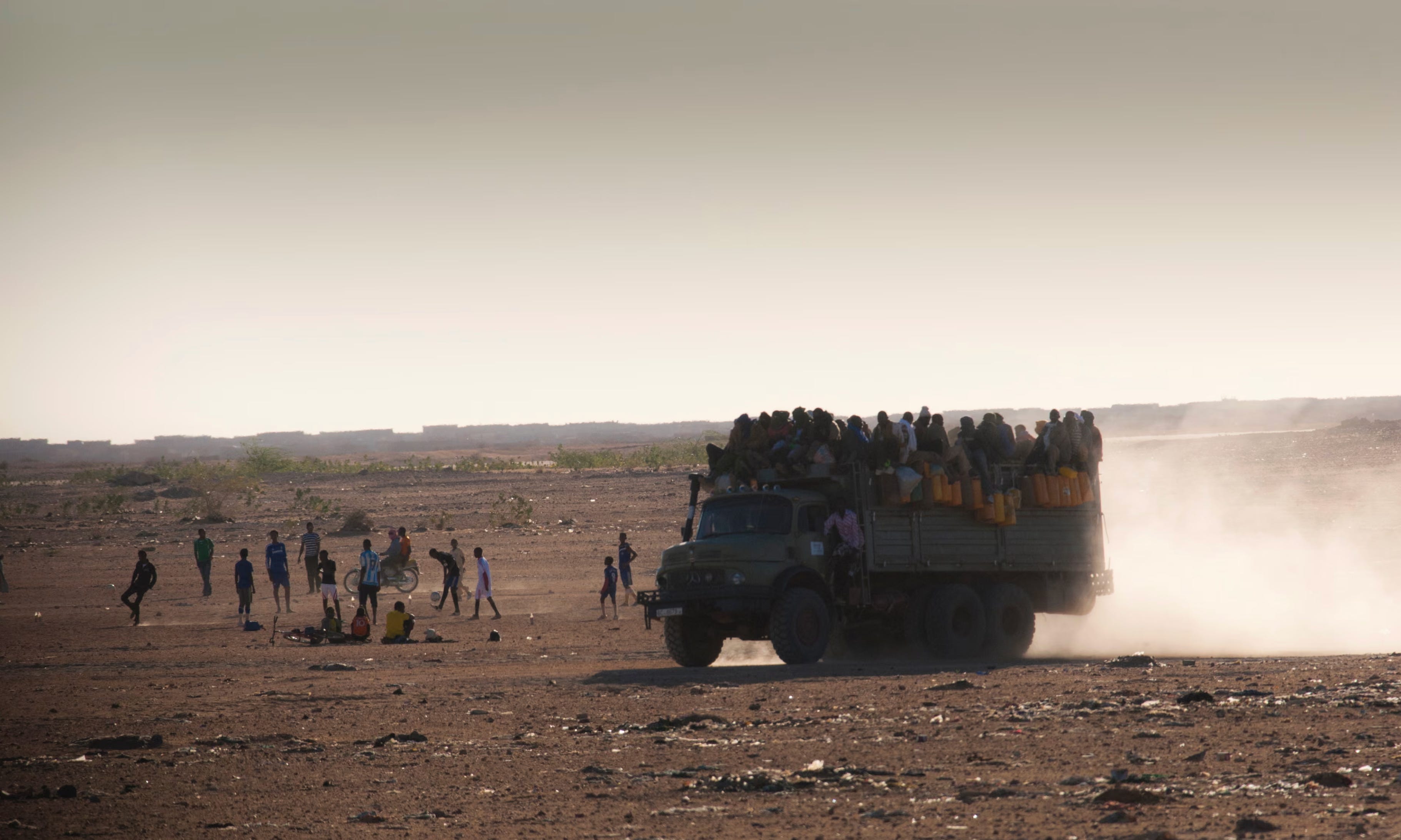
Over the past 20 years, girls and women from Edo State, Nigeria, have increasingly been trafficked to Italy for sex work. To prevent their escape and instill compliance, criminal gangs routinely use ritual sorcery. Adeyinka and colleagues detail that girls may be taken to a juju doctor to swear a sacred oath, pledging never to reveal their trafficker’s identity, and repay the cost of their trip, or else the spirits will punish their families and subject them to madness. During this ritual, the juju doctor may take the women’s knickers, pubic hair or nails - as tools by which to control their bodies.
“I was scared and shaking… The man then told us not to cry, that anyone who cries in that place will die within 24 hours. She [the trafficker] then brought out the paper with my pubic hair and with that of the other girls, she had now written our names on each one. She gave it to the man [juju ritualist] and told him: “these are the girls,” and she wants him to make sure that we pay” (minor, quoted by Adeyinka et al).
As with all religions worldwide, fears of divine punishments can be used to enforce submission. Taken to Agadez in Niger and then Tripoli, women report being detained in warehouses, beaten, raped, sold between captors, and thereafter trapped in criminal networks in Italy. Victims have been reluctant to testify for fear of juju punishments.
Transnational trafficking, gang rule and religious hierarchy are clearly very different, but there is a common pattern: where the state does not constrain male violence, women are vulnerable to coercion.
Europe’s Divergence
Getting to Denmark isn’t just about state policing, but also public attitudes. Back in the 1970s, British police might turn a blind eye to men’s impropriety, dismissing it as ‘just a bit of fun’. Institutional disregard then enabled repeated attacks. An intrepid BBC reporter decided to turn the tables: pinching men’s bums, showing that this was actually weird and unwanted.
Europe has since made ginormous strides towards gender equality:
82% say it is unacceptable for men to ogle, catcall or whistle at women;
78% find it unacceptable for men to make suggestive comments about female colleagues appearances at work;
63% totally reject the proposition that if a woman suffers sexual violence while under the influence of alcohol or drugs then she is at least partly responsible.
79% say it’s unacceptable for a man to control his partner’s activities (e.g. mobile phone use or social media).
92% say a man occasionally slapping his wife or girlfriend is unacceptable.
72% totally disagree that domestic violence is a private matter.
Analysing both World Values Survey and Eurobarometer, I find that countries scoring highly on one dimension of sexism score highly on another. Compared to Western counterparts, Eastern Europeans tend to be more patriarchal. They are more likely to blame victims, dismiss the notion that ‘no means no’, and say that university is more important for boys.
In many former Soviet countries, feminism was suppressed and remains heavily stigmatised. Liberalism in Western Europe and North America was vitally important, enabling the spirit of ‘68 to spread like wild fire across college campuses, igniting the counter-cultural movement and feminist revolution.
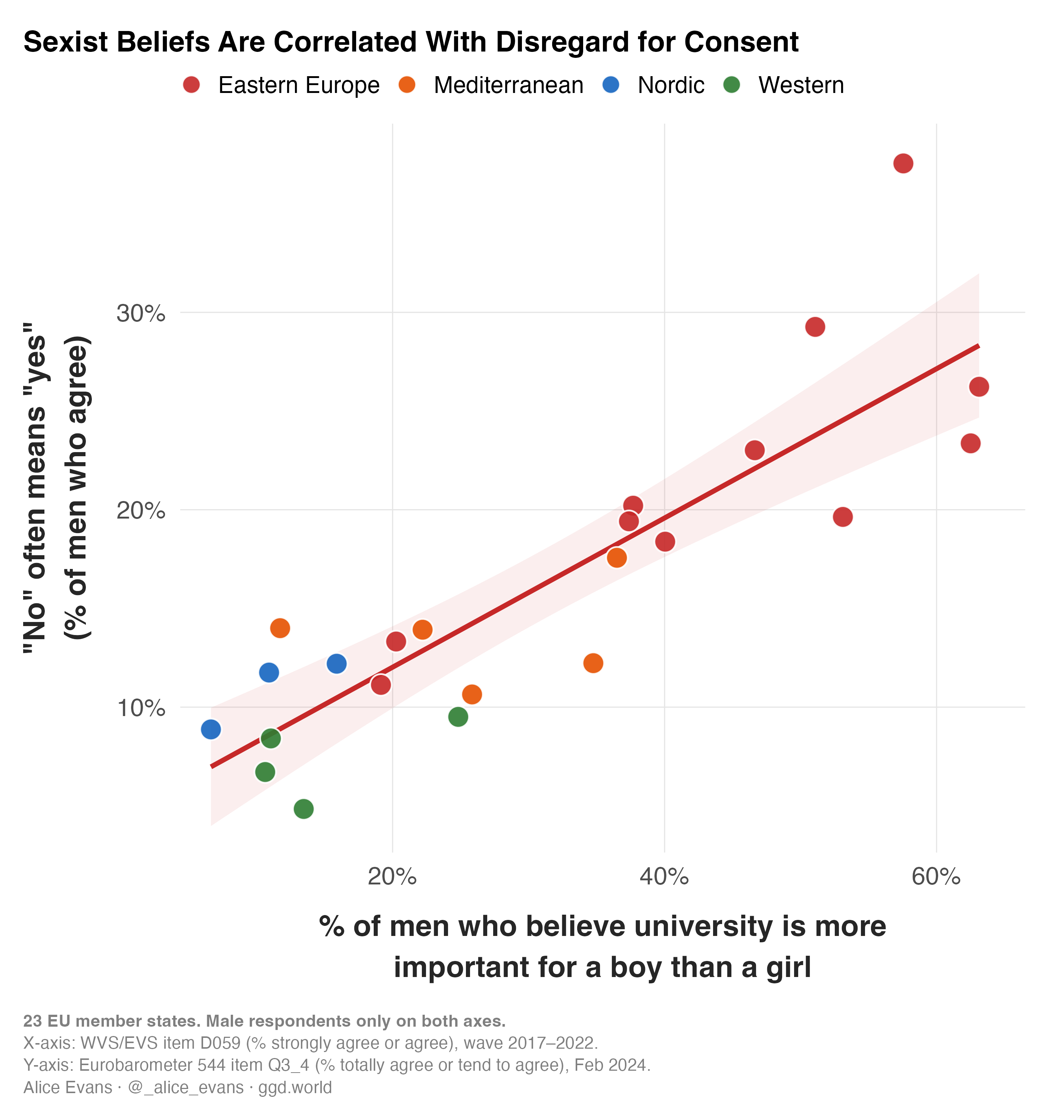
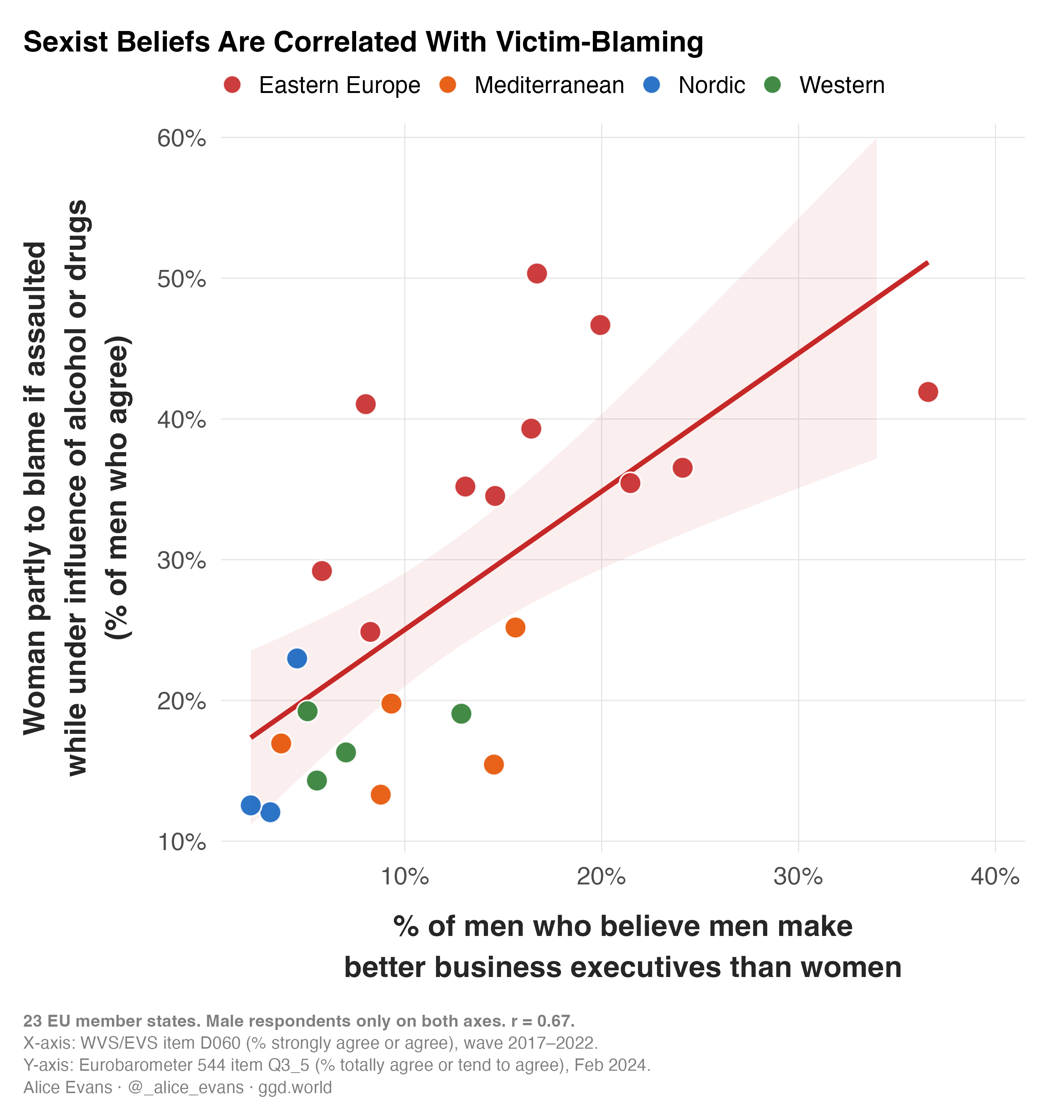
Women’s movements can be catalytic - overthrowing taboos, galvanising public pressure, and demanding government reforms. Indeed, they are a major predictor of state action against gender-based violence. Whereas in Russia, where feminism is heavily stigmatised, the Dumas decriminalised wife battery.
But while Brits and Germans strongly condemn harassment and assault, they are now witnessing rising rapes, low convictions and institutional failures. Women’s safety in the public sphere is perennially vulnerable and requires constant activism.
Do Women Feel Safe Alone at Night?
For the past 300,000 years of human history, male coalitions have exercised dominance and often enjoyed impunity. When #MeToo went viral in 2017 it was nothing short of revolutionary: joining forces, women publicly supported each other, condemned abusers, and collectively signalled that victims would no longer be dismissed, disregarded, shamed or stigmatised.
Yet social scientists have been slow to catch on. Our analyses of progress towards gender equality still focus on economic activity and political representation, omitting a far more basic question: can women walk down the street alone at night and be at ease? Or, for yours truly, can she run into the woods and just enjoy nature?

I'm a little cautious about what we should take away from "do I feel safe walking alone at night" survey data, because it isn't that tight of a correlate of actual danger walking home at night. For example in the United states things have gotten a lot safer in terms of crime rate pretty consistently over time (especially in terms of random violence against strangers), but fear of crime, while somewhat responsive, is not so down and especially recently seems to have spiked way more than actual crime rates.
I guess I have a general skepticism of using survey data for "I feel this is sociological thing is the case" for that sociological thing being the case. whether with crime, Inequality, corruption, etc. Public beliefs about it are important and not totally wrong, but are somewhat different from the thing itself.
Said another way, if you asked people do you feel safe walking alone at night, driving on a highway, drinking alcohol, having a non-functioning smoke detector, eating unhealthy foods, I do not think their relative feeling of safety with each would be very well-calibrated with the actual expected loss of quality adjusted life years.
That being said (1) when we see very large difference country to country, I can totally buy it goes along with actual much higher rates of violence. (2) Fear of crime is a real harm in its own right above and beyond actual instance of crime, in fact it may feasibly actually be worse considering the shear amount of effort and resources spent mitigating and avoiding it.
Thank you! It has always annoyed me how women, when they won an award, had to endure "celebratory" kissing.