


Until quite recently, most history books were written by men for men and about men. Eager to smash that patriarchy, Western feminist scholars have often sought to highlight women’s historical agency, subversion, and hidden powers. Current feminist histories of the Aztec tell us,
“In reality… women’s roles in this field were diverse and significant... Women in Aztec culture were highly valued, respected and influential” (Dodds 2007).
“Far from being oppressed, many women in Aztec culture were respected and influential. Partially freed from the ubiquitous and unequal constraints of childcare by a system in which fathers held primary responsibility for raising their sons after weaning, women held tangible authority within their communities as individuals of economic and administrative importance, and were valued as both workers and mothers, possessing the same inheritance rights and recourse to the law as men” (Pennock 2018).
But what if these correctives inadvertently minimize the oppressive reality of patriarchy? What if human history is indeed the clashes and coalitions of empires, where macho militaries tussled for control, built bureaucracies to extract wealth, then instilled their righteous dominance through patriarchal religions? What if it really is “MEN MEN MEN”?
Keen to learn from the past, I find it extremely valuable to read primary sources, while recognising likely bias, triangulating with archaeology and multiple experts.
Today, let’s dive into the Aztecs, who built an empire across Mesoamerica reigning from the 14th to 16th centuries. Ideally, one would read their own history books. But Spanish conquest often destroyed institutions that preserved pictorial codices. Instead we must read slightly later sources. In 1541, the viceroy of New Spain, Don Antonio de Mendoza, organised native artists to create the Codex Mendoza. It provides a pictographic history of Aztec rulers, their conquests and daily life. You can access it online, along with the superbly detailed description by Berdan and Anawalt.
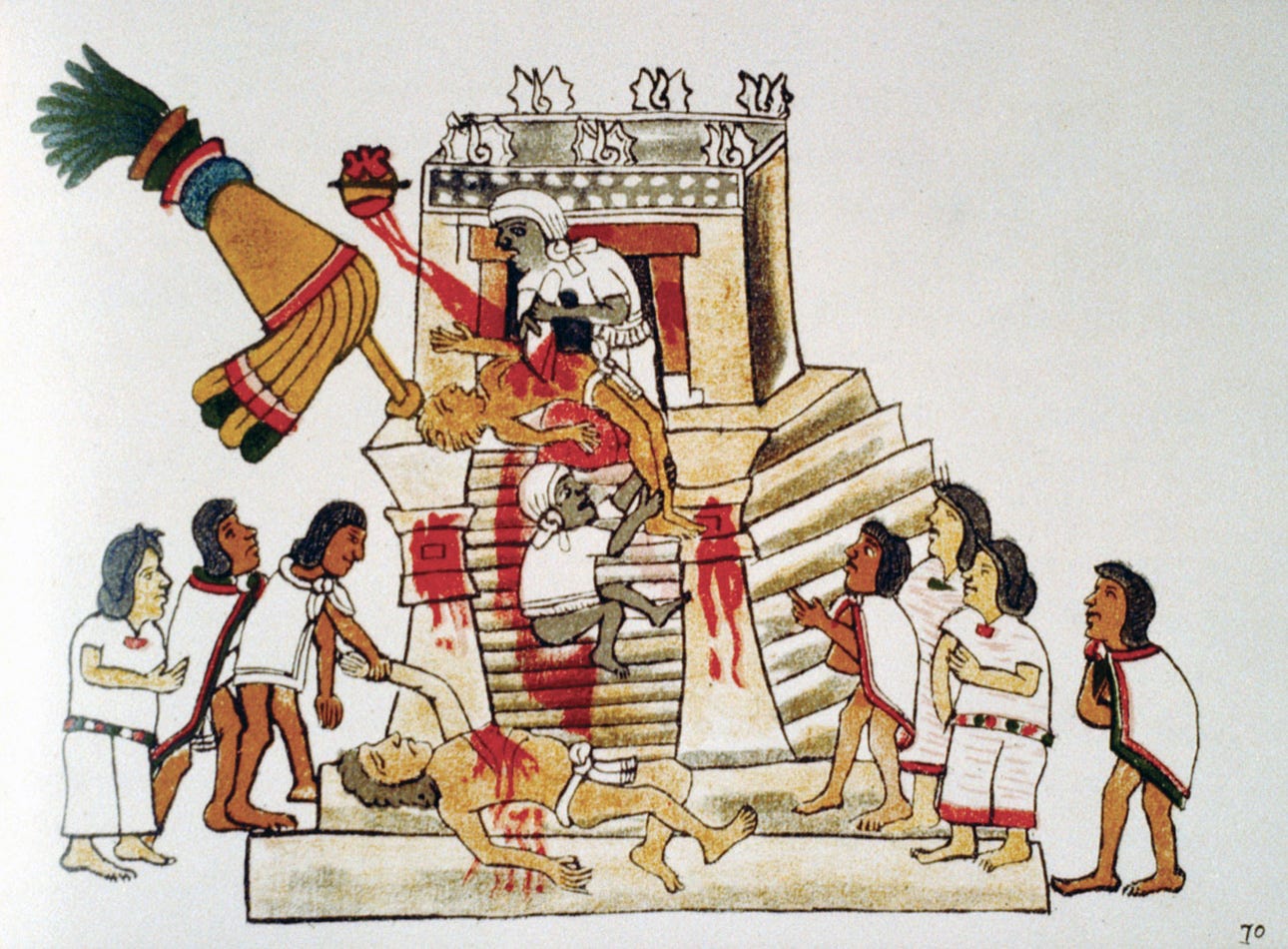
Crucially, the Codex Mendoza must be read as an idealised imperial history, blending description with mythology. Berdan and Anawalt note that while the Mexica present themselves as triumphant conquerors, they were originally marginal vassals. This error it itself important: the Aztecs present their origins as victorious warriors! I would add, the Codex Mendoza seldom shows human sacrifice, even though skeletal evidence shows that was pervasive.
We can also read the Florentine Codex (1577), led by Franciscan friar Bernardino de Sahagún, who arrived in New Spain only eight years after conquest, spoke Nahuatl, and sought to understand indigenous culture. Over several decades, he collaborated with Nahuatl elders, authors, and artists to produce the Florentine Codex. This includes 2,500 images, alongside parallel columns of Nahuatl and Spanish texts.
Join me as I trawl through the primary sources, while also drawing on expert analysis from Berdan and Smith’s tremendous book, “Everyday Life in the Aztec World”, as well as Mexico’s superb National Museum of Archaeology. I also embarked on a trip to an Aztec pyramid, but as loyal readers may recall, this was cut short by a punch in the face.
Controversially, I suggest that feminist narratives often create a rose-tinted patriarchy, vastly exaggerating women’s prominence and downplaying the reality of imperial militarism and back-breaking drudgery.
The Aztec Military Machine!
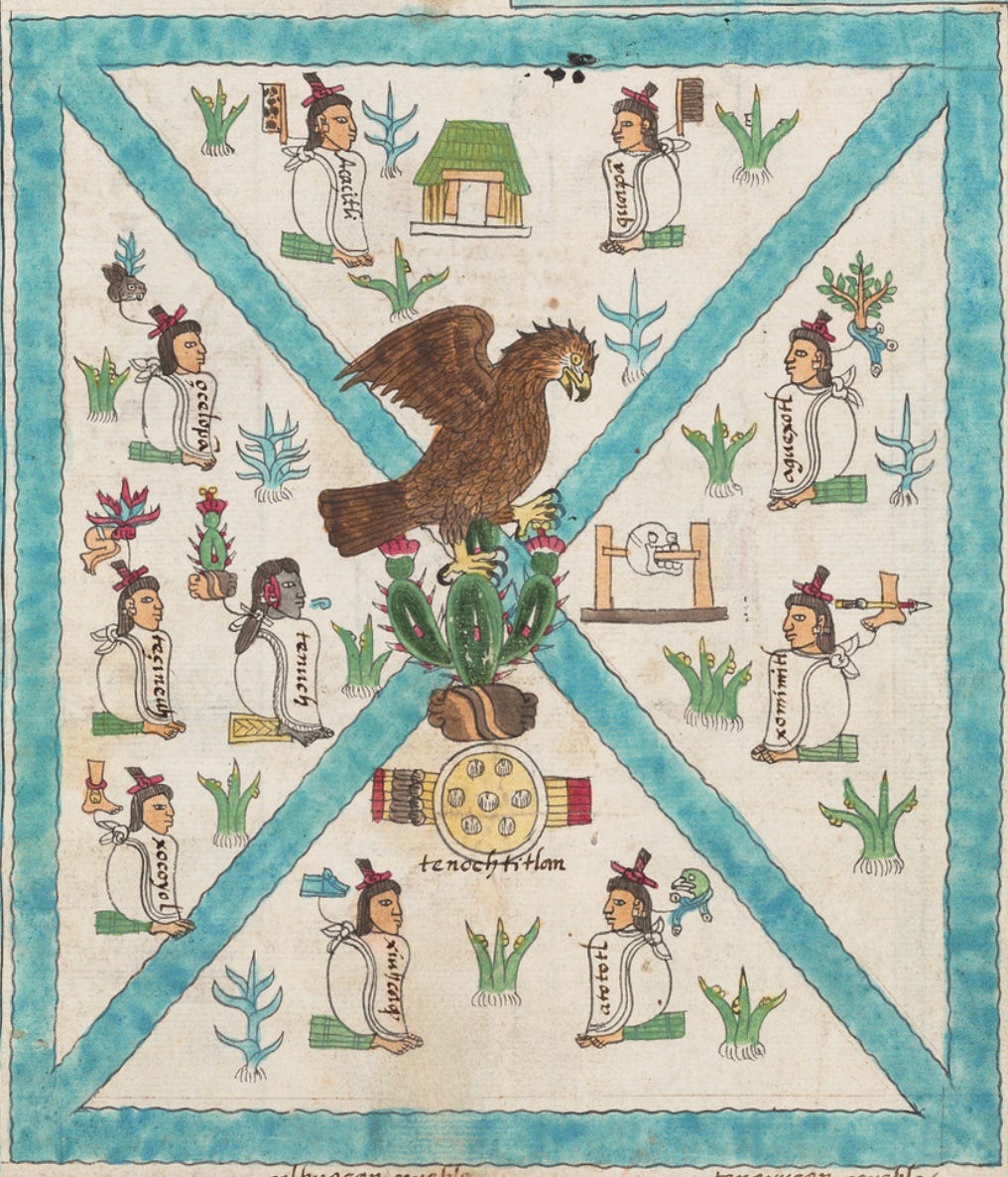
Codex Mendoza Folio 2r represents the Mexica founding of Tenochtitlan, the future imperial capital of the Aztecs! The blue diagonal waterways bisect the city, nourishing flora and fauna. Around the island sit ten founding leaders. The largest is Tenuch - whose black body paint and blood stain mark him as the priestly leader. The other nine dignitaries sport the hairstyle of distinguished warriors (the temillotl, ‘pillar of stone’). Just below the eagle sits a shield and arrows, an Aztec glyph for war. You may also spot the skull rack (tzompantli) - signifying large-scale human sacrifice.
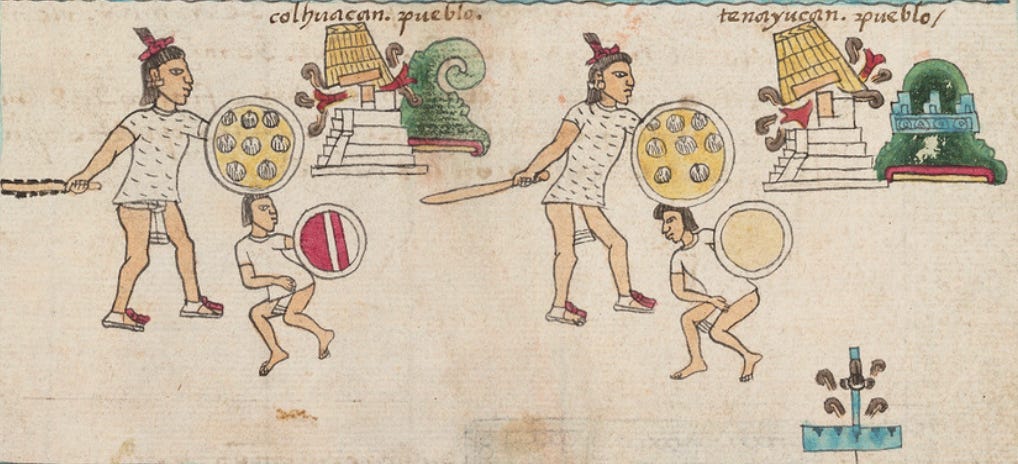
Immediately below we see two conquest scenes. Warriors (with the ‘pillar of stone’ hairstyle) force captives into subservient positions, next to toppled burning pyramid temples. Note the left captor’s ‘macuahuitl’, a club with sharp blades of obsidian!
Conquest
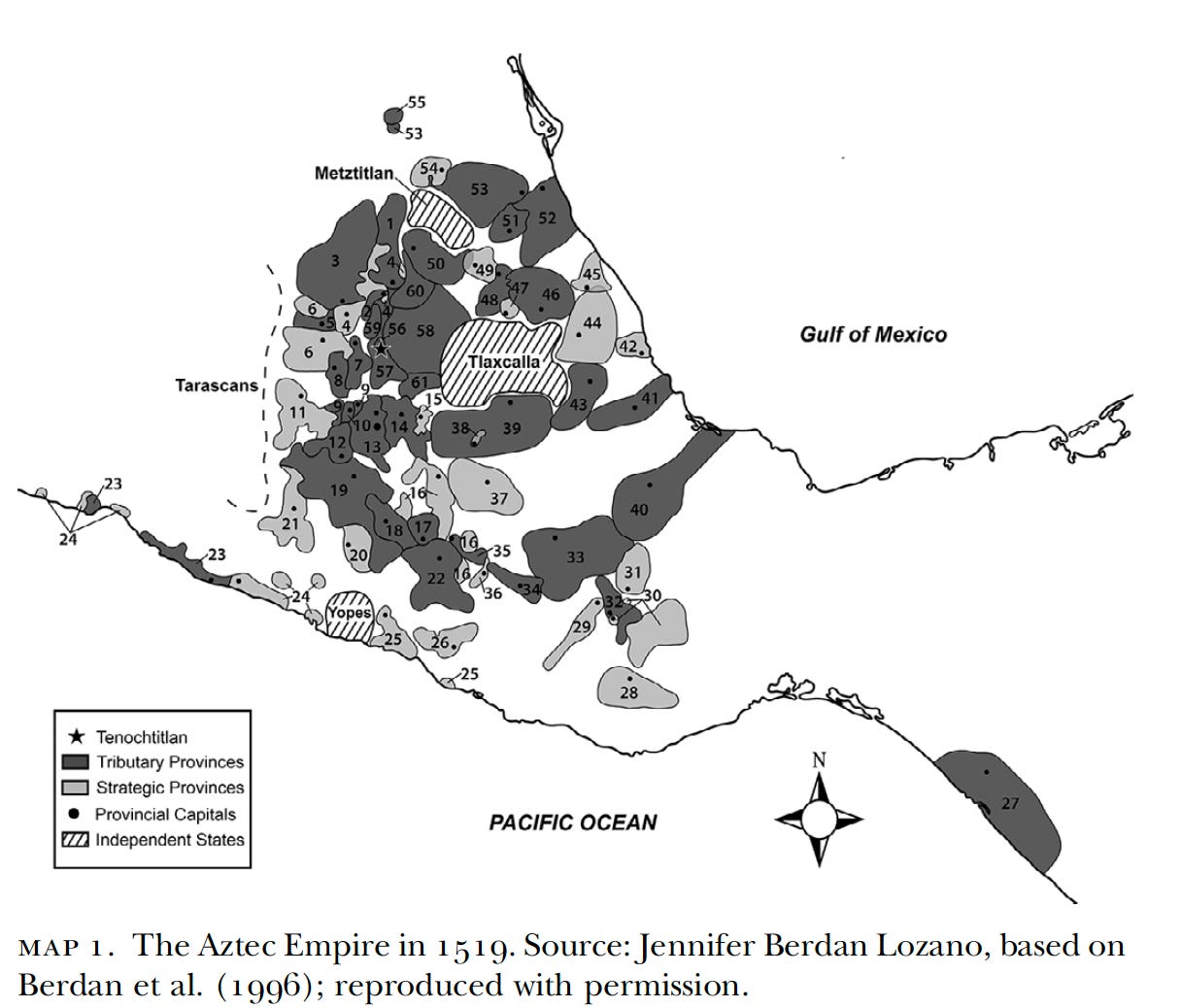
The Aztec Empire emerged through a “Triple Alliance” of city states (Texcoco, Tenochtitlan and Tlacopan) (circa 1428–1430), which then militarily subdued northern Mesoamerica.
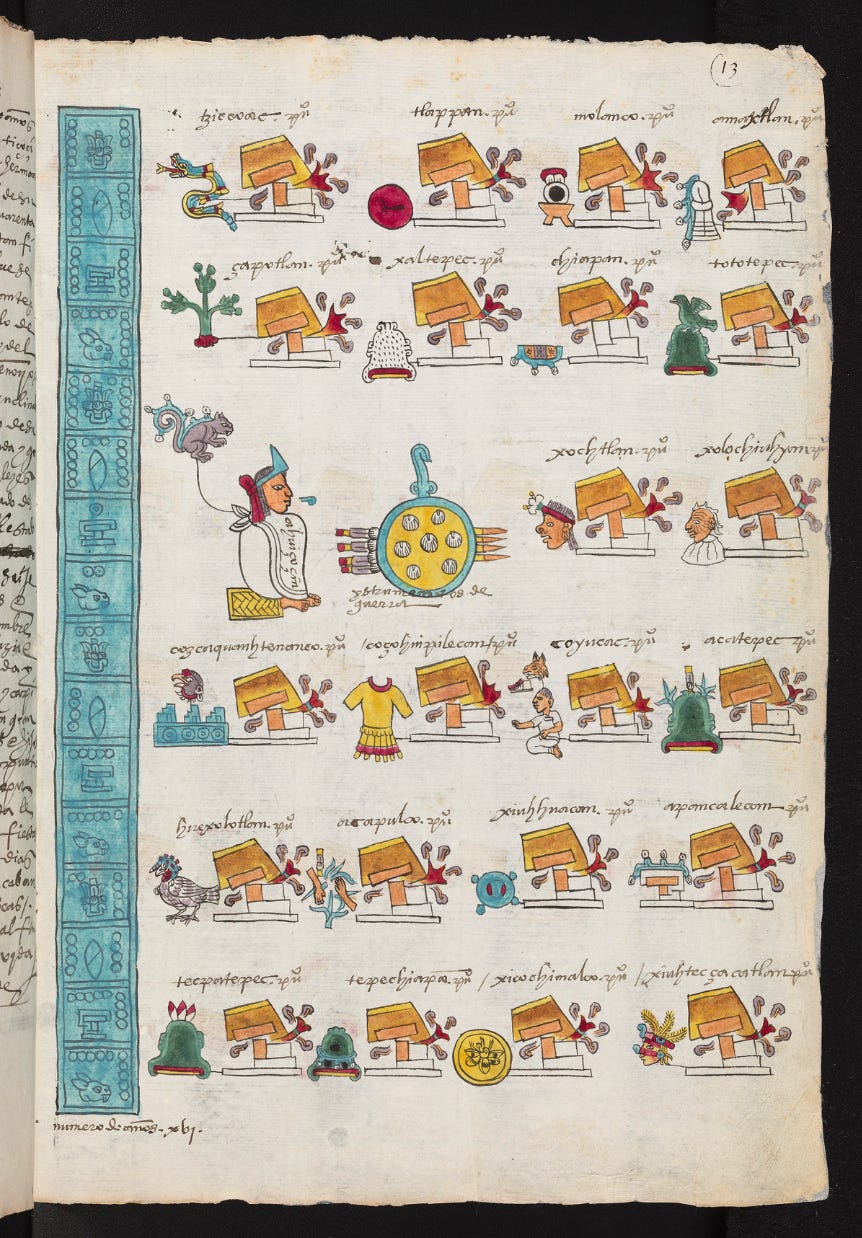
Ahuitzotl ruled from 1487 to 1502. Folio 13r shows him seated on a reed mat, clad in a white cloak. He was the younger brother of the prior ruler and high ranking military officer. For his coronation, a thousand captive warriors were sacrificed on the temple altar. Other rulers likewise would personally go to war and return with sacrificial captives for their coronation.
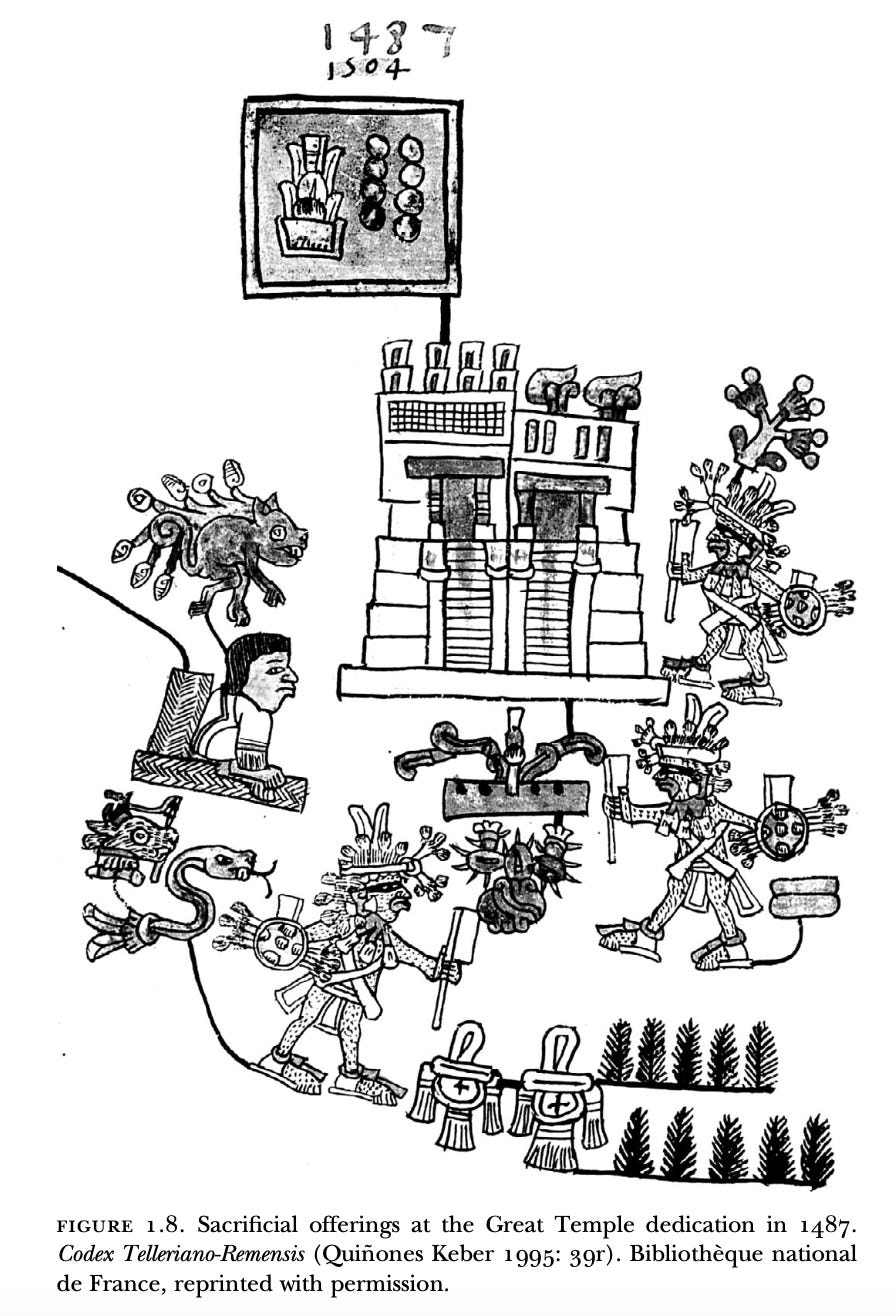
Shortly after his installation as tlatoani, Tenochtitlan’s Great Temple was completed. Before its dedication, Ahuitzotl’s armies captured Huaxteca warriors for ritual sacrifice, as well as prisoners from other subjugated city-states, paid as tribute. Everyone in Tenochtitlan and neighbouring cities was ordered to attend, and mythology boasted of over 20,000 sacrificial warriors. The goal? To demonstrate that the Aztec were masters of the world and strike enemy hearts with fear.
The Mendoza lists 45 conquests under Ahuitzotl, depicted by burning toppling temples, alongside the shield and arrows. Each altepetl (city state) is signified by a temple - conveying the utmost importance of religion.
Tribute
Conquest was not only justified mythologically but also economically beneficial - enabling commerce, diplomatic gifts, and taxes.
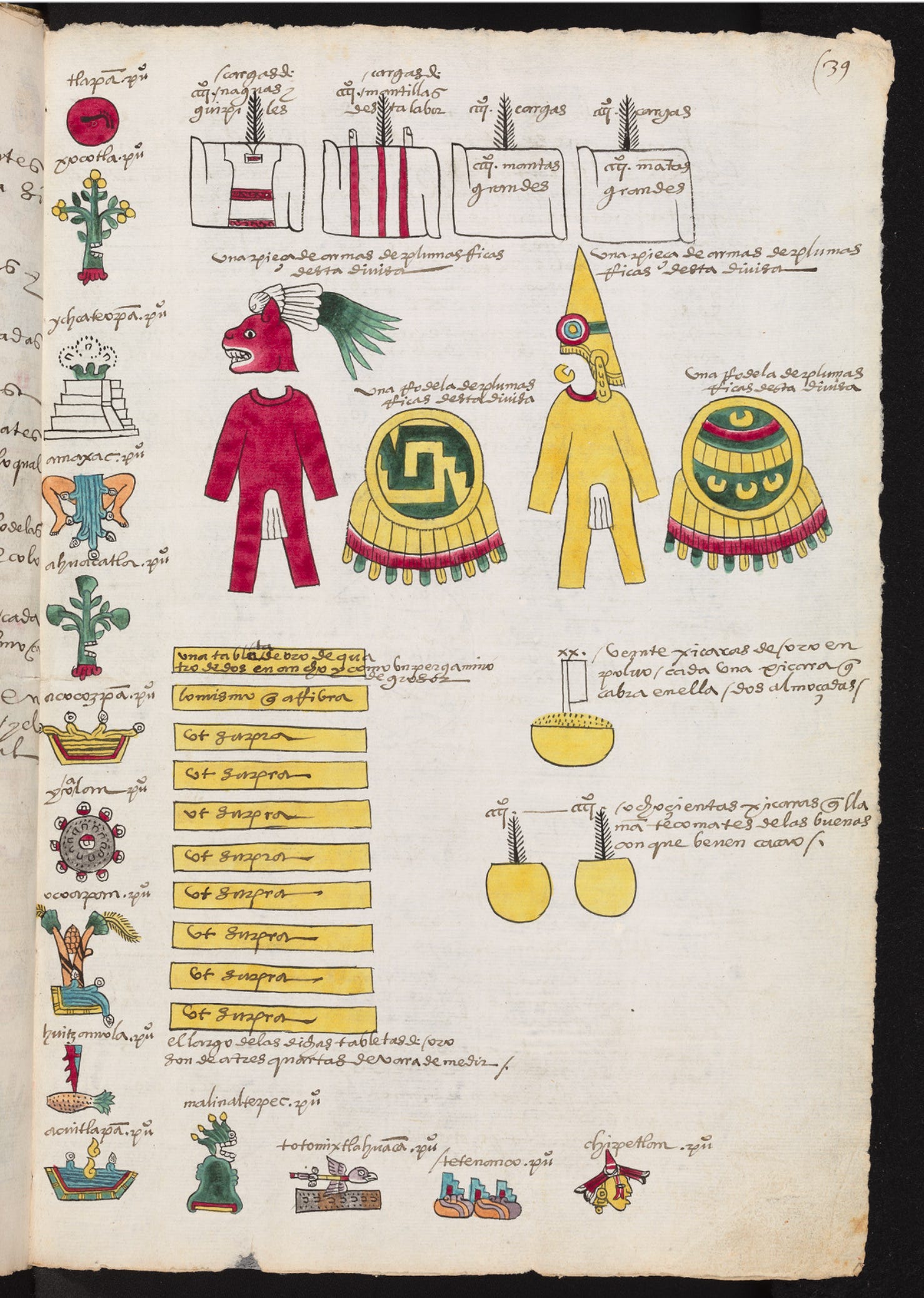
The Codex details the tributes given by each conquered region. Tlapan for example gave 400 women’s tunics and skirts, 400 red-striped mantas (blankets), 800 large mantas and 800 gourd bowls every six months, as well as 1 red warrior costume and shield, 1 yellow warrior costume and shield, and 10 gold tablets (as visualized below in Folio 39r; 163).
Such weaving was done by women. Now, a feminist re-reading might emphasize that women’s work was indispensable to empire, a crucial part of GDP, as part of ‘gender complementarity’. But if we focus on what is actually commemorated and celebrated, we see that women’s labour is merely extracted and invisible.
Childbirth
The following sections on everyday life are from Part 3 of the Codex Mendoza; Berdan and Anawalt say that this was a novel, post-conquest creation with no known pre-hispanic prototype. So it must be carefully triangulated and corroborated with other sources.
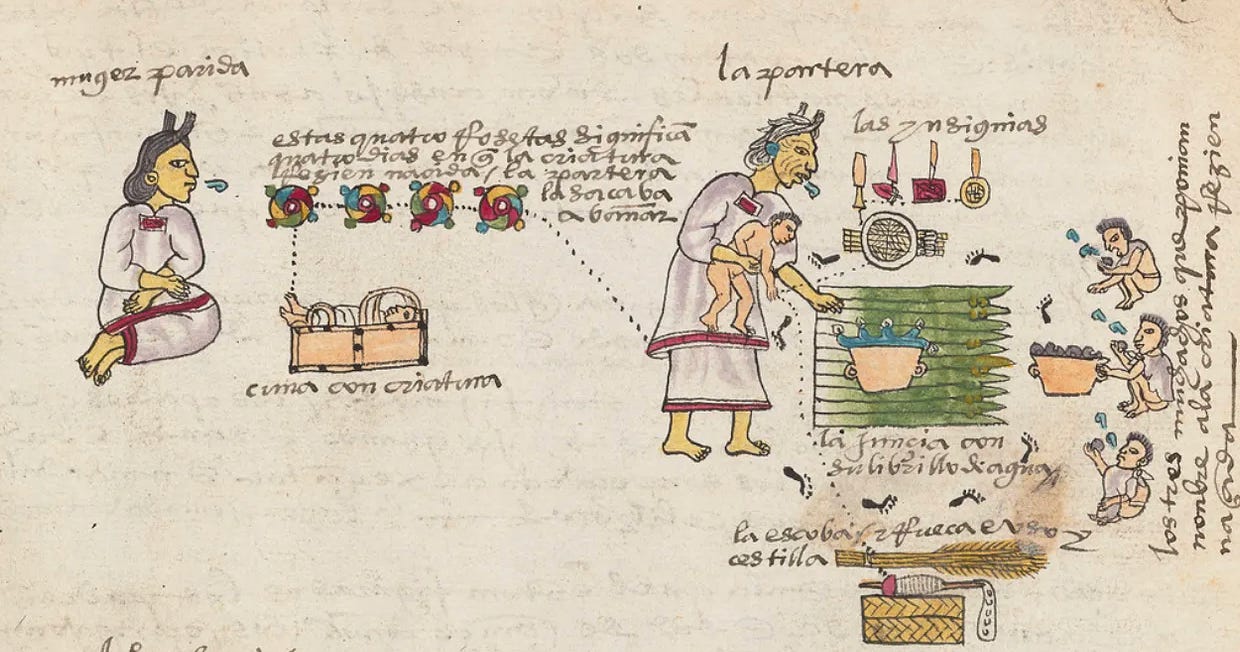
The Florentine Codex, Book 6: Rhetoric, Moral Philosophy, and Theology details that Aztec midwives would give baby boys tiny shields and little arrows. Raising him to the sky, she would let out a war cry and declare:
“He belongs to the family of soldiers and warriors who fight on the battlefield”. (Sahagún 1950-1982 6:172v).
When baptising the baby girl, the midwife includes domestic implements such as a spindle. When offering prayers for the girl, the midwife was apparently very quiet.
This ceremony is illustrated in the Codex Mendoza Folio 57r, top right. Here you see possible careers for the baby boy: a war shield with four arrows, a carpenter’s awl, a featherworker’s obsidian knife, a scribe’s brush and a goldsmith’s tool. The girl’s household tasks are signified by a broom, spindle with thread, and a reed workbasket for spinning and weaving equipment.
Gender Divisions of Labor
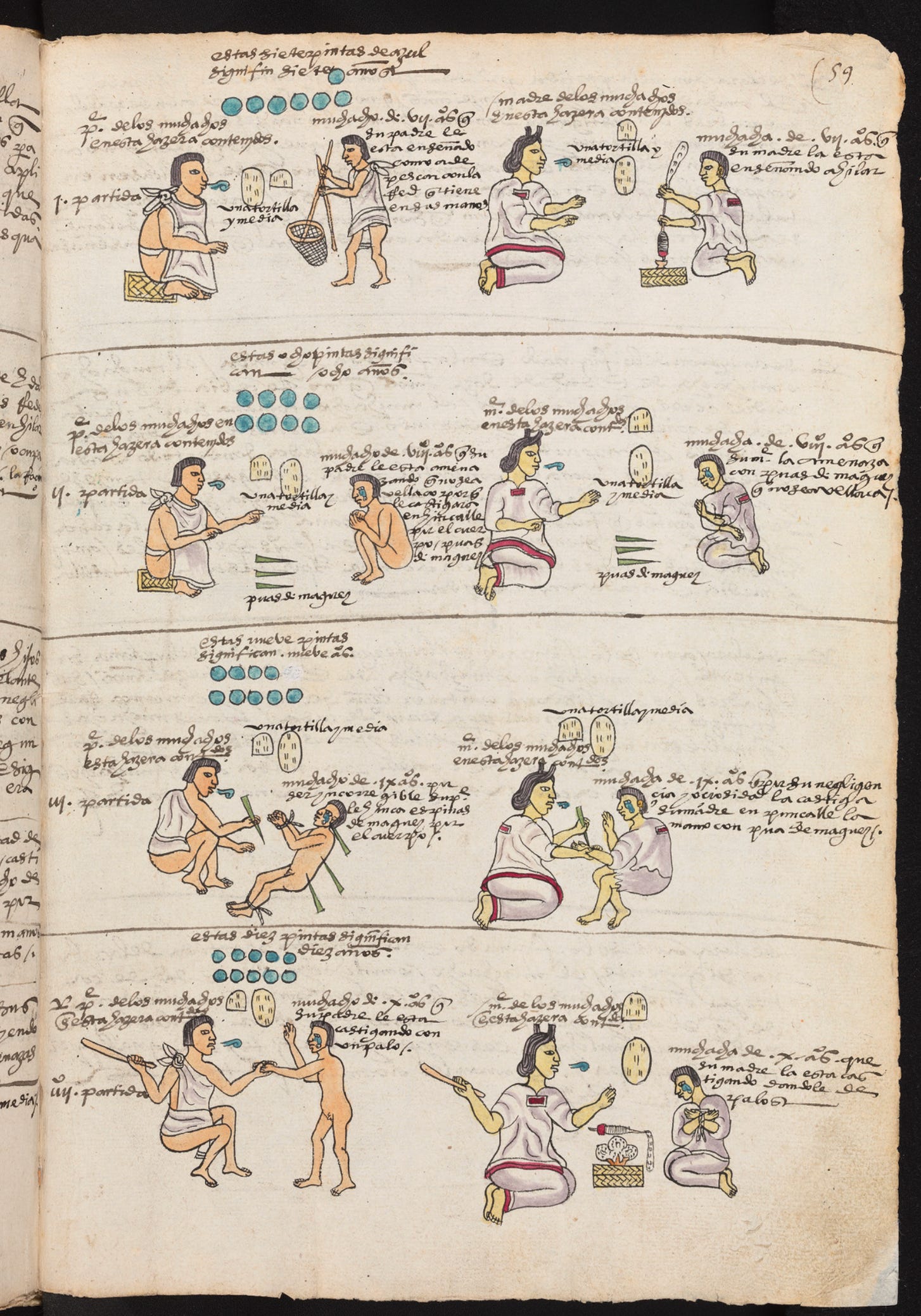
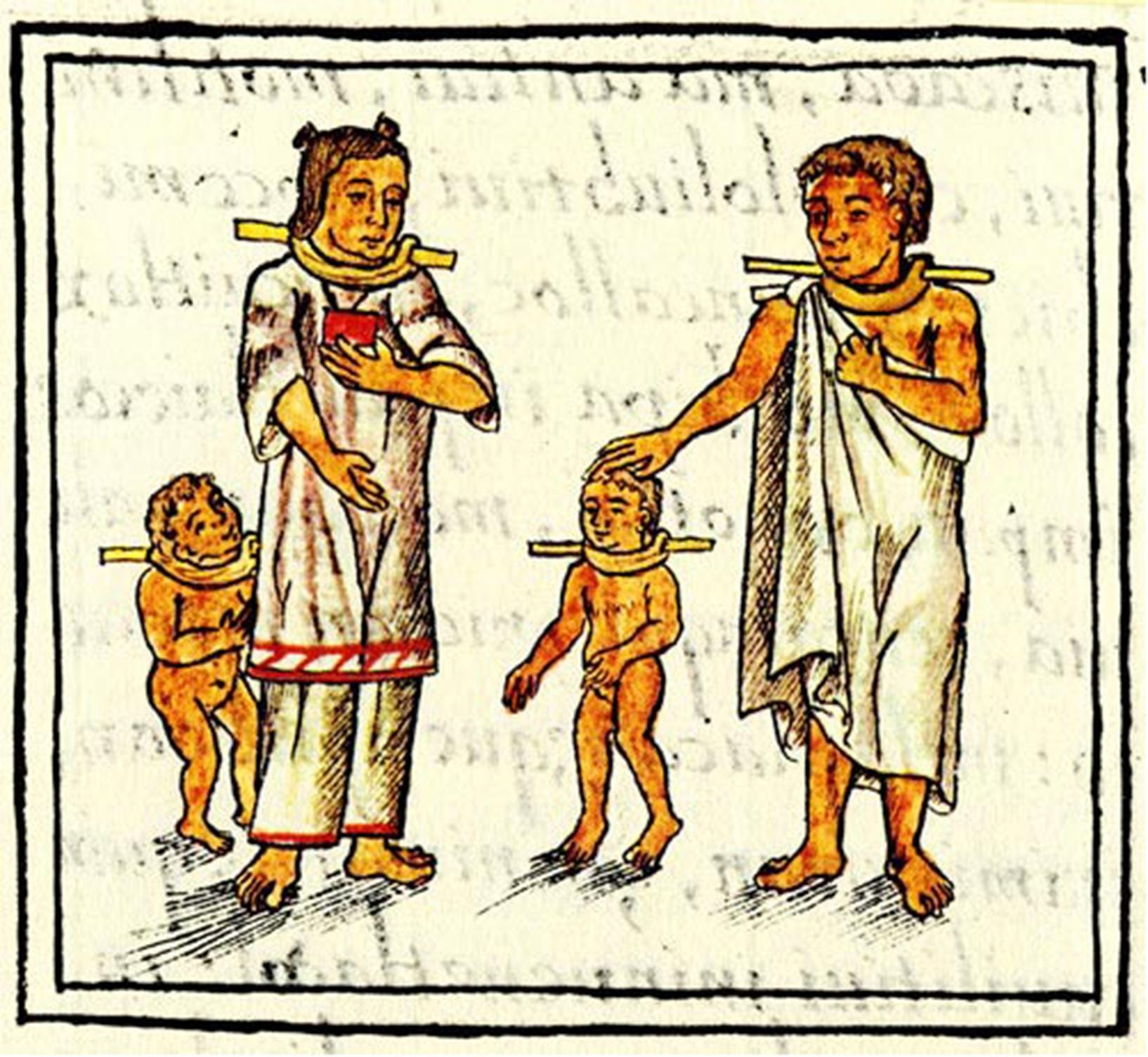
The Codex Mendoza 59r shows how Aztec fathers raised their sons, while mothers raised their daughters. The boy is taught to fish, the girl is taught to spin (158).
The third panel depicts an incorrigible 9 year old boy’s body being pierced with maguey sticks as punishment. The daughter’s wrist is pricked for being negligent and idle. In the fourth panel the misbehaving children are about to hit with sticks. Berdan and Anawalt add that parents might tie their children up while chastising them, and that girls’ feet might be tied to make them sit still and focus on work.
(That is of course precisely the argument that Bossen and Hill Gates make about Chinese footbinding: it was partly to keep girls still, working maximum hours of spinning and weaving).
Punishing Misbehaving Teenagers
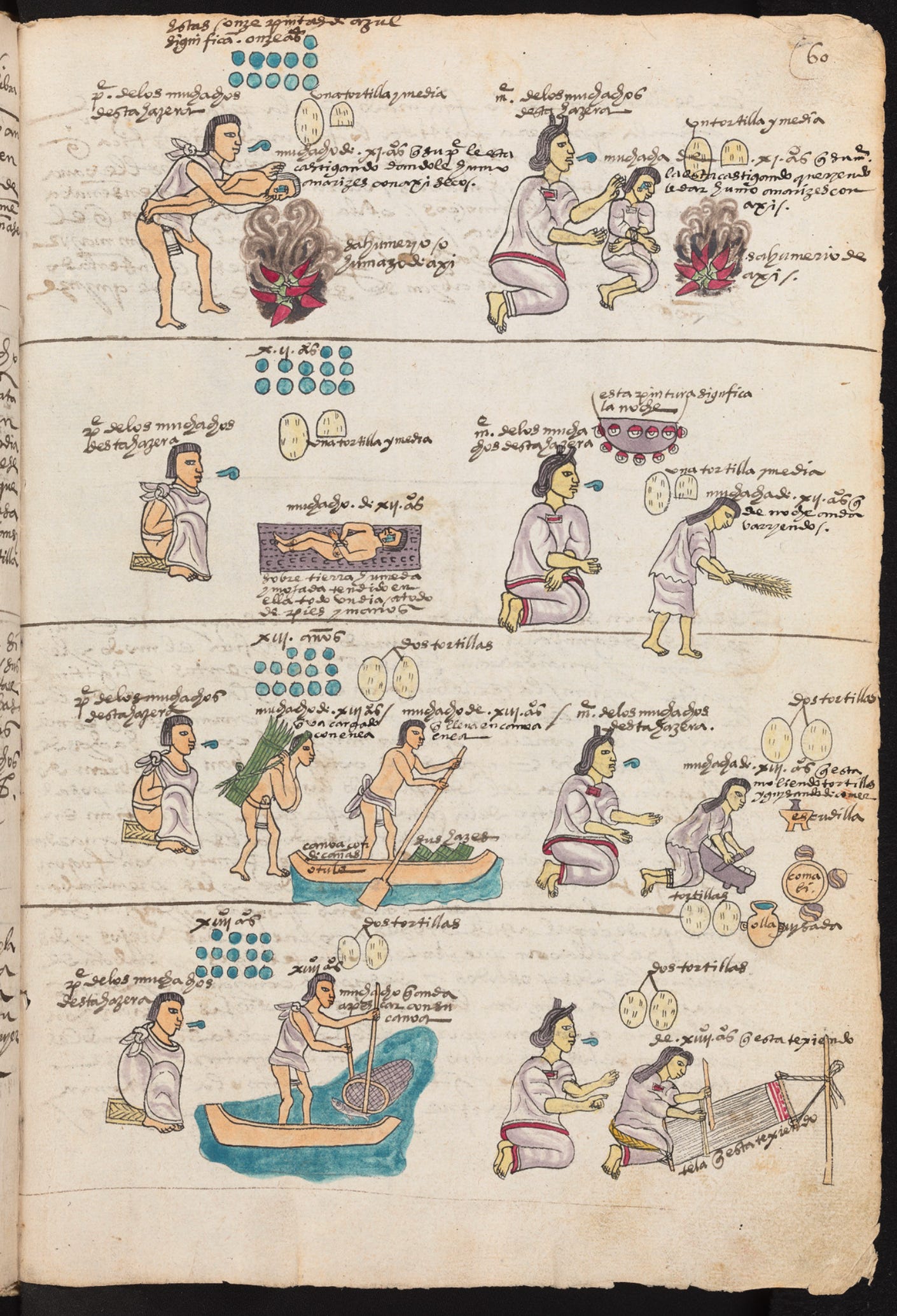
Folio 60r illustrates how children were raised. In the top panel, the children are reprimanded for disregarding their parents’ advice. The 11 year old boy cries, while being held by his father over a fire of burning chiles. Berdan and Anawalt add that chile smoke could be lethal. In the second panel, the son is naked, bound and crying.
After these punishments, the children become more dutiful and hardworking.
Military-Religious Schooling
The Aztecs had several different kinds of educational institutions:
calmecac (temple school for noble boys)
cuicacalli (house of song)
telpochcalli (the house of male youths, for commoners)
Both the calmecac and telpochcalli trained male adolescents for military service.
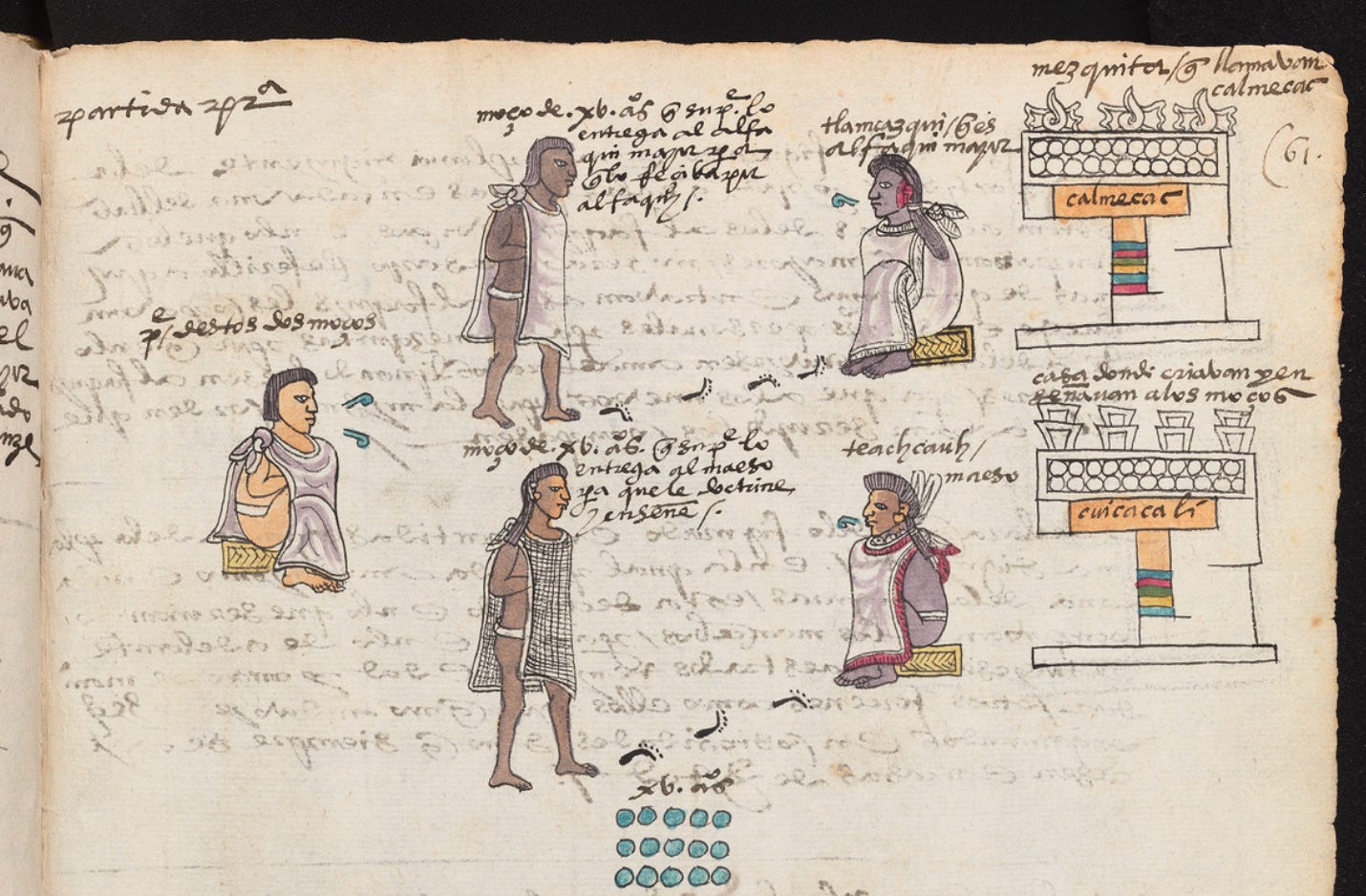
The calmecac was the temple school, run by priests (top right, black body paint). Priests lived in a calmecac. These were generally attended by children of nobility (and some promising commoners), where they would learn to read, as well as military training, religious training, and governance.
Ritual training might vary, since the Aztec were polytheistic and each Aztec deity had its own specific temple, public ceremonies, rituals and retinue of priests (sometimes priestesses). At the calmecac, they practised what Berdan and Smith (2021:44) term ‘auto-sacrifice’: letting one’s own blood as a form of worship (below, see the blood smeared ear).
Girls could attend temple schools, but in a separate facility.
The cuicacalli ‘house of song’ was open to all Aztec children, aged 12-15. Youths learnt religious rituals and ceremonies, by singing and dancing.
After 15, commoner male youths also attended the telpochcalli (the house of male youths), which instructed them to become disciplined laborers and warriors.
Unfortunately, we do not have bioarchaeological data on everyday intimate personal violence, but across the Ethnographic Atlas, Ember and Embar find that warring societies tended to have more homicides, likely because they socialised male adolescents for aggression.
Early Marriage
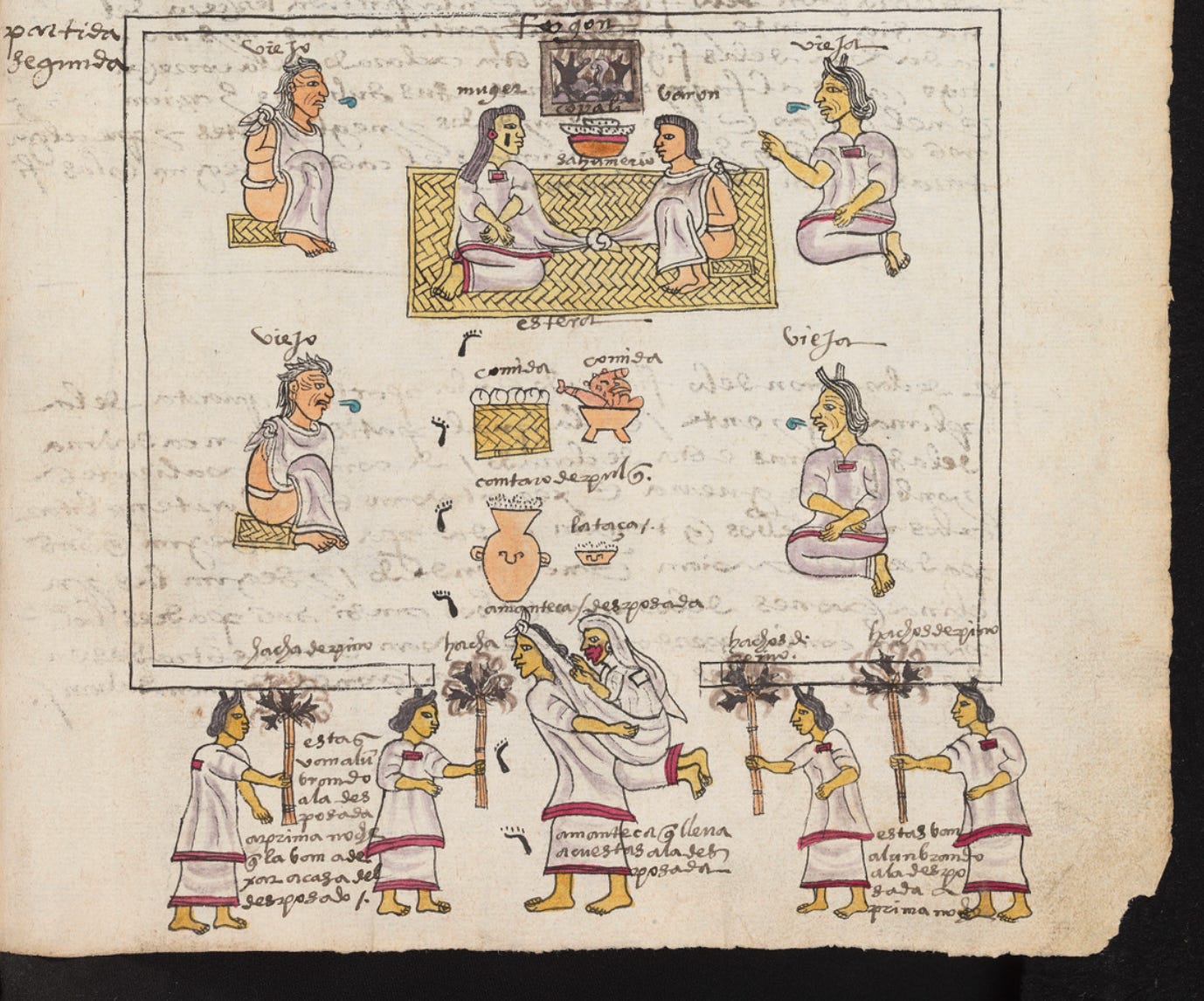
A girl was usually married at 15, as arranged by a match-maker - as shown in Folio 61r.
By 1500, Tenochtitlan had a population of 200,000-250,000. Aztec agriculture and weaving were extremely labor intensive, since they had no beasts of burden, iron or steel tools or practical uses of wheels.
Ethnographer Oscar Lewis (1951) estimated that a woman might spend five hours a day hand-grinding sufficient maize for her family’s tortilla needs. She would then shape and cook the tortillas on the clay griddle.
Besides grinding maize, cooking meals and caring for children, women also spun thread, wove cloth, and went to the marketplace to sell any surplus.
Waking early, most women spent their days performing back-breaking drudgery, with little respite, recognition or reward. This labour was grim.
Slavery
Captive slaves, likely women, were sometimes used for household cotton production: ginning, beating, spinning, and perhaps weaving.
Punishment
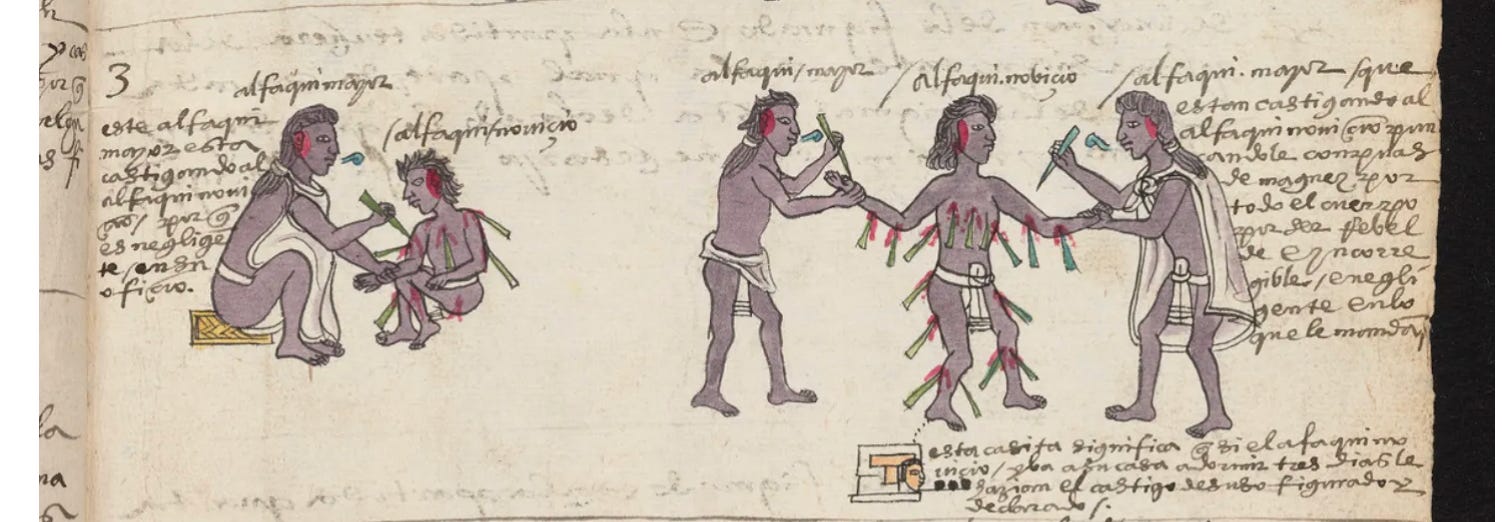
Folio 62r shows the priestly calmecac training. Disobedience was punished by piercing the boy’s body with maguey spikes, drawing blood from the ears, chest, thighs or calves. This instilled fear.
Punishment for illicit sexual activity
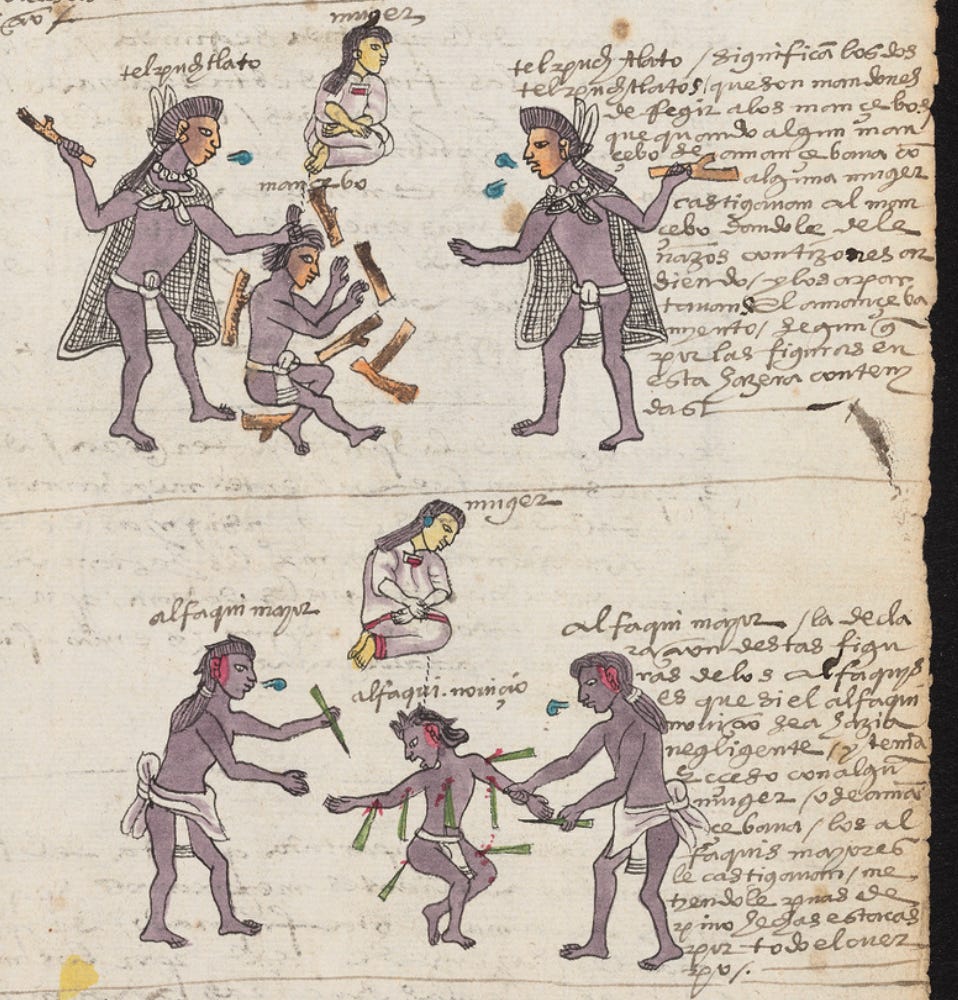
Folio 63r depicts two instructors punishing a youth at a telpochcalli (house of male youths) who had been cohabiting with a woman by beating him with burning firebrands. Male and female adolescents met as part of their cuicacalli training in ritual singing and dancing, though they were supposed to be chaperoned.
The second panel represents the calmecac equivalent of young men’s sexual impropriety. Pine needles are stuck all over his body. The girl is also pictured, with a red trimmed skirt - implying she is from the Aztec nobility. Priests took a strict vow of chastity, and deviance was chastised.
Curiously, her punishment is not shown here.
Conquest & Prestige
Military aggression was vital to territorial expansion and the extraction of tributes, as previously illustrated. War was also a sacred duty, supplying the captured warriors that supplied sacrificial hearts and blood.
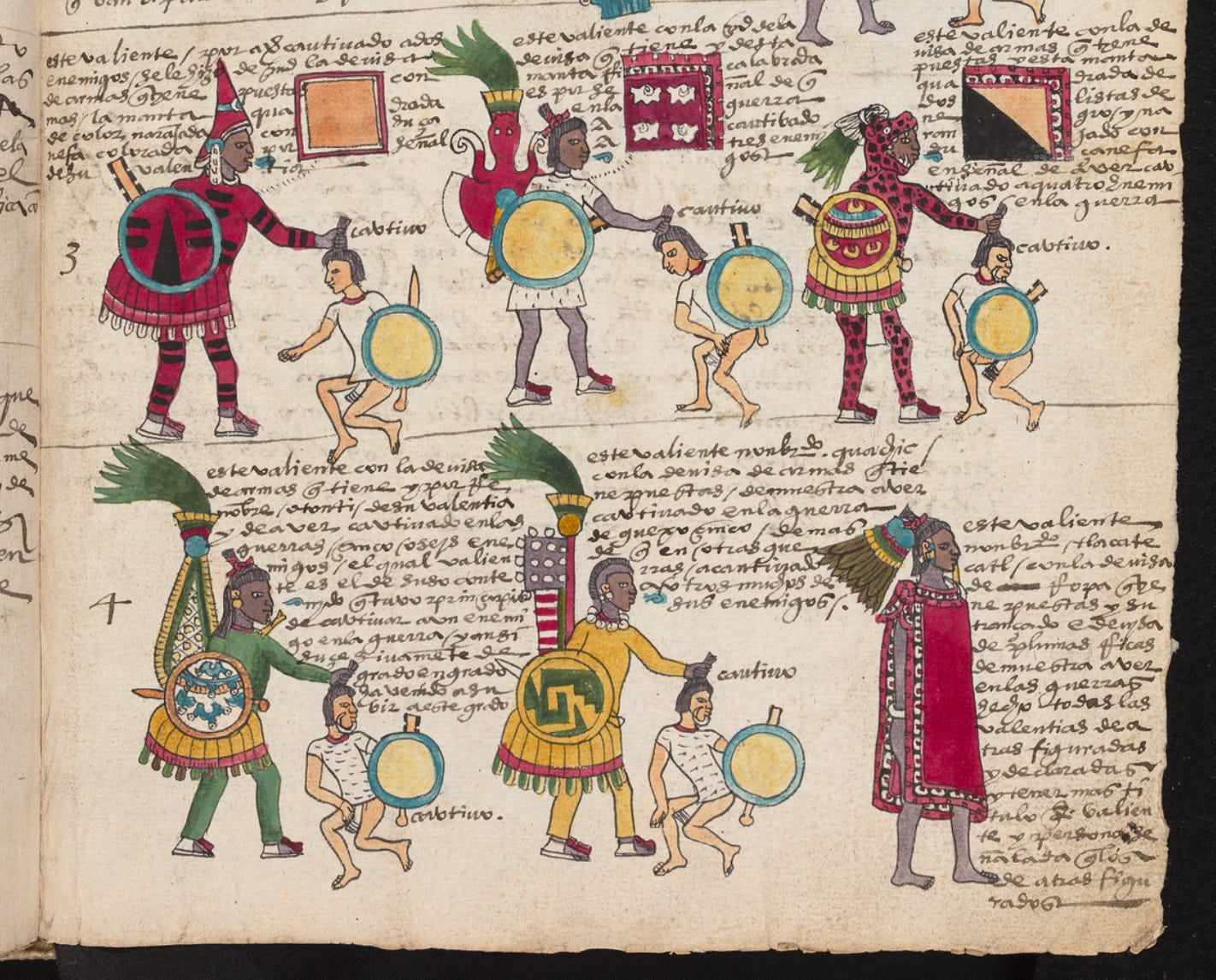
“A primary avenue for social advancement was through military achievement, and successful warriors were publicly rewarded and honoured”, explain Berdan and Smith (2021:212). We see this in the Codex Mendoza, 64r.
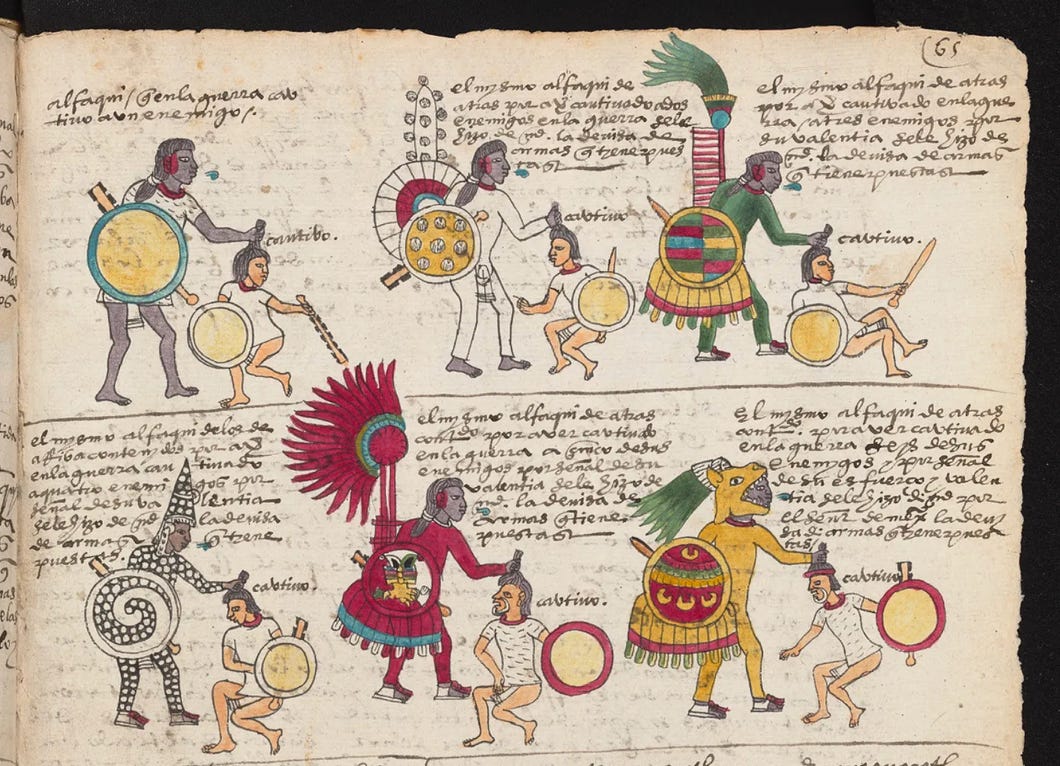
After training at telpochcalli (house of male youths), commoner boys went on to become warriors. As warriors take more captives, they gain higher military ranks and wear a more prestigious costume. Folio 64r shows that with each additional captive, they gain prestige. The final segment reads,
“This warrior, called tlacatecatl, with the style of clothing he is wearing and his device of rich feathers, shows that in war he has performed all the brave deeds of the above [warriors] and has a higher rank as a warrior and famous person than the above”.
Sahagún translates “Tlacatecatl” as “Commanding General”, though Durán says it really means “Man-Cutter” or “Man-Slasher.” This was the most elevated rank of all telpochcalli commoner warriors. The pathway to institutional authority ran through military might.
Priest-Warriors
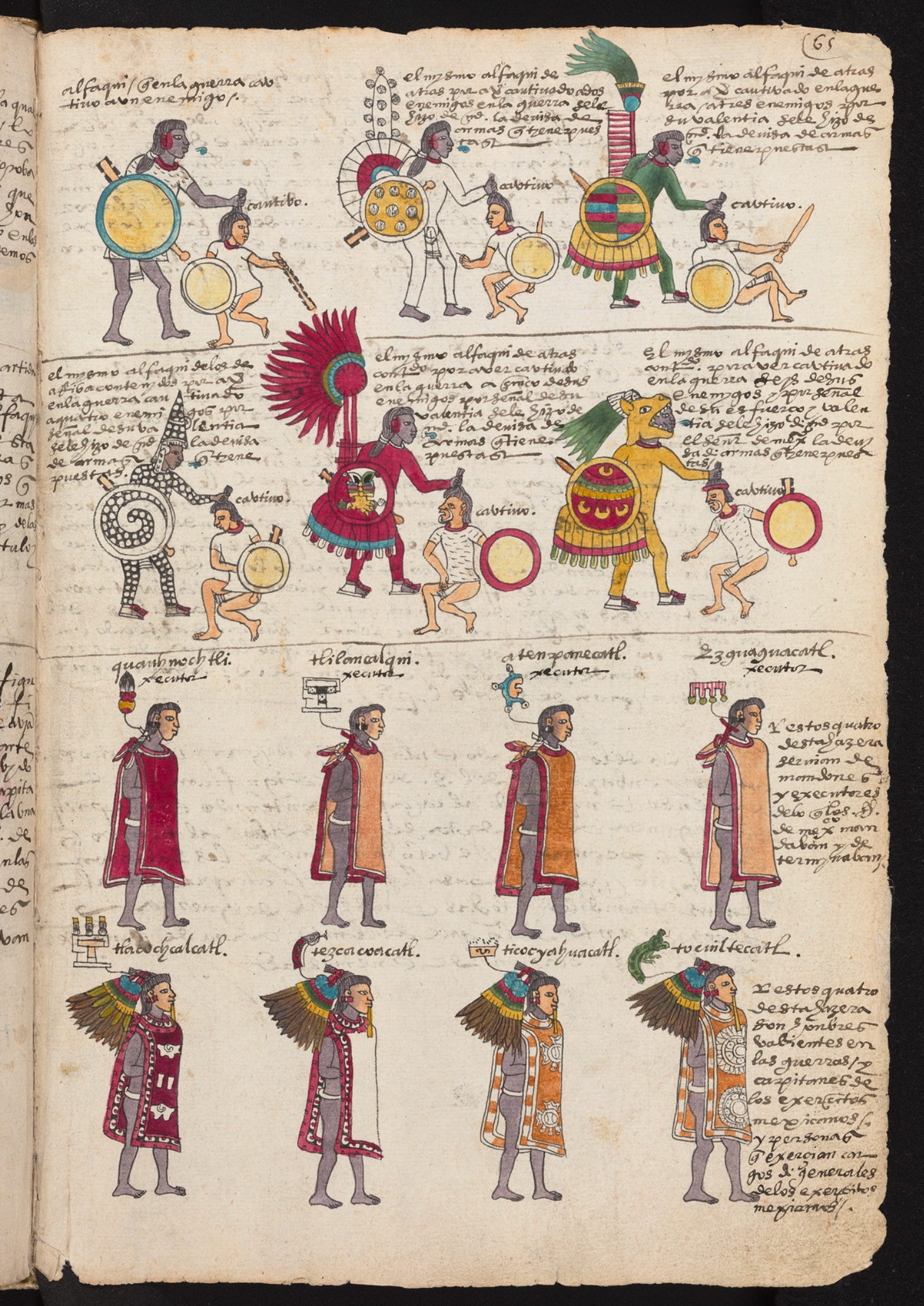
Noble men graduated from the calmecac to become military and governing offices. Folio 65r below shows the military career of the priest warrior. Note his obsidian-studded club and smeared blood on his ear, vanquishing foes.
Once the priest-warrior has taken three captives, his costume is upgraded (green, top right). After he has taken three enemies, he gains the right to wear the coyote attire, with animal-head helmet. (Berdan and Anawalt add, it is unclear which of the below represent nobles and commoners).
An alternative (safer) priestly track was to stay in the temple. These intellectuals wrote books, undertook astronomical observations, presided at ceremonies and worked as teachers.
Priestesses and Female Healers
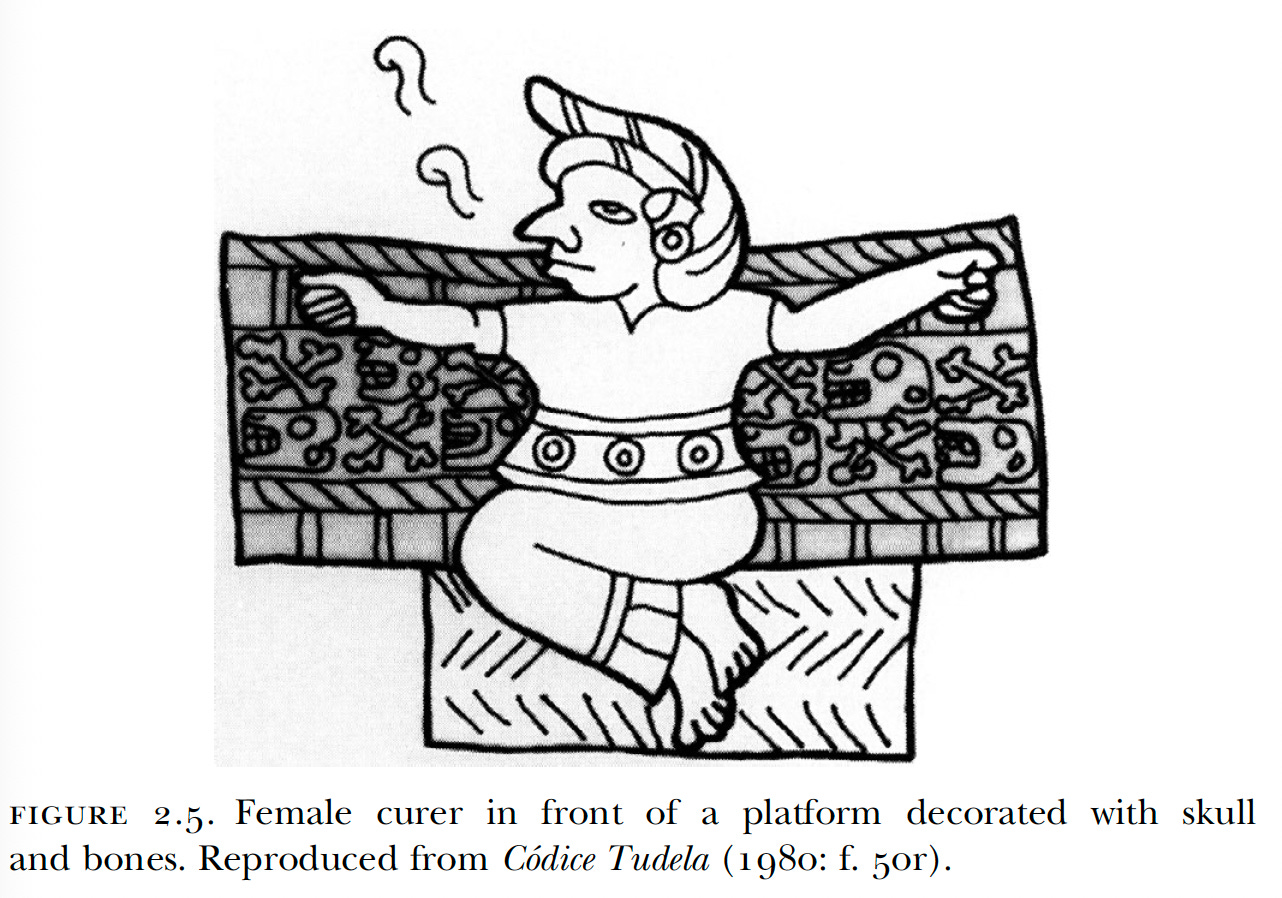
While there were some priestesses, they usually only served a short period, primarily producing elaborate cloth in the image of deities, thereafter leaving to raise families. Berdan and Smith (2021) add that beyond the state there were also non-state female ritual specialists.
Punishments for Rebels
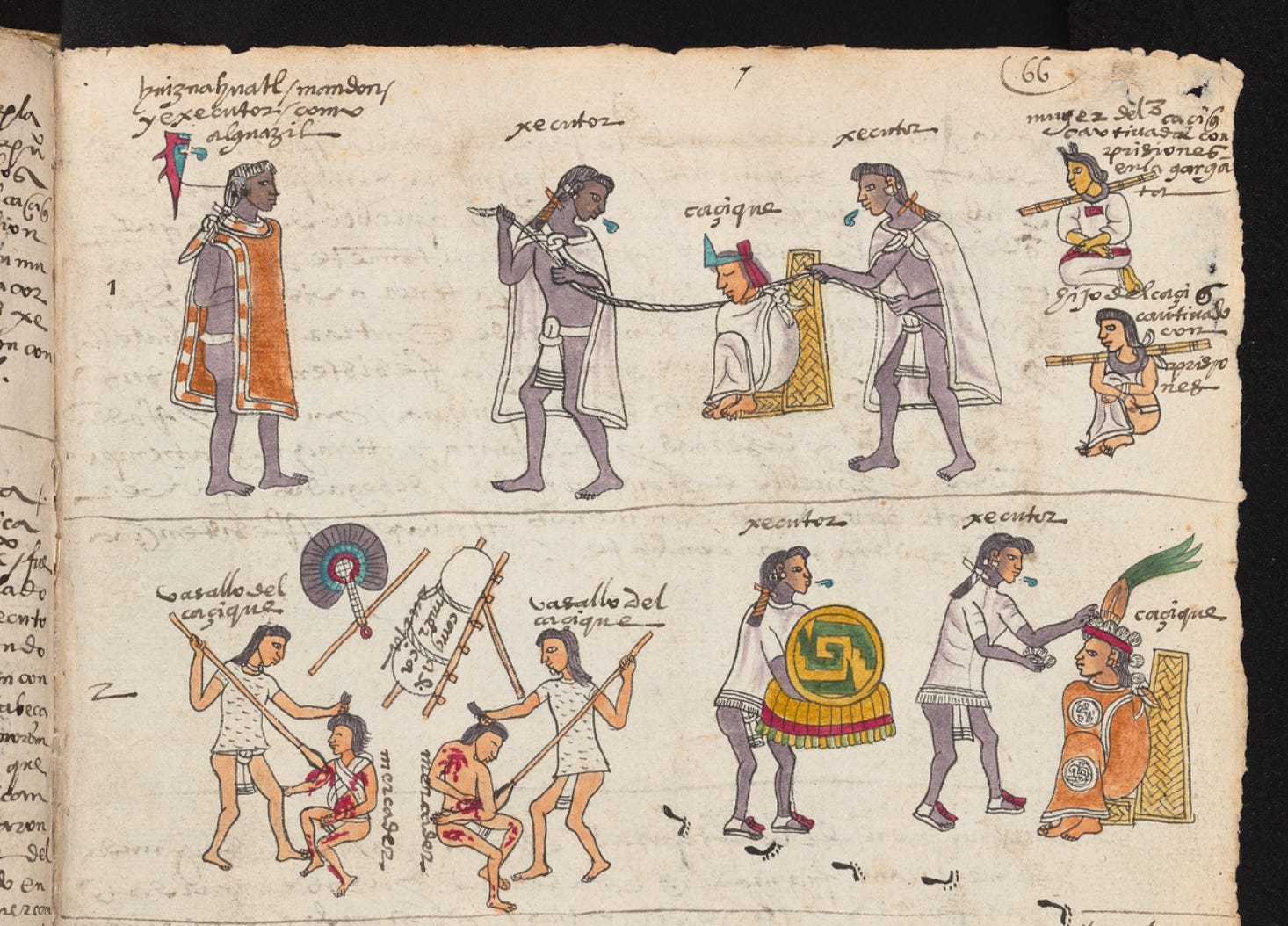
Provincial rulers who rebelled against the Aztecs were punished. Folios 66r and 67 show them (seated on reed mats) being tied, strangled with a rope, stripped and maimed. Note the wooden slave collars in the top right.
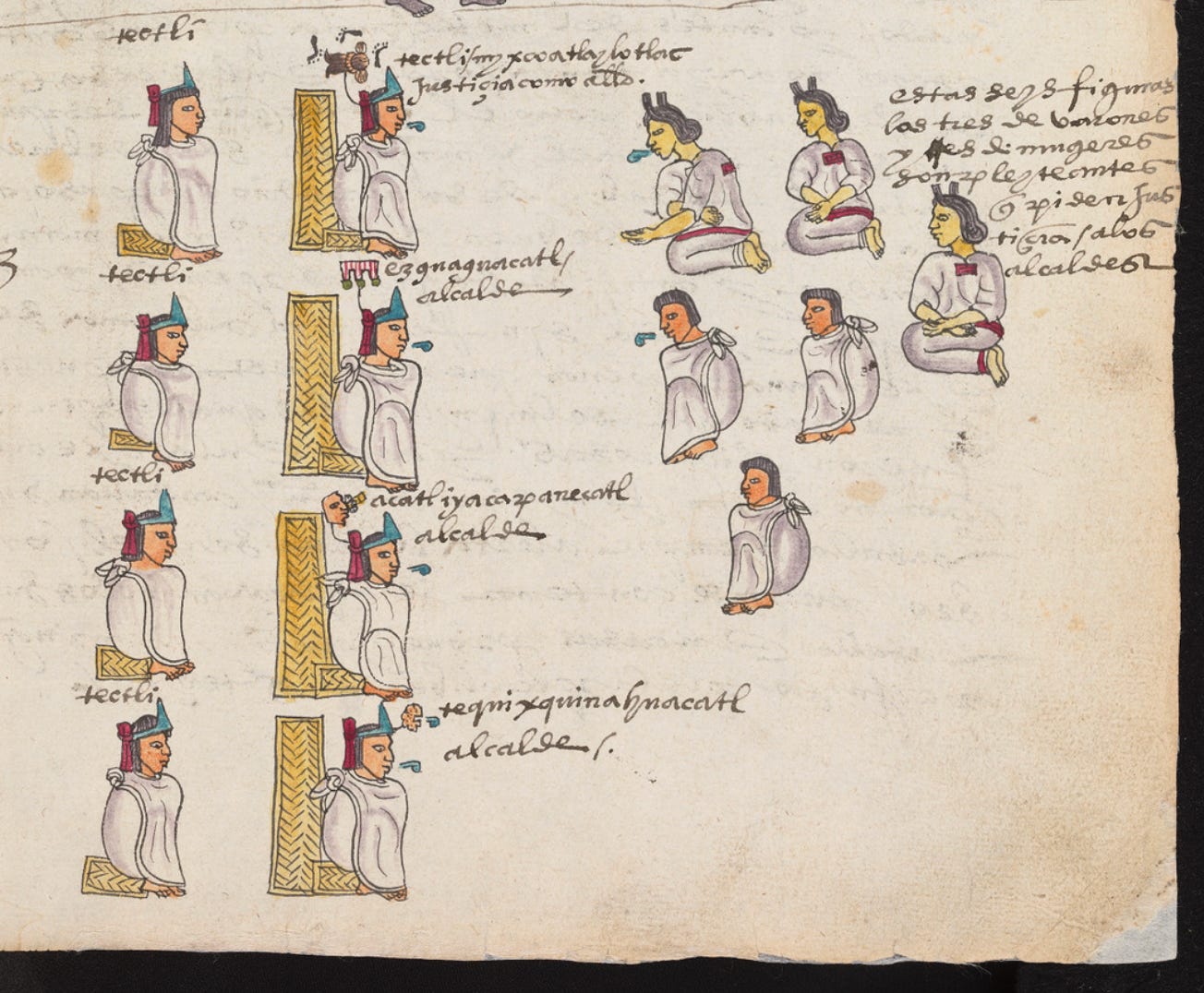
Both men and women could argue in court
Folio 68r show judges on the left, litigants on the right. Men are shown with cloaks wrapped around their knees, women kneel with their hands crossed. Each appears to be arguing their own case, though the Aztec judicial system did include attorneys. There were separate courts for nobles and commoners.
Illicit behaviour was punished
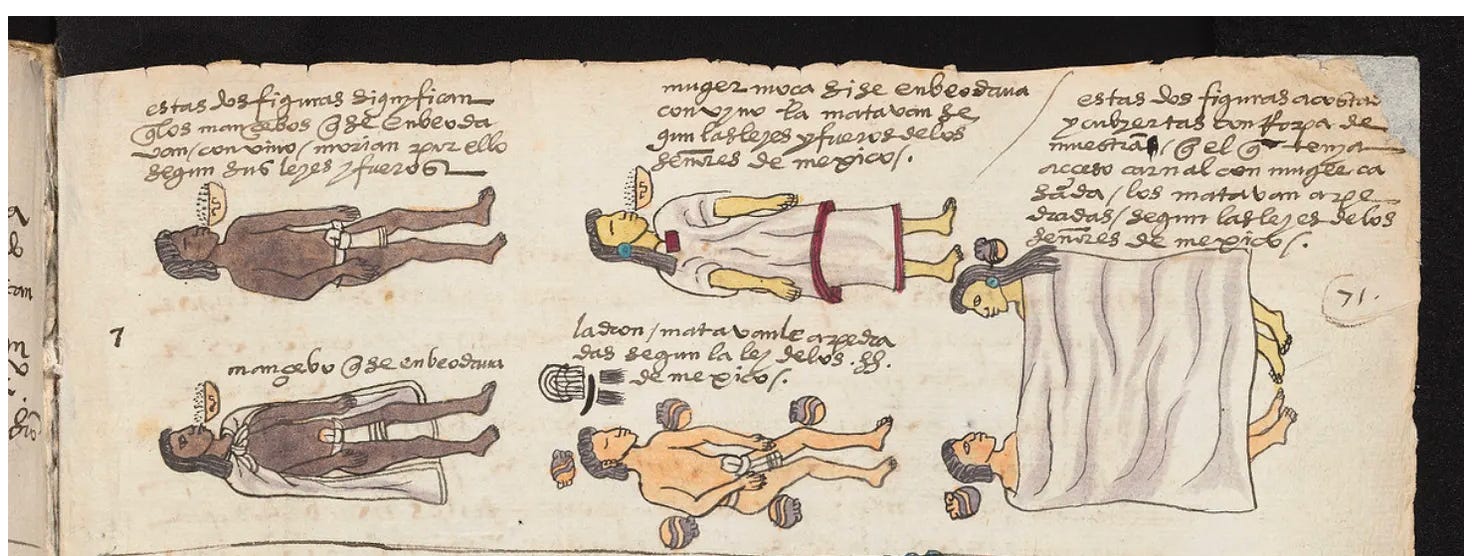
The final folio of Codex Mendoza begins with six individuals who have or will be executed. The first three lie beside pulque bowls - victims of drink. Among the Aztecs, drinking was permissible at certain religious festivals, but was otherwise supposed to be restrained. The fourth person is surrounded by five large stones - thieves were punished by stoning.
The final execution scene is for the adulterers under a blanket, who will be killed by stoning. Since marital bonds were crucial to political alliances, adultery among nobility was severely punished.
Can we use AI to Recode the Past?
In sum, by reading primary sources, one learns how the Aztec war machine glorified martial valor, so as to amp up predation.
Reflecting on the gulf between the Codex Mendoza and feminist narratives, I realise that anyone curious to understand the past currently has 3 options. Each are imperfect.
Read the primary sources - hugely insightful, but laborious;
Rely on secondary narratives - can be useful, sometimes add ideology.
Refer to quantified datasets, such as the Ethnographic Atlas which code original ethnographies, missionary accounts, travel narratives, and colonial reports for over a thousand societies. These are useful, but coding decisions are often unclear and questionable. For example, Murdock often coded bridewealth as ‘insignificant’ in the Americas, likely because he disregarded some payments (e.g. horses). Meanwhile, Sanday built up a composite index of ‘female power’, which set a very low threshold that often coincided with aggressive slave-raiding.
Might I suggest an alternative?
Can experts help train AI agents to read primary sources, with a greater focus on the pathways to power and prestige (i.e. priestly schools, military academies, and martial prowess), as well as a more in-depth understanding of what was revered and status?
Going beyond whether women farmed or inherited, a sharper focus on status, religion, governing institutions and violence, would provide a much sharper analysis of community members gained power and prestige.
Every coding decision could be made public, along with uncertainties. This would make history much more transparent and accessible to all! School children could pose their own questions, interacting with the original sources and AI.
Frankly, there is a gargantuan amount of data that could be digitised and analysed. Forgive my over-excitement, but one could incorporate translations of cuneiform tablets and medieval records, to create a gargantuan library of human history, enabling direct comparisons across time and place.
Sam, Dario, give me a call! :-)
Related Essays using Primary Sources/ Art/ Architecture:
Post-script for newcomers: walking up to Monte Albán pyramid in Oaxaca, a guy tried to grab my phone. Foolishly and perhaps over-estimating my own strength, I refused to give it up and persistently wrestled. After a protracted struggle, he ultimately overpowered me, threw me to the ground, punched me in the face, smacking my head down to the stone. I double-kicked him in the stomach, propelling him off by at least two metres. He then grabbed a serrated knife from his shorts and lunged straight down at me. Looking into his eyes, I realised he did not weight my welfare, and merely wanted to grab what he could. Swiftly, I somersaulted to the side, lobbed my phone and sprinted away - with my white t-shirt covered in blood. (Mine not his). Most people ignored me as I called for help, but a wonderful young woman came to my aid. The next day I flew to Chicago, where I was looked after by the extremely kind James Robinson and Maria Angelica Bautista.

Almost got stabbed on a Mexican pyramid? Out of fashion I think :) Good on you.
So sorry to read about your harrowing experience at Monte Alban - saddened by the resonance with the topics of your post. Thank you for your careful parsing of the "nearest" sources that you could find to try to illuminate "how it might have been." Appreciate the show and tell cadence of the presentation.