

“Women in most African societies prior to 1900 were at least equal and in some cases had more status than African men” asserts Professor Christine Saidi. “Low population density and a constant shortage of laborers made motherhood … a most powerful social institution”, raising women’s status, as manifest in the leadership roles of queen mothers and grandmothers. Head into any Western bookshop and you’ll find similarly grand celebrations of African women’s power, importance and agency.
But I must make 4 crucial rejoinders:
Sub-Saharan Africans valued ‘wealth in people’ - as repeatedly emphasised by anthropologists, political scientists and economic historians. Women were especially valued: comprising the majority of slaves within Africa, and commanding higher slave prices. Their labour, sexuality and fertility were valued commodities.
Patriarchs captured, controlled and expropriated these rents. Men could pawn nieces, accumulate polygnous co-wives, gift girls to chiefs or exchange captives for warhorses. Women’s work generated such high returns that men could convert it into military prowess and fraternal solidarity. These were ‘patriarchal rents’.
Even where royal legitimacy passed through mothers, this did not necessarily strengthen ordinary women’s status or freedoms.
Data is extremely scarce. For historians with few written records, historians rely on genetics, archeology, historical linguistics, oral traditions, and foreigners’ observations. These are useful, but do not justify sweeping projections about how women were perceived or treated in earlier centuries.
Loyal readers will recall my previous essays on the Sahelian-Sudanic belt, detailing how militarised fraternities secured power through outbound raiding, as well as how matrilineal societies could still be extremely patriarchal and coercive (like the Ashanti) or violent and aggressive (like the Bemba). Now let us turn to a society celebrated by Saidi for its prominent Queen Mothers.
The Great Lakes and Buganda
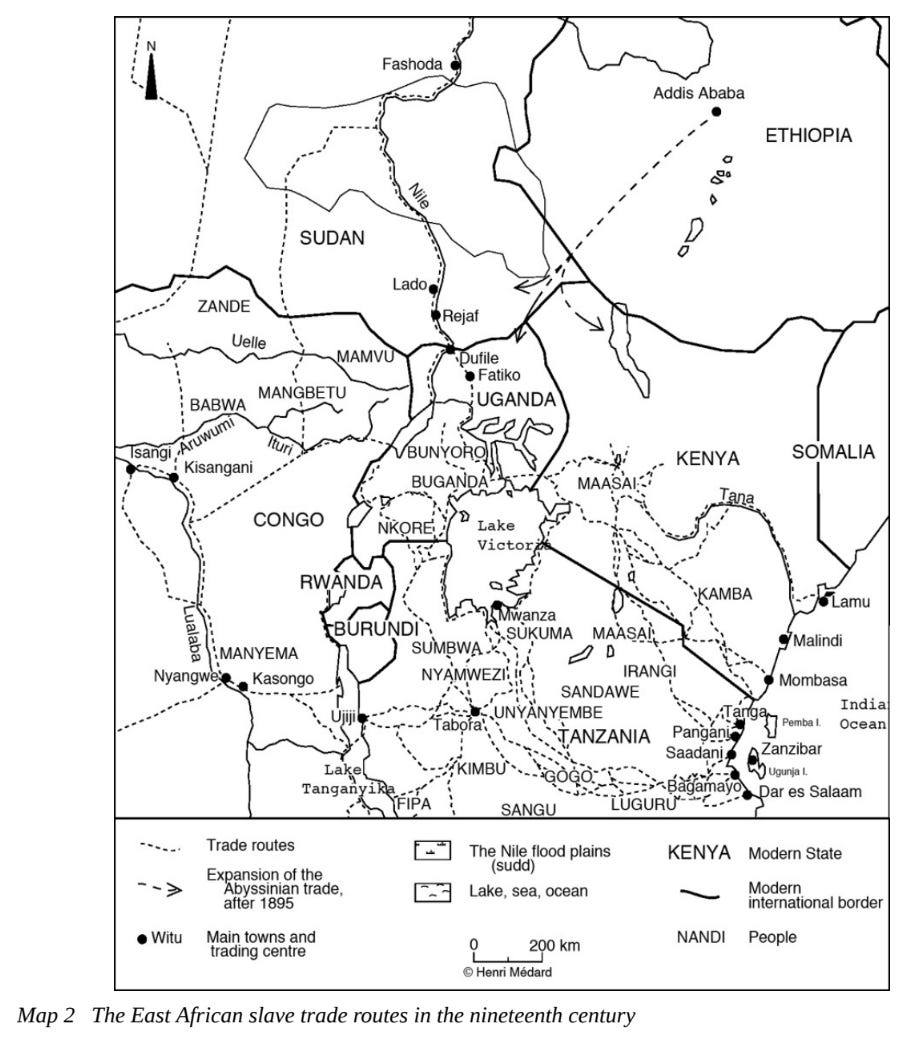
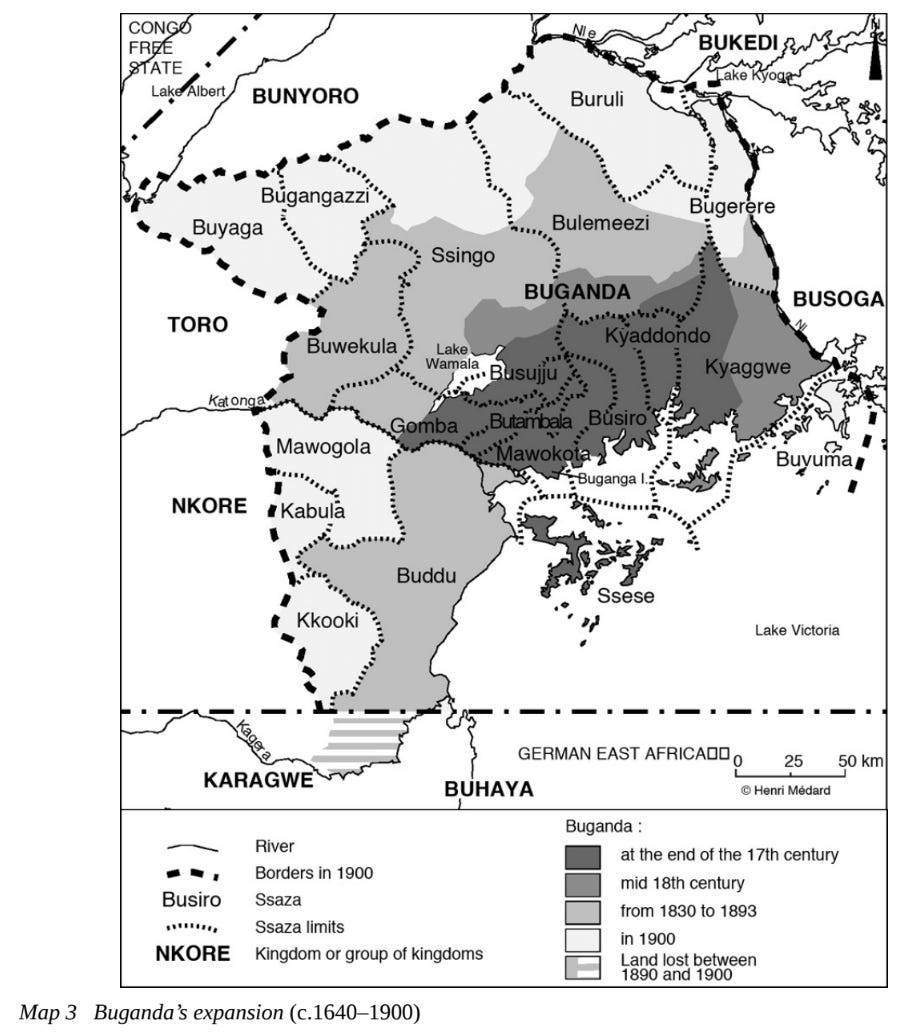
Lake Victoria’s fertile shores supported productive agriculture, especially intensive banana gardens, enabling high population density and political centralisation. In the 19th century Great Lakes, the East African coast sought ever more slaves and ivory. This raised the commercial returns to trade, warfare and slavery. From the 1850s, enslaved people became one of became Buganda’s primary commercial export. Under Kabaka Mwanga, this violence increasingly turned inward, exporting his own people, while older chiefs who had controlled land and followers were increasingly displaced by young male militias with guns.
Wealth in Women
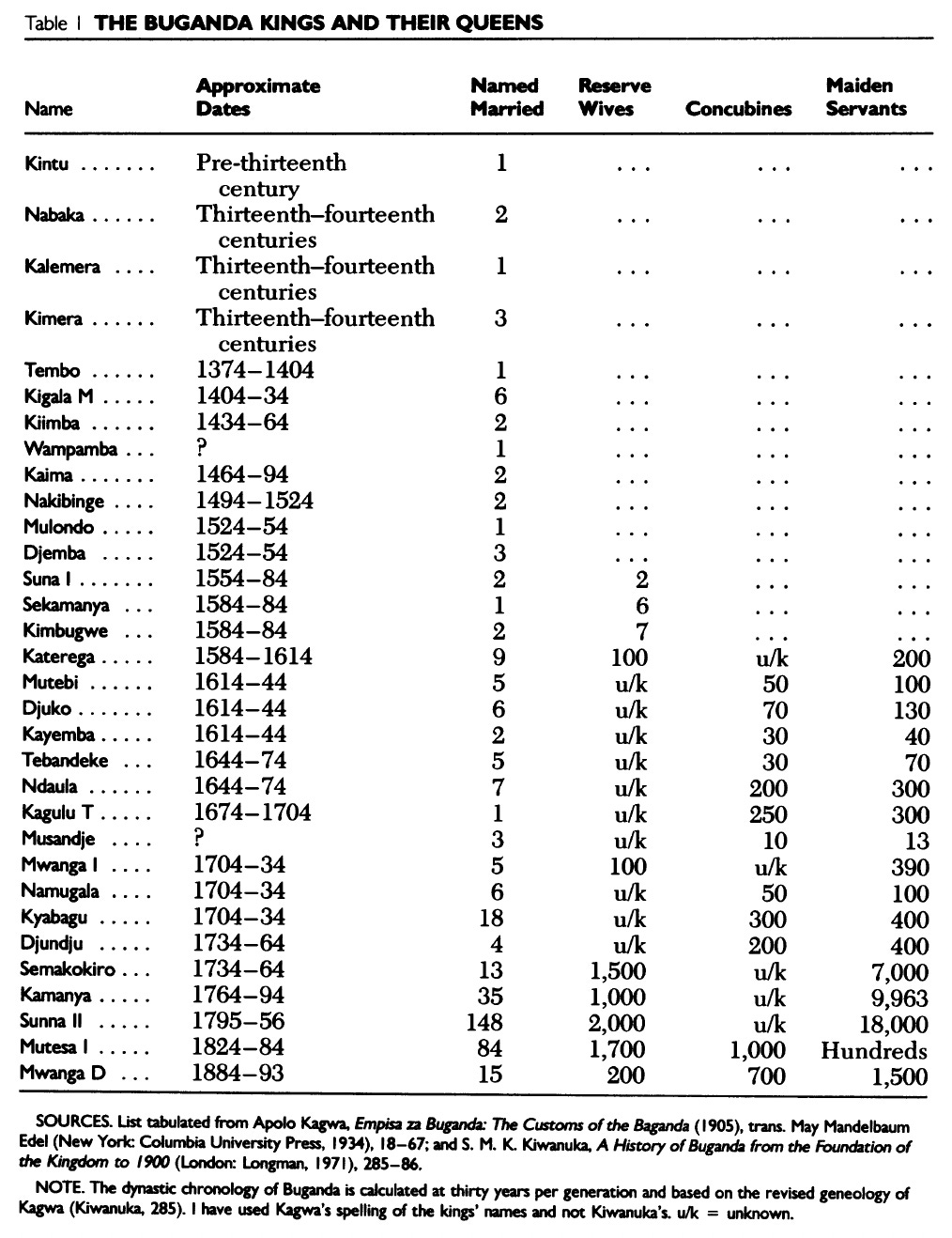
Ganda kings consolidated their control over clans by incorporating additional wives and concubines. They were often acquired through diplomacy. Reverend John Roscoe, a missionary who lived in East Africa for 25 years, details that “it was customary for a person to present the king with one or two girls when asking for a favour… or make “the king a present of women in order to obtain forgiveness”. Girls thus functioned as a form of currency, consolidating economic and political ties between militarised fraternities.
Elite polygyny drastically expanded with warfare, as female captives were distributed among generals. As Musisi remarks, “the more wives a man had, the higher his status on the political and social ladder”.
Echoing the Mughal zenana, the king’s wives were kept behind a high reed fence enclosure (ebisakatte).
Devalued Labourers
Luganda language indicates a wife’s primary value: okufumba means “to cook,” okufumbira means “to cook for someone”, okufumbirwa is “to wed.”
In Buganda, women were economically vital, working on banana gardens,and ritually important in succession. Patriarchs expropriated that labour to consolidate their own dominance. Commoner women could not legally inherit gardens nor build patronage networks, explains Schoenbrun.
“Wives’ and children’s labor made property valuable under the control of a husband’s patrilineage”.
Men sought hard-working, submissive labourers, and looked for brides who demonstrated “obedience to her guardians and parents”. Roscoe adds, “Women were not free to move about without the consent of their husbands or masters”.
Male elders could gain power by acquiring more land, followers and wives, but non-royal women had no comparable routes to accumulation and authority.
Enslaved Girls
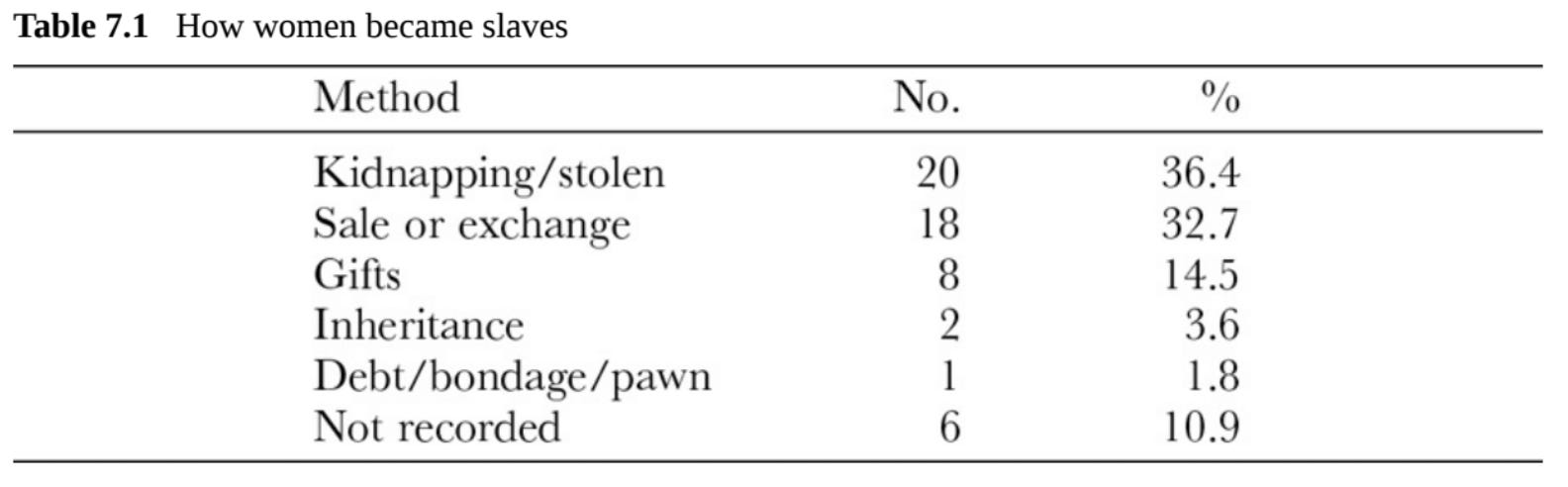
The Saint Joseph’s Foreign Missionary Society recorded the life histories of 55 ex-slave women who were preparing for Catholic Baptism. They provide useful insights into women’s lives in slavery in the late 19th century
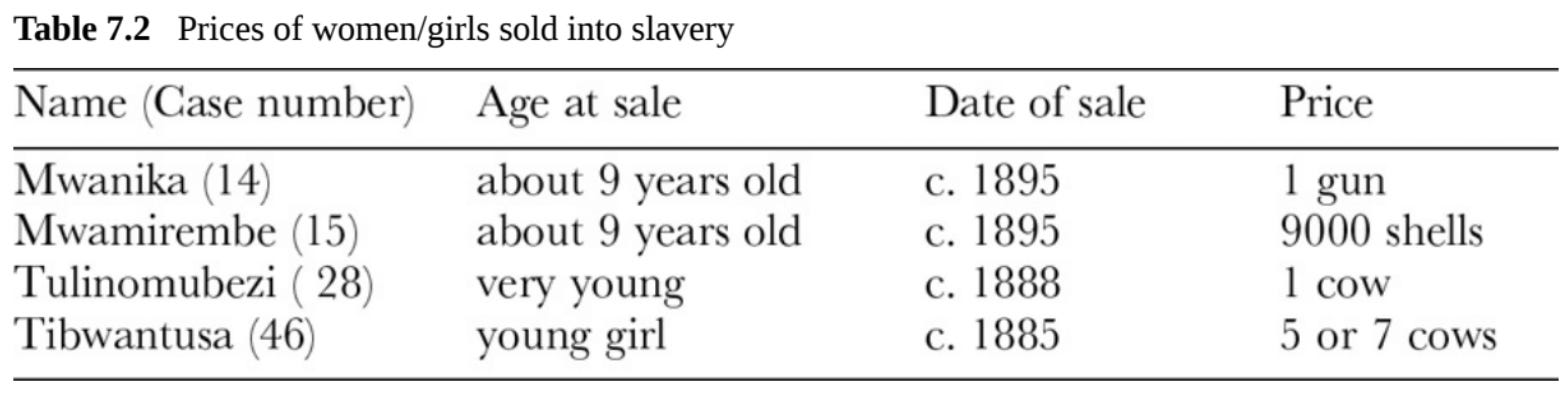
Over a third describe being directly kidnapped, amid endemic warlording. After initial capture, women might be sold, like Mwanika at age 9 was traded for a gun. Alternatively, they might be gifted to chiefs or redistributed to followers. Tuck concludes,
“Ultimately women were the social glue that bound men to one another in patron-client relationships, and also which bound families, clans and lineages to one another…
Senior men were able to use gifts or loans of slave women to extend their patronage. As a result, power in Ganda society also came to be more masculinised, with even senior women operating within the same fashion”
“By the 1880s in Buganda, women’s status was commodified to such an extent that they were virtually a currency traded on par with guns and cows. In fact, it was the exchange of women that tied clans to one another and patrons to clients”.
Autonomy Denied
Saidi, and many others, celebrate Sub-Saharan Africa’s Queen Mothers. In Buganda, the Nnamasole could mobilise her clan and allies in support of her son’s rise to power, protect the Kabaka from hostile chiefs, hold her own court, and extract taxes from her own estates.
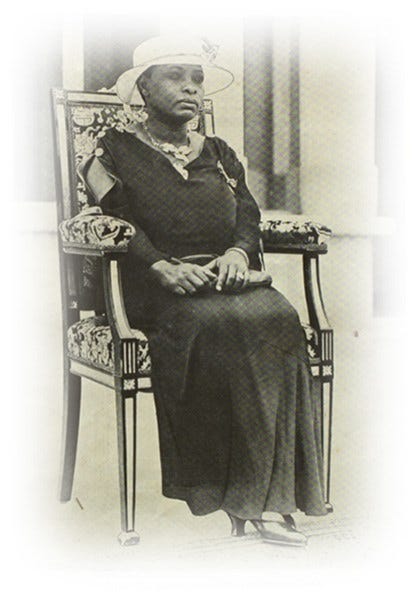
But even Queen Mothers faced patriarchal constraints. In 1941, Buganda’s Queen Mother (a widow) became pregnant and sought to marry Kigozi, a much younger commoner. The Buganda parliament, the Lukiiko, voted against, threatening forced dispossession of her official grants, palace and mailo land. Namaganda married anyway, and lost all entitlements.
Chiefs maintained that they were rightful guardians of custom, including the right to control the Queen Mother’s sexuality. Even if some women were ritually significant, men often sought to monopolise control.
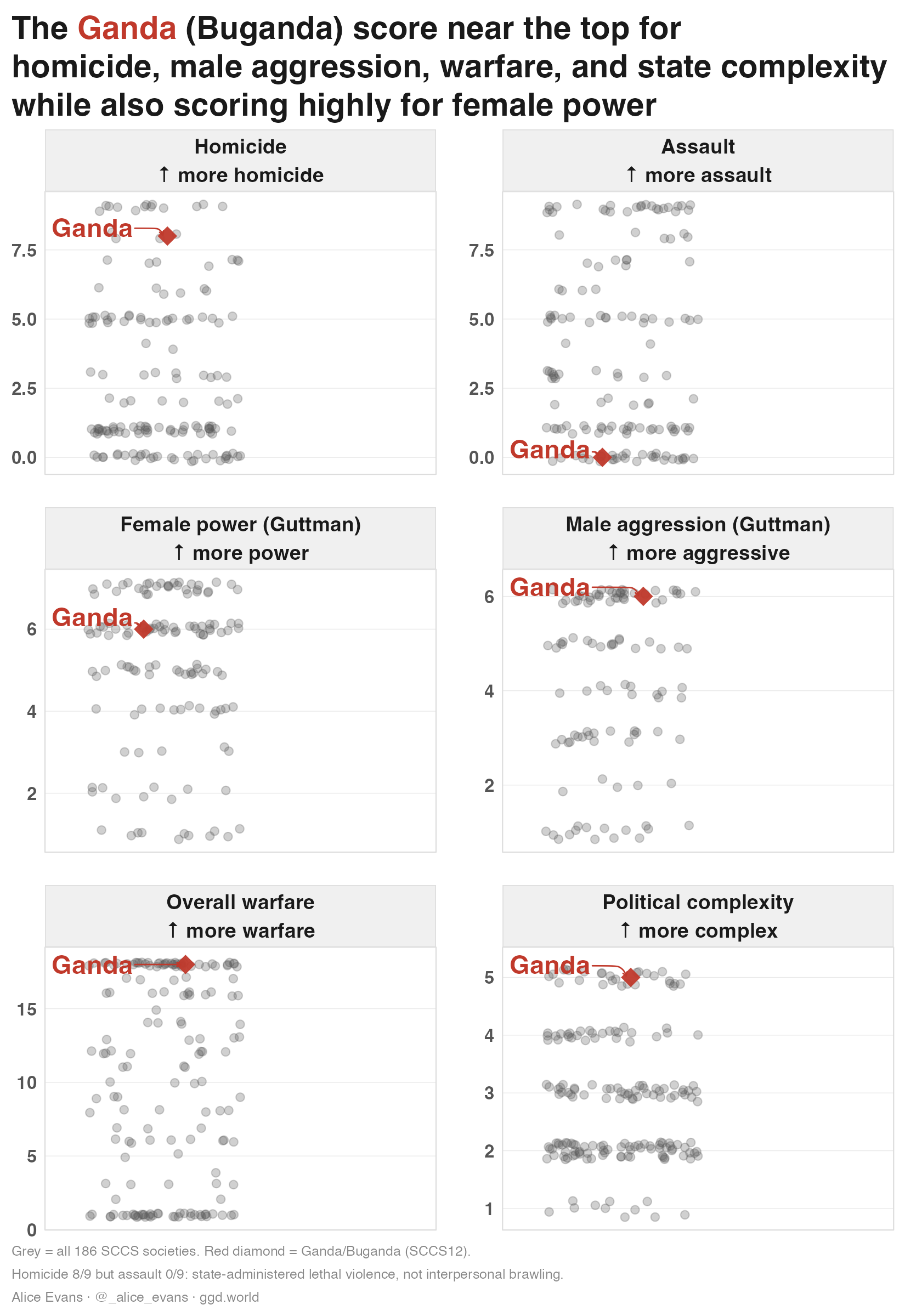
The Ganda nevertheless score highly for “female power”!
In the Standard Cross Cultural Sample, a society with female political influence (like a Queen Mother) is deemed to have high female power. On this metric, the Ganda get the second highest score. Hmm…
The Ganda also get exceptionally high scores for homicides, male aggression, overall warfare and political complexity. They also practised institutional rape.
Patriarchal Rents
Stories of ‘female power’ in overlooked places can be tremendously exciting, but diving more deeply, we so often discover a grimmer reality.
Sub-Saharan Africans valued ‘wealth in people’, specifically wealth in women - who constituted the majority of slaves within Africa, and commanded higher slave prices.
In Buganda, women were absolutely vital - for cooking, banana cultivation, as well as to consolidate patronage networks. Women’s labour increased the agricultural surplus, expanded lineages, and above all strengthened fraternal solidarity. Women were then commodified as assets: their farm-work, cooking, sexuality and fertility generated returns that men could convert into surplus, followers, alliances and status. These were patriarchal rents.
Precisely because these rents were so high, girls were frequently grabbed, gifted, inherited, exchanged, or redistributed to cement alliances between men. This only amplified their vulnerability to predation.
These rents were overwhelmingly captured by men. Male elders, chiefs and warriors used women to consolidate alliances, followers, solidarity and status. Women had few comparable routes to accumulate land, followers, office, or lineage authority. Instead, their submission was praised so that patriarchs could extract a larger, morally legitimate surplus.
So whereas Engels located women’s subordination in the rise of private property, whereby men extracted the surplus, I’ve demonstrated that patriarchal extraction also occurred amid land-abundant societies via control over women’s bodies.
Saidi’s error therefore is confusing value with status, so as to construct a historic utopia. Whereas in fact, African societies that have achieved greater peace and security in the 21st century have actually achieved progress towards gender equality.
Notes
‘Patriarchal rents’ has already been used in other contexts by Braunstein (2008), Braunstein (2014), Small (2023), Purkayastha (1999). This term is excellent and I encourage it to be explored more widely!
Related Essays
Further Reading
Medard and Doyle, Slavery in the Great Lakes Region of East Africa
Reid, Human Booty in Buganda: Some observations on the seizure of people in war c.1700 –1890
Roscoe, The Baganda : an account of their native customs and beliefs
Saidi, A History of African Women from Origins to 800 CE: Bold Grandmas, Powerful Queens, Audacious Entrepreneurs
Saidi, A History of African Women from 800 CE to 1900: Bold Grandmas, Powerful Queens, Audacious Entrepreneurs
Schoenbrun, A Green Place, A Good Place. Agrarian Change, Gender, and Social Identity in the Great Lakes Region to the 15th Century
Schoenbrun, “Gendered Histories between the Great Lakes: Varieties and Limits”
Stephens, A History of African Motherhood: The Case of Uganda, 700-1900
Tuck, Women’s Experiences of Enslavement & Slavery in Late 19th and Early 20th Century Uganda
The work you are doing to re-position female status in light of violence seems paradoxically both sincerely brilliant and somehow so obvious to the point of banality. As in “how on earth could people not have thought of this already”.
I would be really interested to hear how you account for that. By that I mean on a surface level, the attack you experienced in Mexico is a direct and proximate cause for exploring this in more detail.
But the fact that you were engaged in locally specific but globally comparative research is similarly connected to you being in a position for such attacks to occur. Meaning if you stay at Oxford or UCL or Stanford (or whichever institution is lucky enough to host you), and don’t go to places where the risk of violence is frankly much higher, you are unlikely to have had such an experience.
Also staying inside the academy has some feedback loops that make naysaying pre-colonial African culture’s more positive reputation for the treatment of women seems like it would have in-group censure risks and run up against selective blindness (‘woke’ or otherwise).
In parallel, a purely text, statistical or literature based assessment would not have delivered the data needed to re-frame one of the benchmark references for gender in sociology research.
So amazing work and thank you for sharing it but let us know how you are thinking about your own thinking processes.
Great piece. Some points I'd love to know your thoughts on.
1) The empirical base for your arguments is late pre-colonial. Roscoe, Tuck, & Reid were all written around the time Ugandan tribes and kingdoms were selling other Africans to the Zanzibari Arabs through the Indian Ocean trade. One could argue that this is exactly when Buganda and the other pre-colonial Ugandan societies were being remade by Indian Ocean commerce, guns, and militias. So the argument is drawing evidence right when pre-colonial Ugandan societies were at their the most patriarchal, commercialized, and violent. It would be great if 17th and 18th century Bugandan history existed before the bananas-for-guns and Zanzibari Arab demand pull. However, I doubt that evidence exists though since the Buganda and the neighboring kingdoms were oral societies before colonialism.
2) I wonder if there still are counterfactuals. I agree with you that Ashanti exaggerate the impact of Queen mothers despite matriliny. But I wonder if the Igbo dual sex political systems (Amadiume) and Mende Sande in Sierra Leone, where women societies had institutional power, would actually be real examples of female power.... Granted, they could be just ,ore romanticization of non-white cultures again. But, I wonder if the examples I gave you were actual examples of female power vs. white people romanticizing non-white societies vs. ritual overlay masquerading as female power vs. African writers defending their history even when it it's exaggerated at best and dishonest at worse. I am pretty sure the Igbo umuada councils could economically sanction men, and the 1929 Aba Woman's war is hard to explain without women having some institutional capacity.