


History isn’t just a study of the past, it’s an ideological battle: eulogising saviours, demonising villains, omitting awkward things we’d rather forget, and thereby iteratively affirming our values.
Most books on warcraft, scientific innovations and revolutions glorify male protagonists. They are celebrated as brilliant strategists who shaped our world. Women - though comprising half the population - were often omitted. Erasure persists even when women actually achieve great prominence. At South Korea’s national museum, women are totally obscured. The pre-Confucian Silla Queens are absolutely omitted.
Since the 1970s, Western feminist historians, anthropologists, and archaeologists have fought back - eager to demonstrate women’s ‘agency’. Disavowing presumptions of ‘passivity’, concubines are portrayed as strategically manoeuvring to advance their self-interest. A wealth of literature tries to show that women mattered.
But actually, I wish to be a little heretical… First, ‘agency’ seems uninformative. Second, rather than a ‘rose-tinted patriarchy’ that celebrates incredible women who overcame obstacles, I think we need to be more systematic and ask why were ordinary women excluded? Third, by cherry-picking powerful women from the past, we blinker ourselves to enormous 20th century progress.
‘Agency’ seems uninformative
First, I suggest that we ditch the focus on ‘agency’. As emphasised by Marx, we all make choices, but under circumstances beyond our control. Someone who grows up in Montgomery (rather than Moscow) may long for biscuit (over borscht). As the Bemba in Southern Africa say, “a child praises their mother’s cooking” (umwana uwashala atasha nyina ukunaya). Everyone exercises ‘agency’, but that tells you very little about the global cultural heterogeneity.

Some feminists have argued that women’s embrace of patriarchal ideals should also be considered ‘agentic’. But if the term covers all behaviour, then its value seems unclear. Whether one endorses or rejects an ethical code, that’s still deemed ‘agentic’.
As a social scientist, I want to understand the big levers of history, the drivers of cultural evolution. Everyone is making choices, but I want to know why! My recent essay on Indonesia’s rising Salafism explores the interconnections between Saudi funding, madrasahs, marriage markets, and political parties.
Rose-Tinted Patriarchy
Quests to uncover brilliant women from the historical record can create what I call a ‘rose-tinted patriarchy’. While shattering stereotypes always excites media attention (e.g. ‘women hunters’), more systematic analyses indicate women’s exclusion.
A recent paper in the Journal of Economic History is entitled “Invisible Women: Entrepreneurship, Innovation, and Family Firms in Nineteenth-Century France”. It richly details the many female French inventors. Burrowed in the middle is one tiny detail: “women filed 2.4 percent of all French patents in this era”. For me, that is the important fact that needs explaining. Not their presence, but their near absence!
By harnessing Big Data, we can now be much more systematic and analyse structural trends. Instead of being misled by non-representative studies, we can finally see the big picture. Arash Nekeoi and Fabian Sinn have chronicled 5000 years of patriarchy, by drawing on Wikipedia biographies in 292 languages. They show that - with the exception of Ancient Egypt - elites were overwhelmingly male.
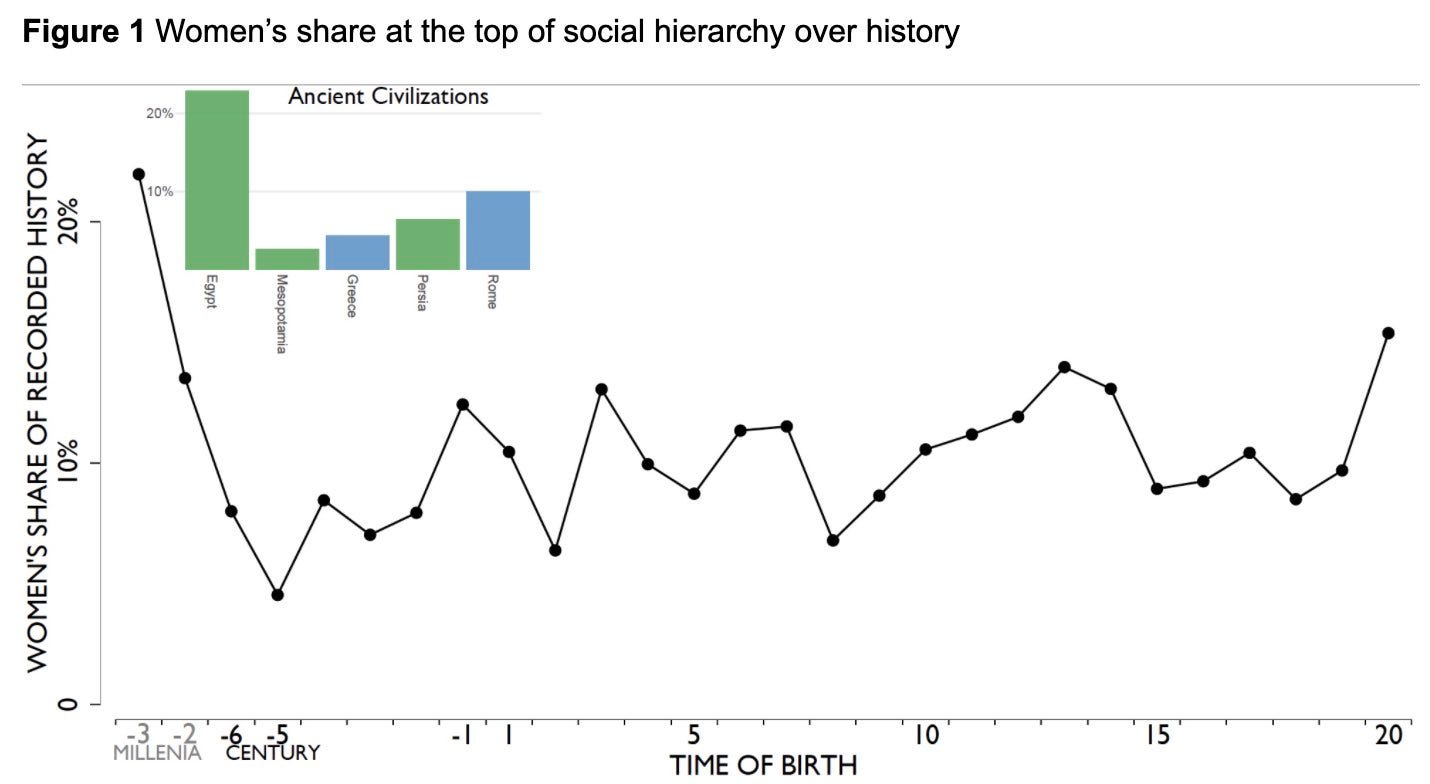
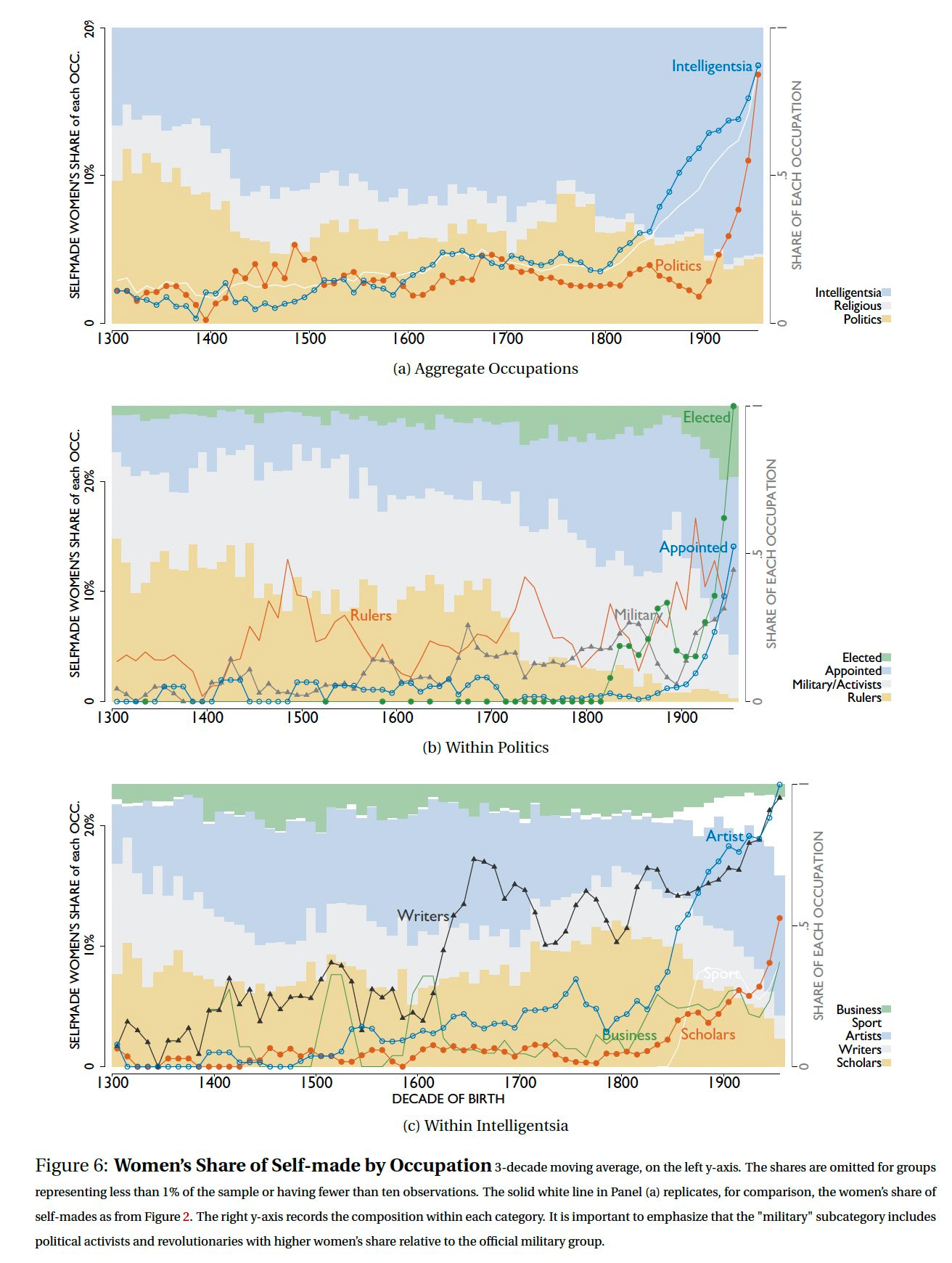
Nekeoi and Sinn further distinguish between prominent women who inherited status through kinship versus ‘self-made’. Before the 20th century, women comprised less than 10% of ‘self-mades’. Ordinary women were oppressed and could not rise up independently.

Sinn and Nekeoi further show variation by field. The first breakthrough occurred in writing: Protestant women increasingly wrote books.
Life in the Roman Army
The British Museum has a new exhibition on “Legion: life in the Roman army”. Brilliant Mary Beard makes an important contribution.
“Roman army camps were not 'men-only' zones…
[However] the unsurprising truth is that women in general were far more often the victims of ancient warfare than active participants. The long, sad history of the rape of the defeated goes back to the Romans and earlier. The scenes of Roman reprisals against the Germans, sculpted on the column in Rome erected to commemorate the military successes of the emperor Marcus Aurelius, include several scenes of women being (to put it euphemistically) ‘carried off’.
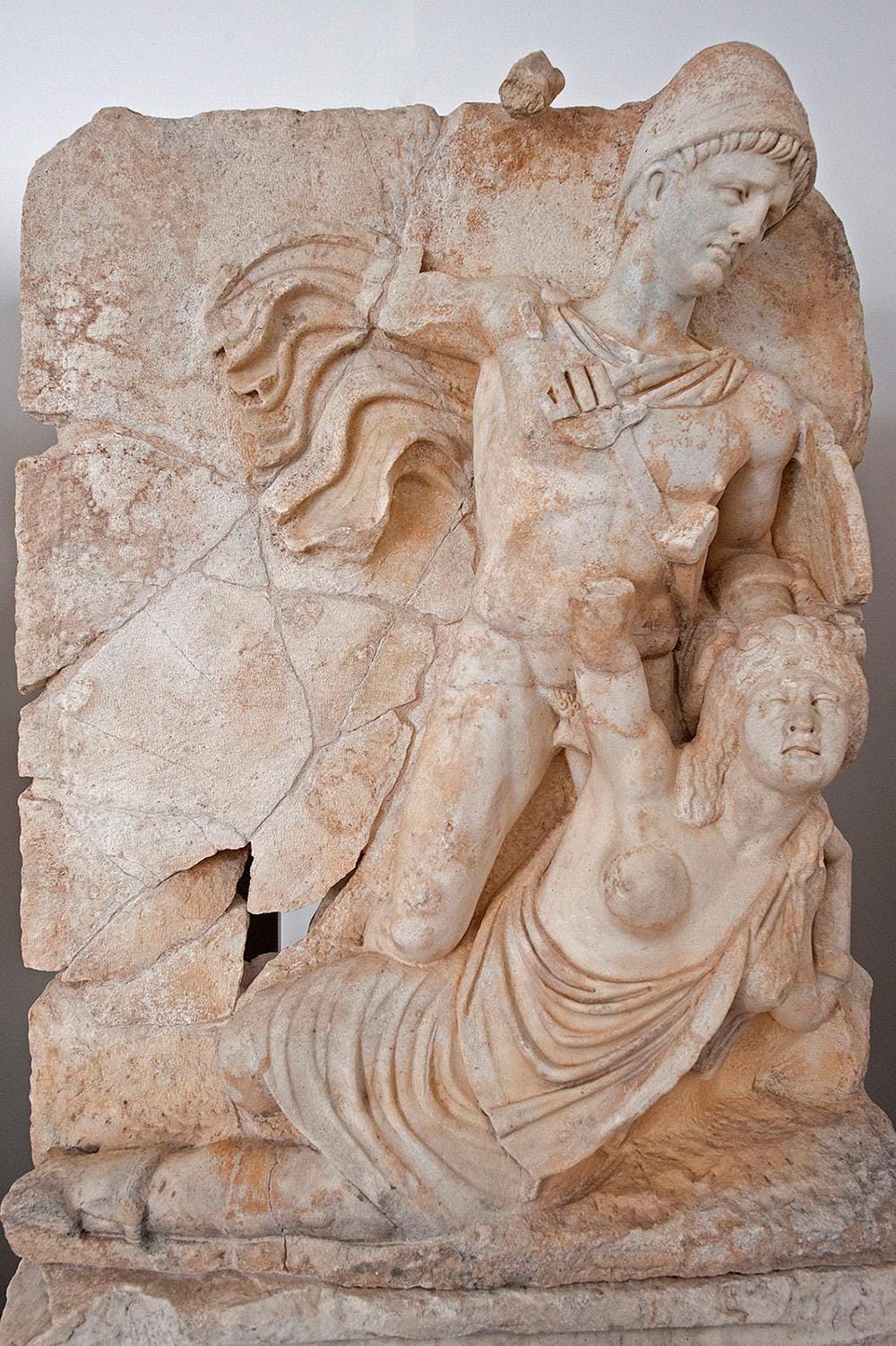
Closer to home, I suspect that not many people know that the first surviving representation of ‘Britannia’ in art (a sculptured marble panel from the mid-first century AD, from the Roman city of Aphrodisias in modern Turkey) shows her not as the stately, powerful warrior as we now see her, but as the semi-naked, sexual victim of the emperor Claudius, who conquered the province in AD 43”

My project therefore is to study the cultural evolution of every single society, in a bid to discover how the entire world became more gender equal, and why some societies are now much more gender equal than others.
To that end, ‘agency’ and historic heroines are uninformative and misleading. By cherry-picking powerful women from the past, we distract ourselves from enormous 20th century progress, such as the systematic decline of mass rape.
I'm a man, and I am in agreement with your project to understand as fully as possible why we have more gender equality now in modern western society, then we ever had before. There are too many people who want to turn the clock back and destroy what we've accomplished here. And there is no guarantee that they won't succeed at some point if we don't stay vigilant and actively resist this reactionary movement.