


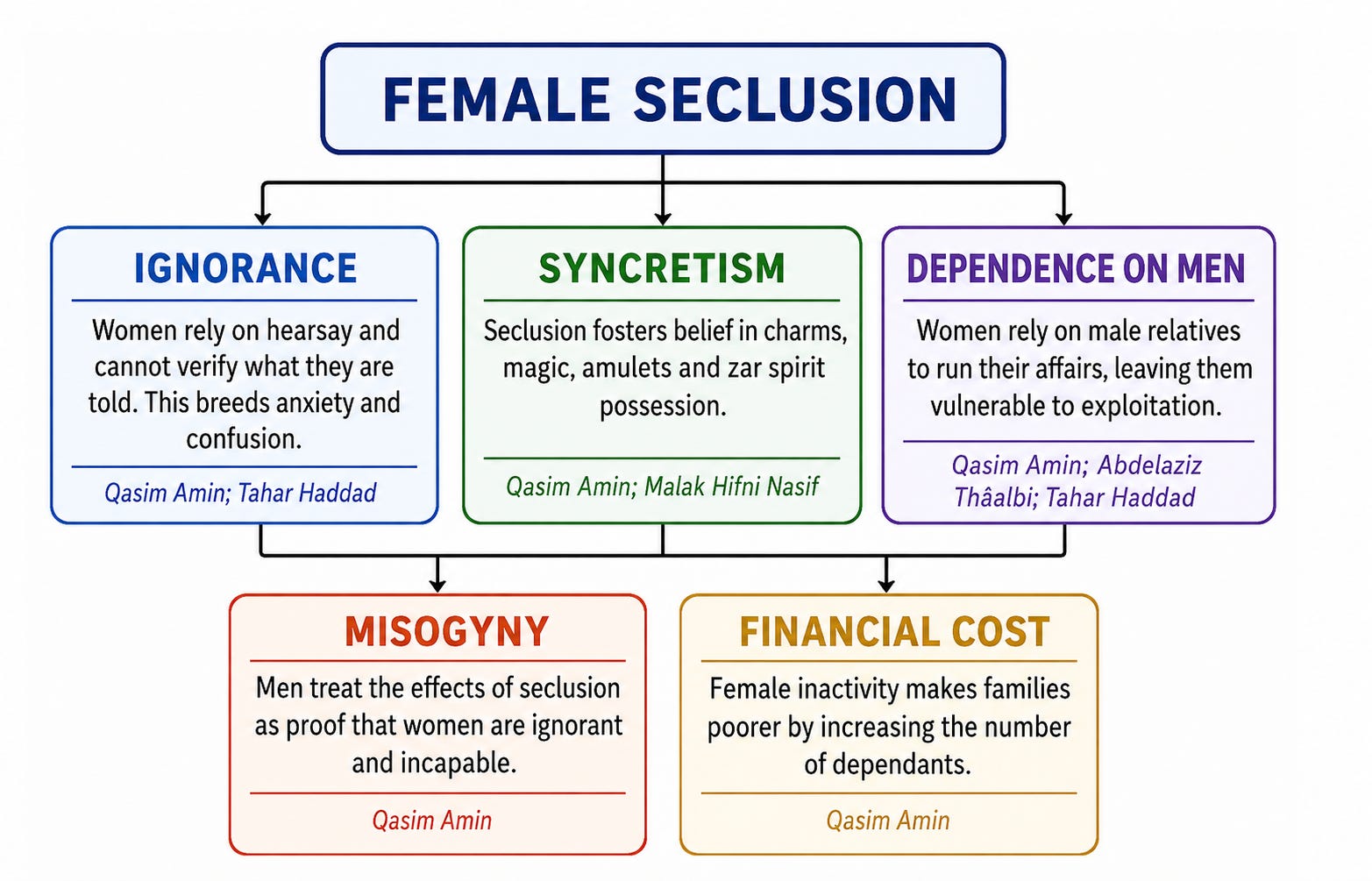
“Despising the woman, a man filled his home with slaves, white or black, or with numerous wives... He imprisoned her in the house and boasted about her permanent restriction.. this has been the status of women in Egypt” - wrote Qasim Amin.
Qasim Amin was a Muslim Egyptian judge, trained in law at Montpellier, who later co-founded Cairo University. His two books - The Liberation of Women (1899) and the New Woman (1900) - argue that Islam upheld women’s equal rights, and he strongly opposed female seclusion as this reinforced misogyny and ignorance.
Malak Hifni Nasif was also a reformer, but opposed unveiling. Her essays, published in 1910, describe city women’s seclusion, ignorance, and syncretism, as well as men’s tyranny and street harassment. Meanwhile, Muhammad Tal'at Harb, who would become a pioneering national industrialist, lambasted the sexes’ “free-mixing”.
Tunisia saw parallel debates. Ibn Abi ‘l-Diyaf, private secretary to Ahmad Bey, wrote a treatise on the position of women in Muslim society, championing patriarchy. Whereas Abdelaziz Thâalbi co-authored a book in 1904 on the liberal spirit of the Quran, while jailed for blasphemy. Later in 1930, Tahar Haddad pressed for women’s freedoms, but leading sheikhs declared him a heretic, his book was outlawed and he died in isolation.
Even the reformists upheld the Quran as arbiter of women’s rights and freedoms, none denied its veracity or applicability. They merely differed over interpretation. Qasim Amin leaned on ‘aql (reason): seclusion thwarts learning and progress. Tal’at Harb’s rebuttal relied on naql and ijma - the Quran, Hadith, and consensus of esteemed theologians. Thâalbi and Haddad argued that scripture never commanded veiling or seclusion. Nasif conceded that scripture does command veiling, yet insisted that customs of total seclusion were harmful.
Over the 20th century, these same questions dominated moral debates across Arab lands. Which ideal would ultimately prevail: economic progress or religious orthodoxy?
European Progress
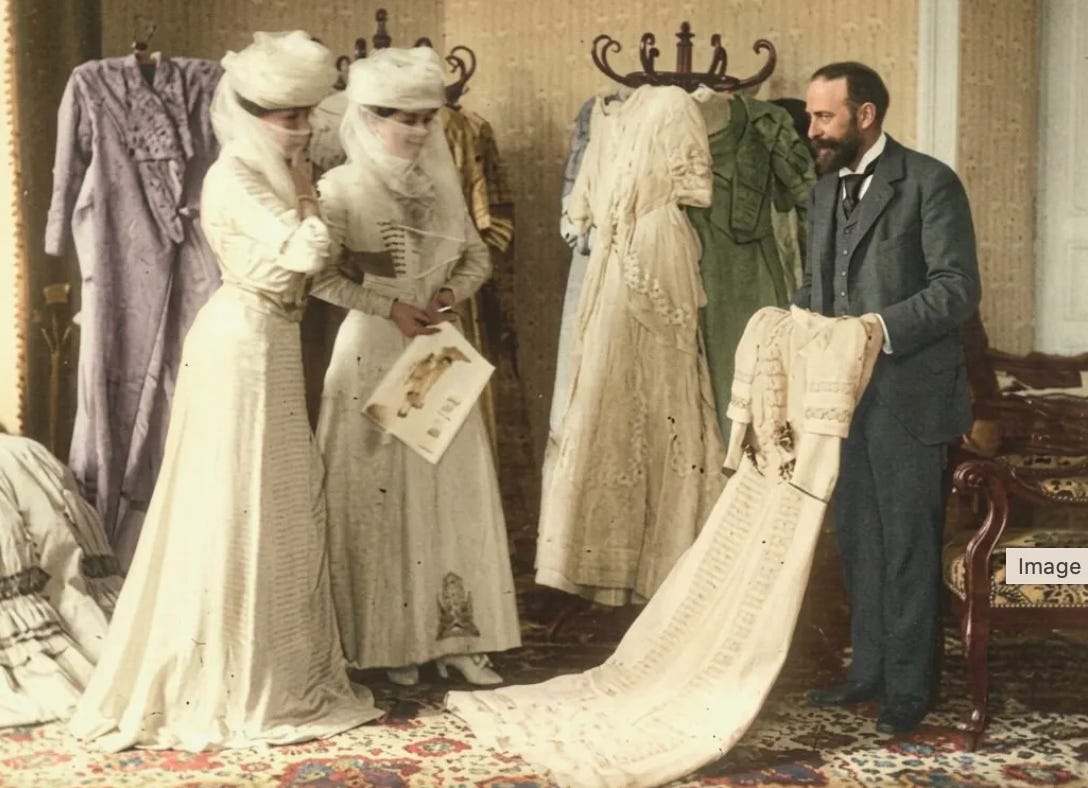
Amin argues that as the West came to shed delusion, suspicion and superstition, it ultimately became more scientific, liberal and gender equal.
While European men previously regarded women as mentally inferior, temptresses and agents of the Devil, they had since lifted this “veil of ignorance” and come to recognize that women’s capacities can be developed through education. Thus women came to participate in social and scientific life as a “refined individual”. Noting that women had already achieved suffrage and become judges in Wyoming, he anticipated wider reform across the United States (Amin 1900, 115-125).
Amin, who studied in France for four years, adds that if an Eastern man travels to Europe or America, he will “discover that the division between the sexes, which he accepts as natural, is almost nonexistent. He will observe women working at men’s jobs” (1900, 147).
Tahar Haddad, writing in 1930, likewise remarked about Europe’s progress towards gender equality - emphasising female education and representatives in public office.
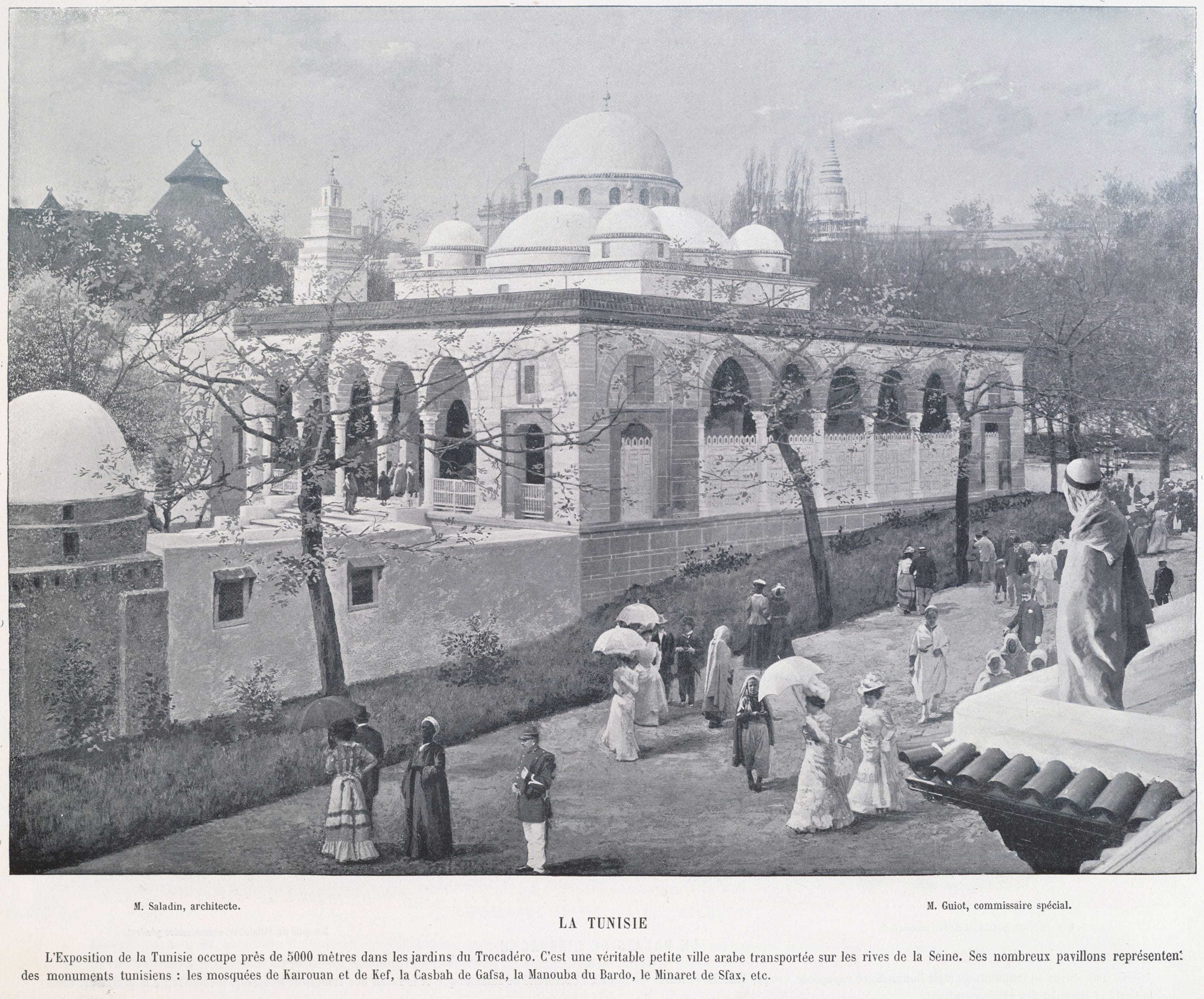
In Egypt too, Change was Afoot
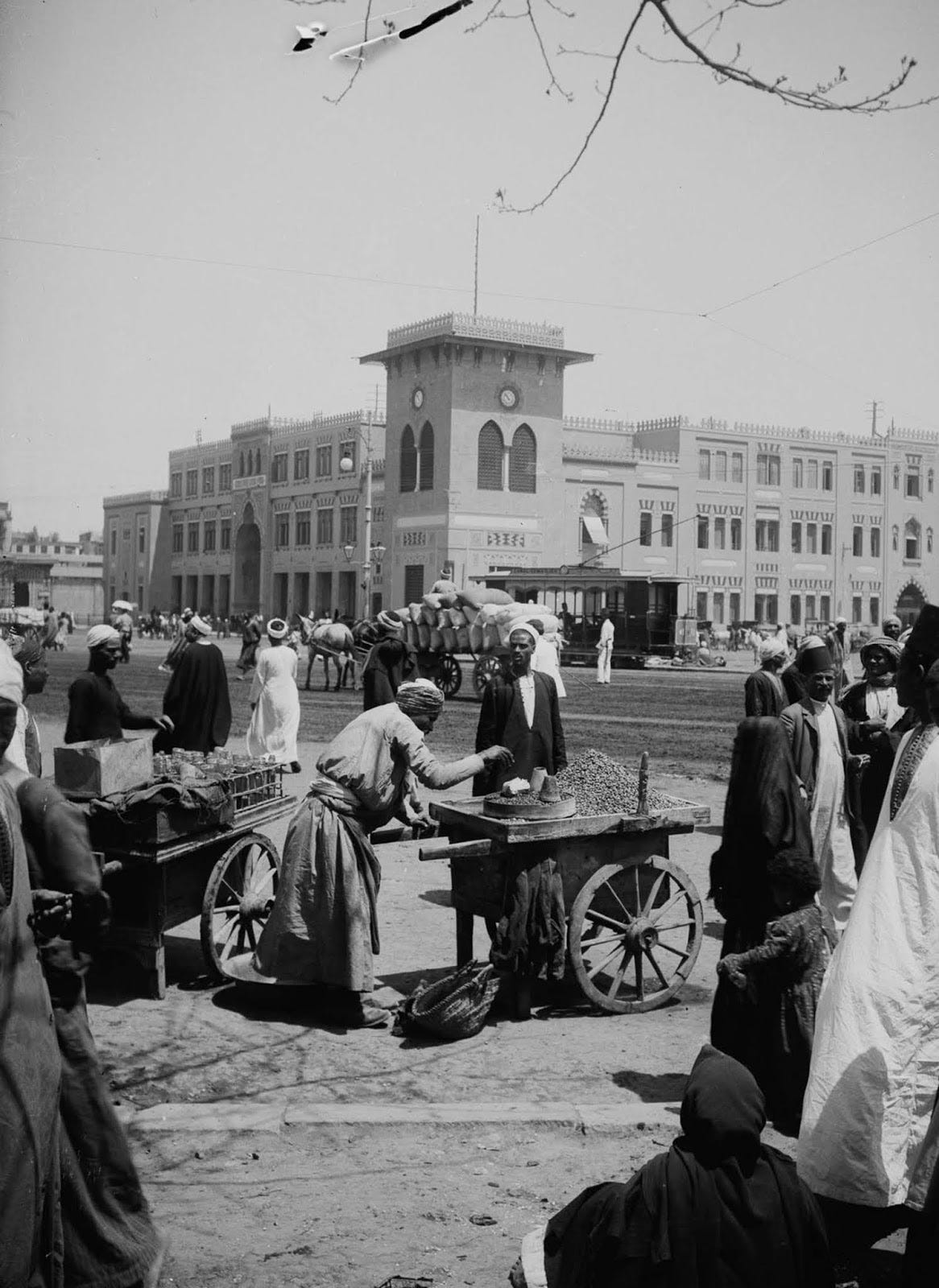
Amin observed that while past generations of Egyptians observed strict seclusion, elite women were increasingly stepping out, such as to go to the park.
“A generation ago a woman would have been disgraced had she left her husband’s house or been seen by a stranger. When she went on a trip, all necessary measures were taken for her to travel at night so that no one would see her. A man’s mother, sister, or daughter was apprehensive about sitting at the same table as him while he was eating. If we compare those times with today, without a doubt we find that these customs are on the wane…
Women at present… quite often go to public parks in order to take the fresh air” (Amin 1899, 10-36).

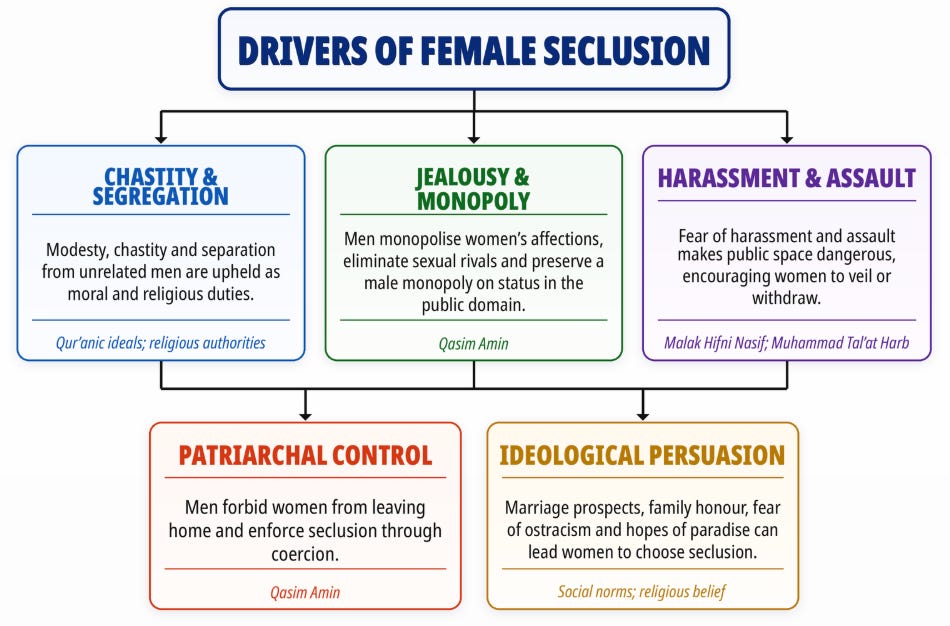
Why Seclude Women?
Amin states that men seclude their womenfolk in order to preserve their purity and prevent immorality. They “shove their wives behind bolted doors, thinking that this will alleviate their concerns and suspicions”. Amin does not question the imperative of chastity, but rather argues that strict restrictions reflect men’s distrust and misogyny:
“In truth, we act as if our women are incapable of chastity. Is it not strange that there is not a single man among us who trusts a woman..? Is it not inappropriate for us to mistrust these dear, loved, innocent ones, and to have such poor opinions of them?” (Amin 1899, 53-58).
In Tunisia too, Haddad argues that female seclusion is enforced by men to secure female chastity:
“The opponents of women regard this amount of freedom as exceeding the bounds of isolation that is necessary to prevent temptation and inhibit intimacy with men…
Some influential people among them believe, however, that we can advance ourselves as a society without woman, as was the case in Arab civilization in the past” (Haddad 1930, 30).
Harassment
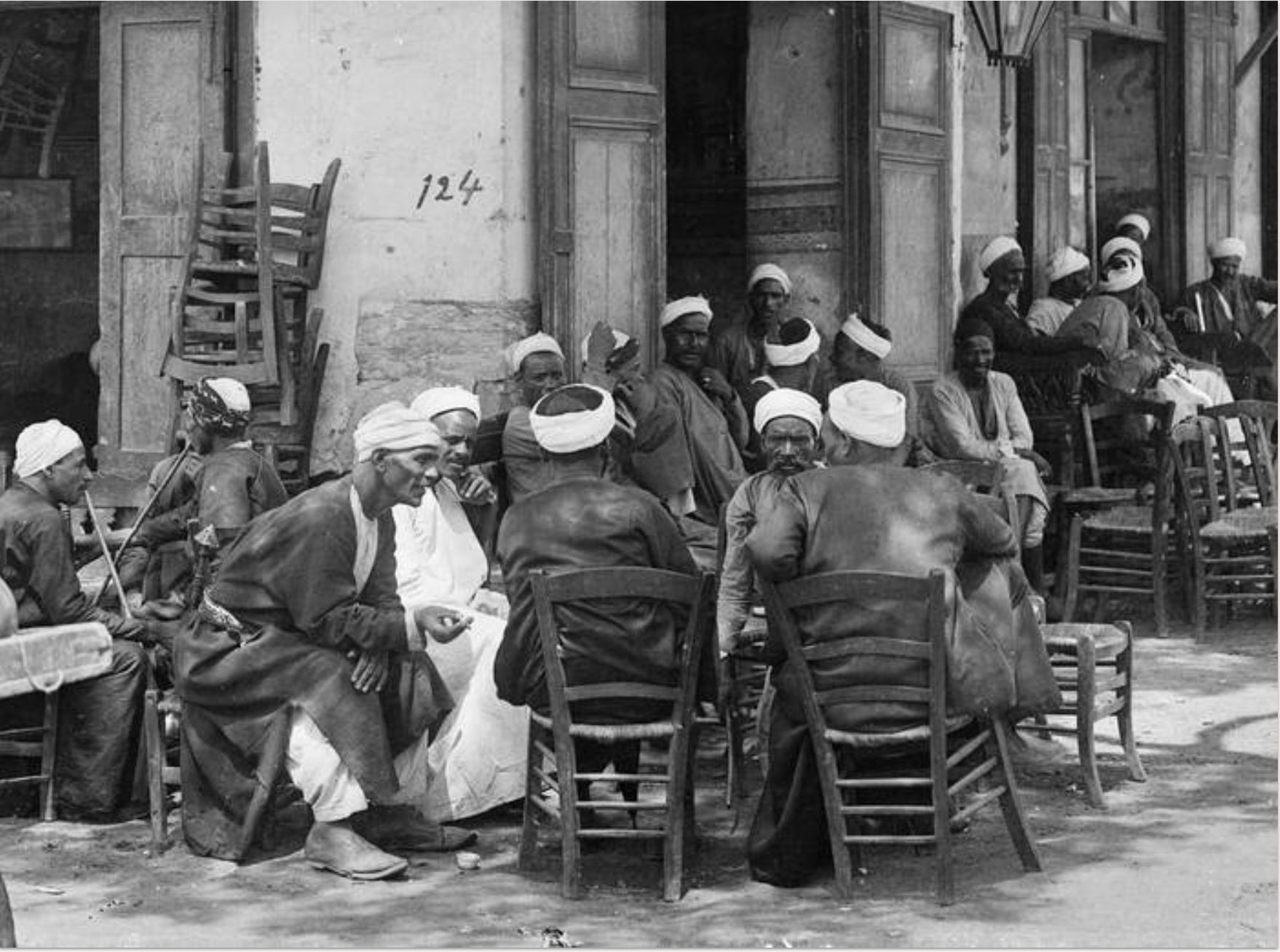
Malak Hifni Nasif highlights another driver of female seclusion: Egyptian men are so lecherous, an unveiled woman would be pelted with harassment, creating a sea of moral corruption:
“If one of us walks down a street, expressions of obscenity still rain down upon her - this one pelts her with a lecherous stare, that one splashes her with the water of his vileness until she drips with sweat from shame?
A body of men like our present one cannot under any circumstances be entrusted with a woman’s affairs, to leave her exposed to its abuse and its shamelessness” (Nasif 1910, 19, translated with Fable).
Muhammad Tal’at Harb similarly details rampant street harassment, with men shouting obscenities, buying indecent pictures and flaunting them at veiled women, then bursting out in laughter. Apparently, some even rode their bicycles, trying to degrade women in carriages and cause their loss of honor. “And to Egypt’s ill fortune, [these young men] are not few!” (1899, 41).
Where men harass with impunity, women may try to guard themselves by veiling:
“Where men’s purposes have grown foul, their aims sunk, and their manners deformed, the veil is for the woman nothing but a fortress that guards her from the aggression of the foul corrupters” (Nasif 1910, 103).
If I may lodge one criticism of Amin it is that he over-states the extent to which female seclusion persists through force. In “the New Woman”, he emphasizes how men oppress women, forbid them from leaving the house, and treat them as “prisoners” and “slaves”.
This downplays the importance of ideological persuasion, women’s own belief in eternal rewards, and also their fears of social ostracism. Even if a woman is not forcibly restricted, she may nevertheless choose to remain secluded in the belief that this will raise her marriage prospects and respectability (or else be hounded as a harlot), and further secure passage to paradise.
Seclusion reinforces Patriarchy
By keeping women in seclusion, Amin suggests that men can both monopolize opportunities in the public sphere and also ensure that women will be motivated to pleasure and obey:
“Men have slammed shut the doors of opportunity in women’s faces, thus hindering them from earning a living. As a consequence, the only recourse left to a woman was to be a wife or a whore… They were left with only the commodity of entertaining and gratifying the physical needs of men according to the men’s demands. As a result, women directed all their energy toward inventing ways to attract men and to capture their affection” (Amin 1899, 15).
Seclusion can be considered as anti-competitive in two ways. First, it ensures that men monopolize all opportunities in the public sphere and routes to prestige; second, it eliminates competition over a wife’s affection. By extracting these benefits, men can thus capture what I call “patriarchal rents”.
“He confined her in his house, forbidding her to leave it, thus denying all but himself the fortune of enjoying her, if only in a look or in conversation. He is like an owner who hoards his property, monopolizing all of its advantages to himself” (Amin 1900, 133).
Over in Tunisia, Abdelaziz Thâalbi likewise pushed for women to go out into the world:
“The abolition of this veil is the emancipation of woman; it is war on fanaticism and ignorance; it is the diffusion of the ideas of progress and civilization…
Nothing obliges her to live shut up at home and to withdraw herself from view; that she may, like the European woman, come in, go out, and go about her occupations (Thâalbi et al 1904, 12, 18).
Women’s Ignorance
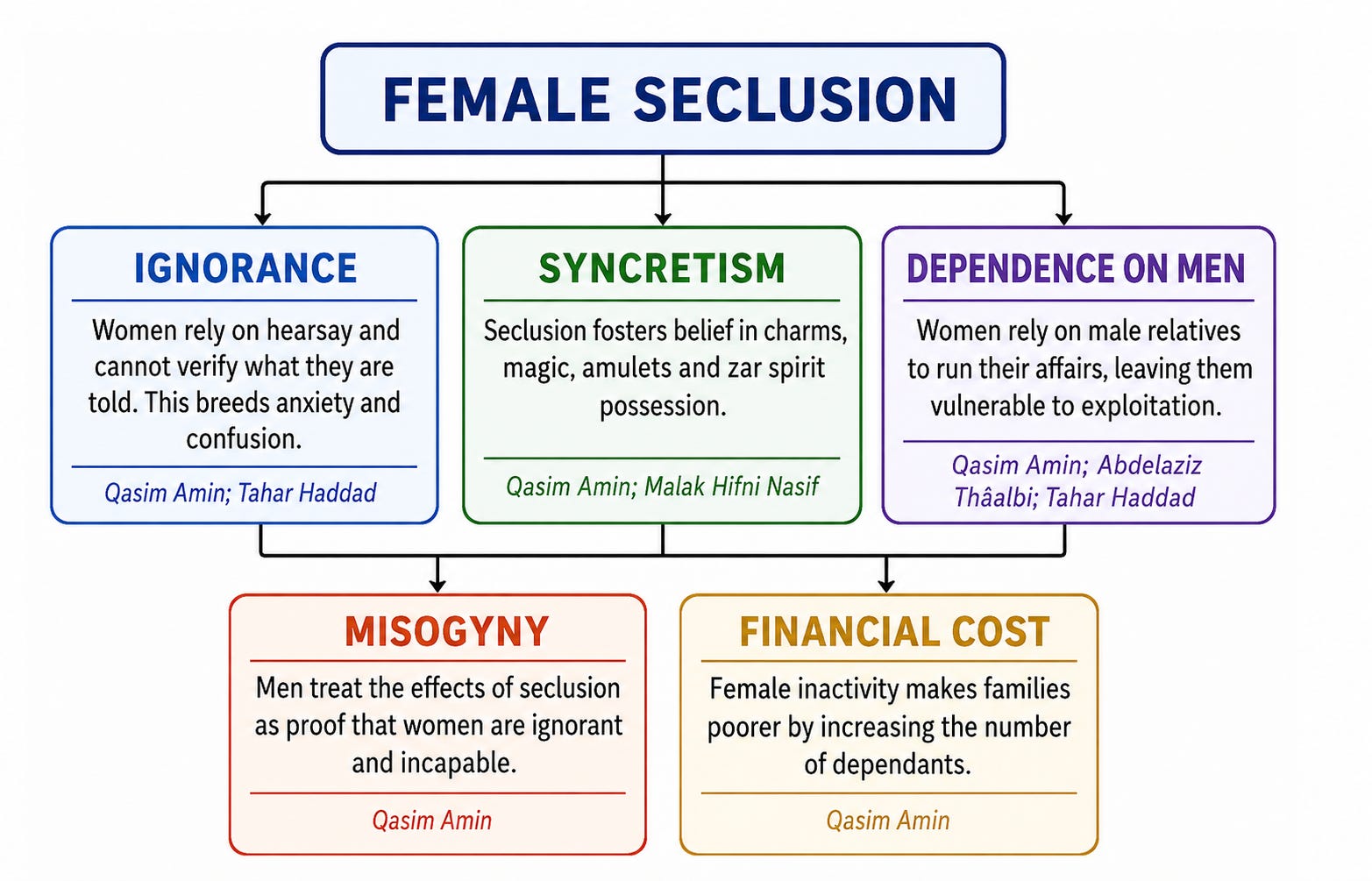
Amin notes that even though the Quran gave women rights of property ownership, because men keep their wives in seclusion, this keeps women ignorant. Lacking direct experience of the world, she relies on hearsay and cannot adjudicate fact from fiction.
“Seclusion confines a woman inside a narrow circle where she cannot see or hear anything except trivia, and she is separated from the living world of thought, action, and work. Little reaches her from the outside world; what does is usually twisted or misinterpreted. If she continued to have contact with the outside world, she would gain by observing events and by exploring the wide range of knowledge which comes with them. She would also develop through her interaction with others, her social relationships, her observations, her perceptions” (Amin 1899, 48-49).
Some may hand over the administration of their assets to a relative or stranger, creating risks of exploitation:
“At present whenever we think of a woman, we assume that she has a guardian who administers all facets of her life… We also see women use their personal seal for accounts, deeds, and contracts without knowing the content of the documents they are approving, implying that they do not understand the value or importance of the documents. Thus a woman can become stripped of her permanent rights through forgeries, cheating, or embezzlement committed by her husband, one of her relatives, or her trustee. Would this occur if the woman were educated?” (Amin 1899, 14).

Talent is then lost. A 15 year old boy might even be more intelligent and experienced than his mother (Amin 1900, 132).
“Our women have natural abilities that qualify them to be equal to women in other countries. However, their status today is very low, primarily because we have curtailed the use of their minds and feelings; we have encroached on their inherent rights and thereby decreased their worth” (Amin 1899, 50).
Even if a girl were to go to school, seclusion means that she cannot experiment or gains first-hand knowledge of different people (Amin 1900, 183).
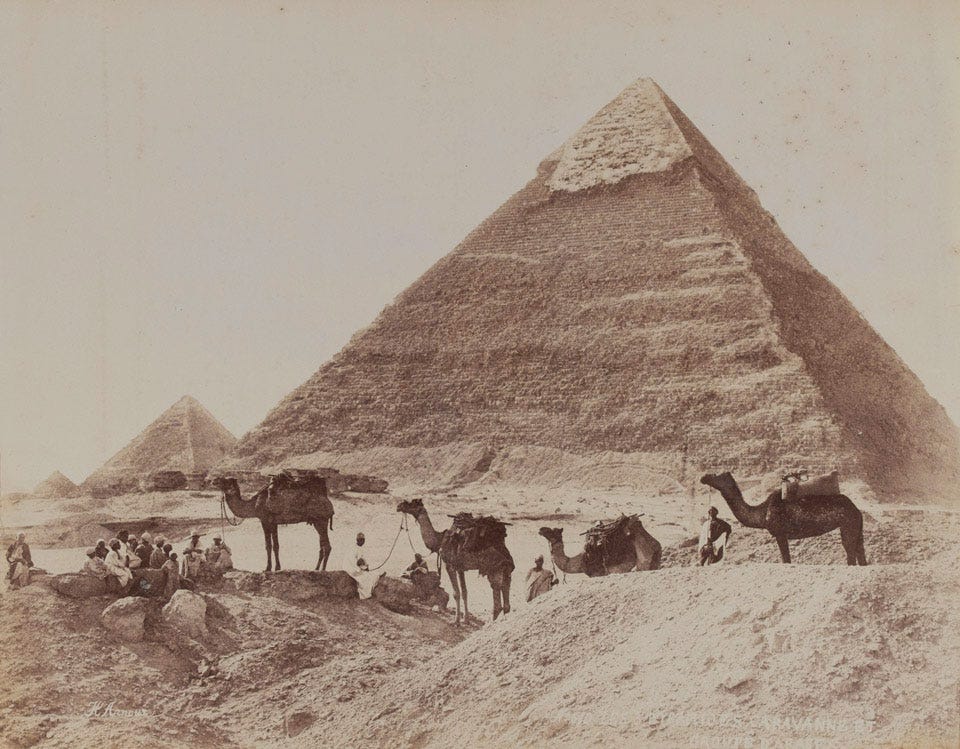
Nasif wholeheartedly concurs, adding that foreigners tell women about their own pyramids:
“Our whole life is sitting upon sitting: we remain the captives of narrow houses… Have you seen anything stranger than a sighted person blind?! The Pyramids stand a gunshot from Cairo, yet many of us have never visited them; the foreign tourist women tell us of our own monuments, and we display a disgraceful ignorance and marvel at what is recounted to us... Our legs … are all but crippled from long sitting - and our eyes have seen nothing of the wonders of the universe” (Nasif 1910, 75-76).
In Tunisia, Thâalbi (1904: 21) likewise argued that prohibitions on women’s intermixing mean that when she receives an inheritance or owns property, she cannot administer it herself. Ignorant of the external world, she must rely on an agent, “who is always unfaithful and appropriates the fortunes entrusted to his honesty”.
Haddad concurs that “the women are lost in a world that is filled with darkness, pain and incomprehensible events” (1930, 145). Seclusion further enables exploitation: “surrender[ing] their rights to male guardians” (ibid, 150). She struggles to gain confidence and capacities:
“She is alarmed at the slightest official paper that is delivered by the postman calling on her husband or anyone else among her (male) relatives to give testimony or appear in a civil action… Her innocence and remoteness from life mean that the only thing she can do is feel anxious, lament, be confused at the state of her husband or relatives, and to give into weeping” (Haddad 1930, 117).
This isolation also makes women “ignorant”. And asks whether any society can really achieve glory if “half of society is living in darkness” (Haddad 1930, 150).
Ignorance and Syncretism
Since Egypt had been under religious authoritarianism for centuries, one might assume strong support for sharia. Today, social scientists often refer to religious orthodoxy as ‘tradition’, as if ordinary people have always understood “correct practice”. Both views are incorrect.
Amin notes that when women were kept at home and did not receive any formal religious education, they were actually deeply syncretic. Nasif likewise describes ‘ignorant’ women, relying on “magic, spirit possession and amulets”. She suggests that zar (spirit possession) is especially common among brides married as children - a weapon of the weak (1910, 19, 57).
“Is it not her ignorance that impels her to hang charms on her child for his protection, and to lead him around graves and shrines of Muslim saints? Is it not her ignorance that forces her to follow other superstitions?” (Amin 1899, 27).
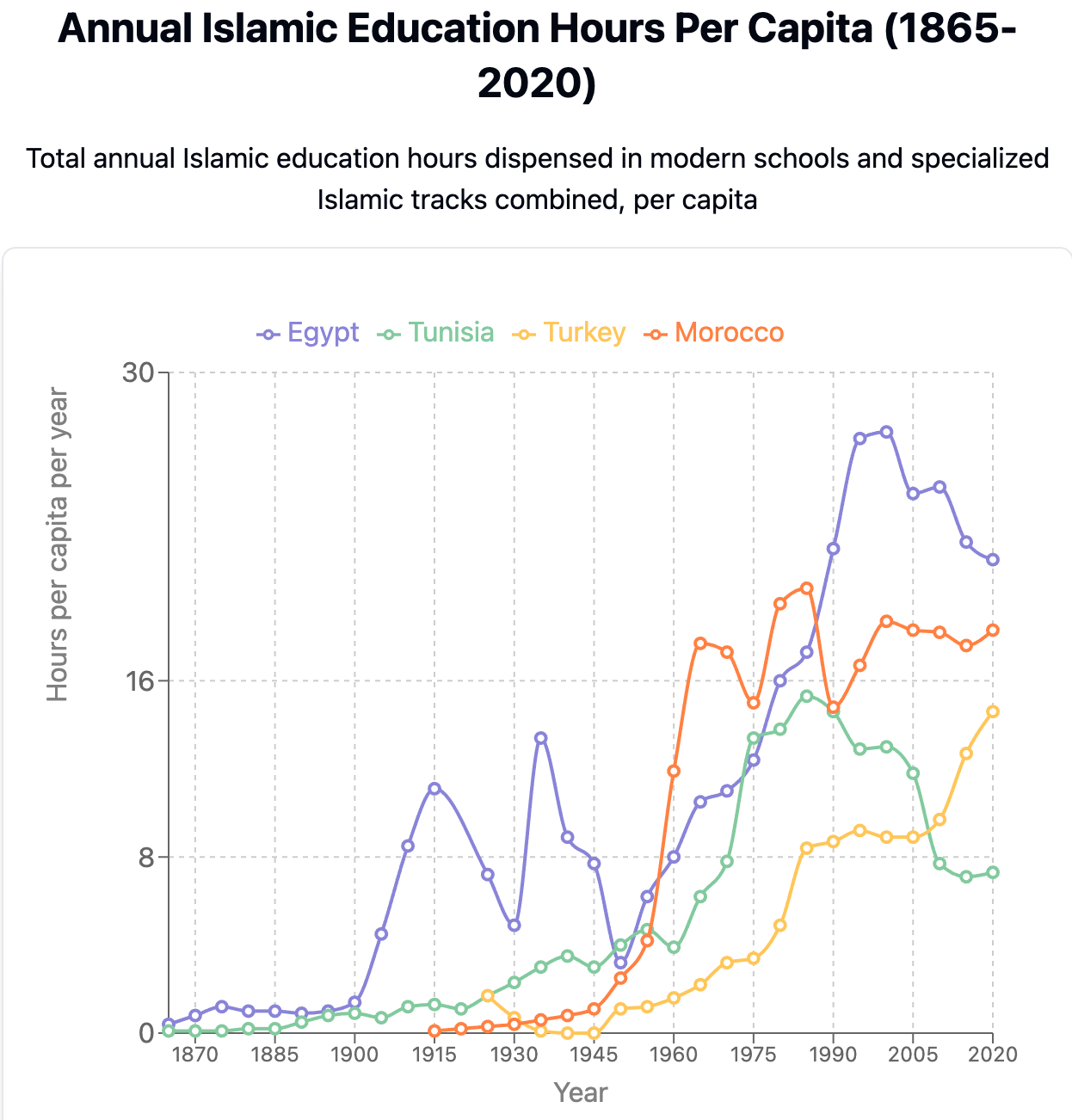
Salafists would consider such syncretism as “shirk”. But it was nonetheless widespread, even in the Islamic heartland. In 1900, before mass schooling, the average Egyptian child received very little religious education:
Misogyny
In 1792, Wollstonecraft damned men for denying women education then condemning their frivolity and justifying their exclusion. Echoing this same critique, Amin argued that keeping women in seclusion reinforced Egyptian men’s misogyny:
“Men robbed women of their confidence and then thought that women were the devil’s helpers. You hear men criticizing women’s natural dispositions, belittling their minds, and warning other men of their slyness. I do not claim that at present women are innocent of these traits, but I do perceive that the responsibility for this state of affairs lies with men” (Amin 1899, 30).
As Amin himself highlights, much Arab writing, poetry and folklore was often extremely misogynistic (1900, 152). Celebrated philosophers like Rumi, Tusi and Davani all derided women as untrustworthy, and reinforcing proper allegiances to men.
Class variation
The French consul-general in Tunis, Léon Roches (fluent in Arabic), asked Ibn Abi ‘l-Diyaf:
“Why is a husband allowed to beat his wife without any lawful reason and to make her carry heavy loads as if she were an animal, while he himself does not do so? In European countries, this kind of thing can only result from a lack of chivalry on the part of the husband” (2007, 10)
Ibn Abi ‘l-Diyaf replied that it was only disadvantaged communities that used women for heavy tasks. This is a useful acknowledgement that even if peasant women were not so severely secluded, they were nonetheless low status.
The Financial Cost of Female Seclusion
Women’s absence from the workforce also has important economic implications, since it means that multiple dependents rely on a few earners:
“There is hardly an Egyptian family free of the burdensome expense of supporting a number of needy women unable to work or be self-sufficient” (Amin 1899, 13-14).
Arranged Marriages
Patriarchy and female seclusion also meant that women did not choose their own husbands, let alone meet before marriage. Nasif suggests that such arrangements create incompatibility and “discord between the spouses”.
“The man.. shoulders vast expenses, for a bride he has never in his life seen… The girl surprised by a husband who is a drunkard, or a rake, or corrupt of conduct - how long is what she must suffer!
Among the greatest of the causes productive of the spouses’ misery among us is the want of affinity between them (Nasif 1910, 25, 28).
If the man is displeased, he may be “light and loose” - pursuing divorce or multiple wives (Nasif 1910, 25). To ameliorate these risks, she proposed that couples should not marry until they have met in person, in the presence of a mahram (relative).
Deference to Husbands
Even as elite Egyptian men returned from Europe, trumpeting ideas of reform, Nasif notes that they did not necessarily treat their wives with respect:
“Most of our men have visited Europe and the civilized countries and seen with their own eyes how the European man honors his wife - she is given precedence over him in every gathering. They came back calling for the necessity of woman’s education, declaring in their talk that they are her partisans and that she is owed respect.
But their talk is not long in going off with the wind - except that when they meet a Frankish tourist or a Western woman, they show her great courtesy: they help her down from her carriage, hold her bag for her, and lift the tarboosh in reverence to her; while one of the same men disdains to ride in one carriage with his own wife” (Nasif 1910, 54)
Nasif states that while bedouins, peasants and European spouses address each other by their first name and fairly share food, Egyptian city marriages are much more hierarchical, with some even addressing their husbands as “Your Honour”, “Your Excellency” [hadritak, sa’adtak]: “how many a woman accepts her husband’s insult in meek submission”. Economic dependency and fear of divorce, she argues, compel wives to submit (1910, 61-62).

,_by_Osman_Hamdi_Bey.jpg)
Religious Backlash
Arab reformists’ capacity for ideological persuasion depended on the countervailing power of respected religious authorities.
Where the ulama commanded popular or state-backed authority, reformists were punished. Ali Abdel Raziq questioned the religious justification of the caliphate and Al-Azhar stripped him of his credentials. Thâalbi, returned from Cairo with reformist ideas, but was jailed for “insulting religion” - accused of calling the Quran outdated, labelling one of the Prophet’s companions despotic, and cursing Sufi figures. A sharia tribunal sentenced him to death, French authorities intervened and re-routed him to a civil court which convicted him of offending public order. Haddad criticized polygamy, unequal divorce rights, and unequal inheritance, then was ostracized and insulted. Several fatwas declared him a heretic, one deemed him an apostate.
By 1914, 70% of Muslims were under Christian rule. Even though Egypt’s colonizers did not revise sharia rulings on marriage, divorce, polygamy or inheritance, women’s bodies became a symbolic battleground between the West and Islam. This in turn triggered defensive backlash.
Tal'at Harb denounced men and women’s intermixing as a foreign imposition:
“the lifting of the veil and the mixing of the sexes are a wish Europe has cherished for a long time… for a purpose grasped by everyone acquainted with Europe’s designs on the Islamic world” (Tal'at Harb 1899, 3).
“Women have.. come forth from their private quarters, and have become goers-in and wanderers-about in the streets and the promenades, displaying themselves, adorned, showing in the roads such signals and movements as sound taste recoils… These things we see are nothing but violations, all of them, of religion and of the plain sense of the noble Quran, which decrees the lowering of the gaze…
But when mixing occurred between us and the foreigners - by their penetration of our lands through trade and conquest, and by our journeys in theirs - the morals of men and women were corrupted by what entered under the name of Western civilization…
The women of the East began to venture out of the houses secretly; then they showed themselves and went out openly… shamelessness increased, many honors were lost, secluded gentlewomen were disgraced... Then debauchery climbed further, until women came to attend the gatherings of amusement, to go to the theaters” (Tal'at Harb 1899, 92, 96).
Where the state subordinated the ulama, reform could still be imposed from above - Kemalist Turkey, Bourguiba’s Tunisia. But leaders’ capacity to spearhead secular modernization was still contingent on their capacity to maintain popular legitimacy, and, as loyal readers know, that soon came under attack.
Translation Notes
Malak Hifni Nasif, Muhammad Tal’at Harb and Thâalbi’s texts are not available in English translations, so I gave the Arab and French originals to Claude for translation, requesting page by page. I double checked these translations with other reports in the secondary literature. Correctives are welcome.
I also sourced translations of Ali Abdel Razek’s “Islam and the Foundations of Political Power”, as well as al-Tahir al-Haddad’s “Imra ‘tuna fi ‘l-sharia wa ‘l-mujtama”.
Thank you, Alice Evans, for this deeply thought-provoking piece on the debates around women, seclusion, religion and public life in the Arab world. What makes it especially valuable is how it complicates the easy binaries of “Islam vs. modernity” and “tradition vs. freedom.” It offers a wonderful lens through which to think about our own societies, our Pashtun culture, the interplay of religion and custom, ideas of honour and seclusion, and, above all, women’s access to the public world and social power.
A fascinating and generous contribution to a much-needed conversation.
Very interesting. I wasn't aware of any of this history, probably because the reformers lost the argument. I don't think Islam is the primary cause. In Egypt for example one of the most extreme expressions of anti-feminism, FGM, is almost as widely practiced in the Coptic Christian community as it is amongst Muslims. If Emmanuel Todd is correct, the underlying cause of such things is the family structure which gives rise to the type of religion adopted as well as the culture's attitudes to women and a whole range of social, political and economic values and behaviour.