


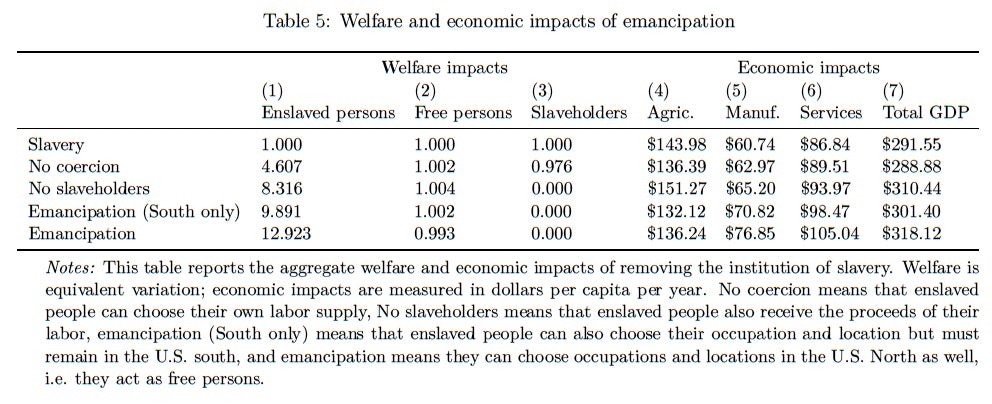
Treb Allen, Winston Chen and Suresh Naidu have a new paper on the economic geography of American slavery. They argue that slavery distorted the economy not only by extracting the proceeds of enslaved people’s labour, but also by coercing them to work harder and assigning them to sectors and locations that maximised slaveholder profits rather than workers’ welfare. This included disease-prone areas at risk of malaria.
Their goal is to estimate the general-equilibrium effects of slavery by modelling what the antebellum economy would have looked like under full emancipation. Under this counterfactual, formerly enslaved workers would be free to choose their own labour supply, sector and location. Many would leave Southern agriculture and head north, to manufacturing and services. Allen et al estimate that “aggregate GDP rises by 9.1%”.
Did Female Emancipation raise East Asia’s GDP?
Similar questions can be asked about the general-equilibrium effects of female emancipation. But here we must distinguish between two transitions:
When societies loosen restrictions on women’s labour, enabling them to work in more productive sectors, this will mechanically raise economic output. But..
If those women also seize the means of persuasion and raise their standards for marriage and child-bearing, while men refuse to provide caring, committed egalitarian companionship, then fertility takes a hit, shrinks populations and mechanically lowers aggregate economic output.
Modernisation thus unleashes something once suppressed by patriarchy, a mismatch in men and women’s preferences. For this reason, female emancipation significantly raises women’s welfare, but whether it boosts long-run GDP depends on men’s adaptive preferences.

Stage 1: Industrialisation
Back in 1900, East Asian girls were raised to be obedient, uphold filial piety, accept being sent off to unknown homes, where they would toil for their in-laws, bear children for their husband’s lineage, even enduring abuse. To quote a historic saying “The husband sings and the wife follows”. Without her own ideas or independence, she was merely supposed to echo. Since divorce was condemned and girls were taught to please others, patrilineal clans were able to extract more labour and fertility than women would have otherwise supplied. I call these “patriarchal rents”.
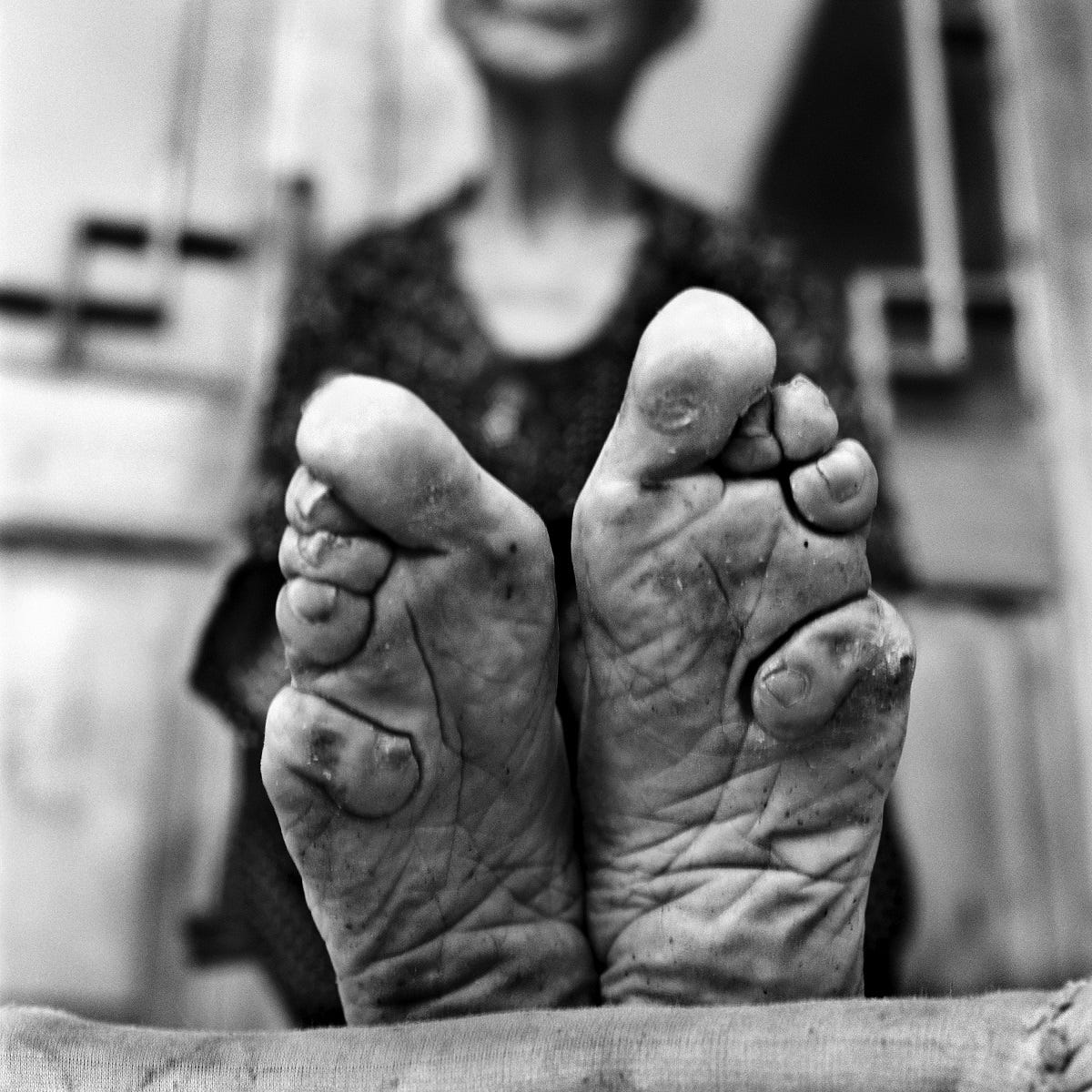
Some communities even extracted that labour through physical violence - breaking and binding girls’ feet so that they might spend all day at the loom, unable to run away. Ideologies of male supremacy also trapped women in less productive sectors, since they were not permitted to take the imperial examinations nor even compete for prestigious domains.
20th century structural transformation was then transformative. Massive demand for factory labour raised the opportunity cost of keeping your daughter at home. Entire villages then despatched girls and women to work in sweatshops, bundled into over-crowded trains, sharing dirty dormitories, toiling long hours into the nights in bustling cities, expecting them to duly remit earnings back home.
Female employment thus raised East Asian GDP through both extensive and intensive growth.
It was extensive because women who might otherwise have been secluded at home entered market work, increasing the sheer number of labour inputs in the economy. Women then did more work than before, raising children and working for pay.
It was also intensive growth because women also moved out of unpaid household production and low-productivity agriculture into factories, offices, schools, hospitals and services. Even without any technological change, this sectoral reallocation mechanically raises economy-wide productivity: more labour is deployed in activities with higher output per worker. East Asia thus gained twice over: it mobilised more labour and moved that labour into more productive sectors, which in turn drove industrialisation and structural transformation
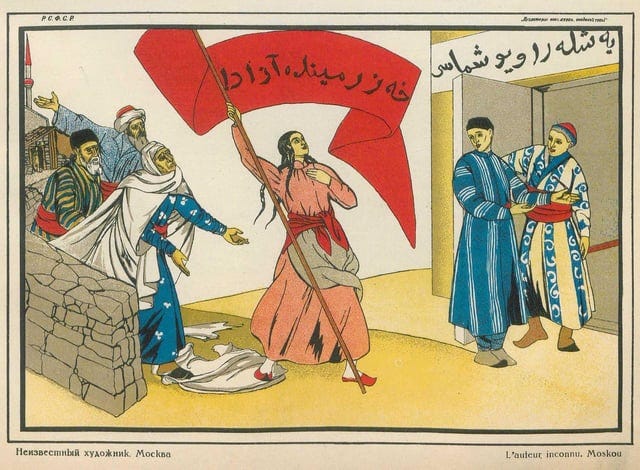
The USSR likewise mobilise female labour so as to spearhead industrialisation - not just in Russia but also in Muslim Central Asia.
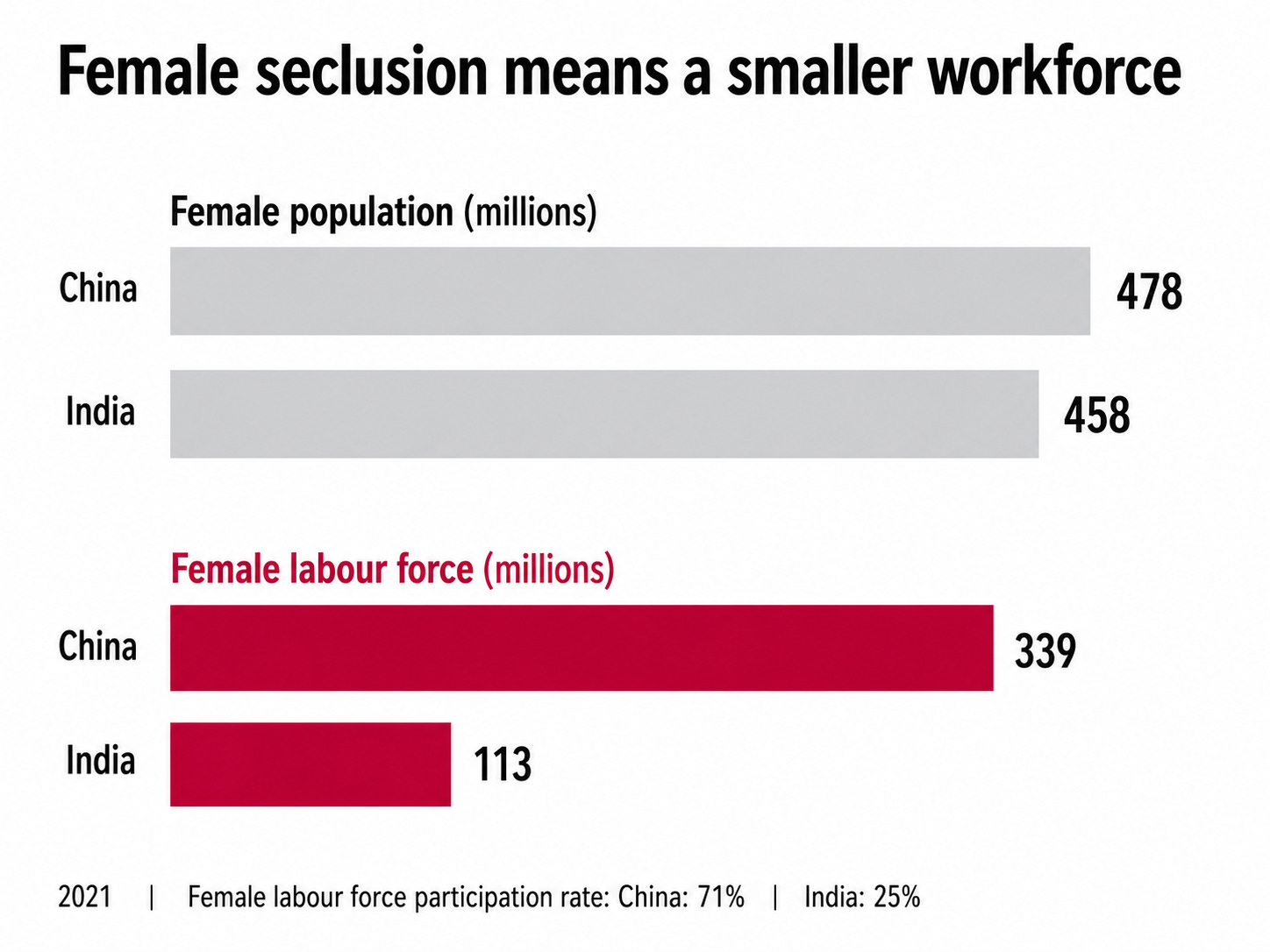
By contrast, societies with a stronger preference for female seclusion have forfeited these economic benefits. In a geographical band that stretches from Casablanca to Calcutta, patriarchs confine women in home-based social reproduction and low-productivity agriculture in order to maintain honour. India has just as many working-age women as China, but far fewer of them work. Moreover, Indian women outpace men in higher education. Female seclusion mechanically reduces the size of the labour force, haemorrages talent, as well as aggregate GDP and GDP per worker.
Of course, there are other factors (such as labour demand, human capital, and infrastructure), but halving your workforce is significant.
Stage 2: Women Raise their Standards
As East Asians headed into cities and secured wage labour, they increasingly forged independent friendships, chose their own partners, and placed higher value on their own individual happiness.
For the first time in history, East Asian women then seized the means of persuasion. Rather than patriachs praising filial piety, female submission and sacrifice; feminist journalists, novelists, comic bloggers and stand-ups comedians challenged everyday sexism, pushed for their own prerogatives. Bestsellers include ‘Kim Jiyoung, Born 1982’ and ‘the Vegetarian’, movies like “Her Story” made $98m at the Box Office, and UrbanGirl Vivian’s story about women breaking out of stereotypes went viral. Now here’s a sprinkling of Yanyi Yangue’s performances on “Rock & Roast”:
“I handle washing dishes and cooking, and he handles eating and critiquing…. Being with him makes me experience the greatest joy a woman can feel: the joy of giving”.
“Have you noticed that women’s summer clothes don’t have pockets? Why not? Women will not contaminate pockets. Pockets are not ancestral graves”.
In 2020, Yang Li asked, “Why are men so ordinary yet so confident” and launched thousands of memes, including male vitriol. She replied,
“You men have stepped on me countless times, but you react in such a disproportionate manner the one time I hit back. We women have been repressed our entire lives. You have no idea what we have been putting up with.”


In my own interviews, Chinese young women tend to rejected the drudgery of cooking and cleaning for Lunar New Year festivals only for the men to have all the fun. Seeing their mothers’ social reproduction as a sacrifice, they increasingly put themselves first, and prioritised their own welfare. Young women became increasingly selective. Many are now raising the ‘reservation wage’ at which they will provide all the sex, care, companionship and laundry traditionally bundled with marriage.
But while East Asian women increasingly want egalitarian companionship, many men still prefer deference. Given this mismatch in preferences, they remain single. Moreover, men have myriad outside options, including drinking baijiu with male friends, enjoying sexy ladies in karaoke bars, online video games, convenience foods, marrying imported brides from poorer regions, or even turning to AI companions. As such, they are not necessarily prepared to pay the new price of marriage: egalitarian respect, care, companionship and emotional attentiveness. Instead, male-dominated platforms brim with resentment.
Now that women are free to avoid unsatisfactory unions and prefer egalitarian companionship, which many men are unwilling to supply because they prefer hierarchy, we see a rise of singles and collapse in fertility.
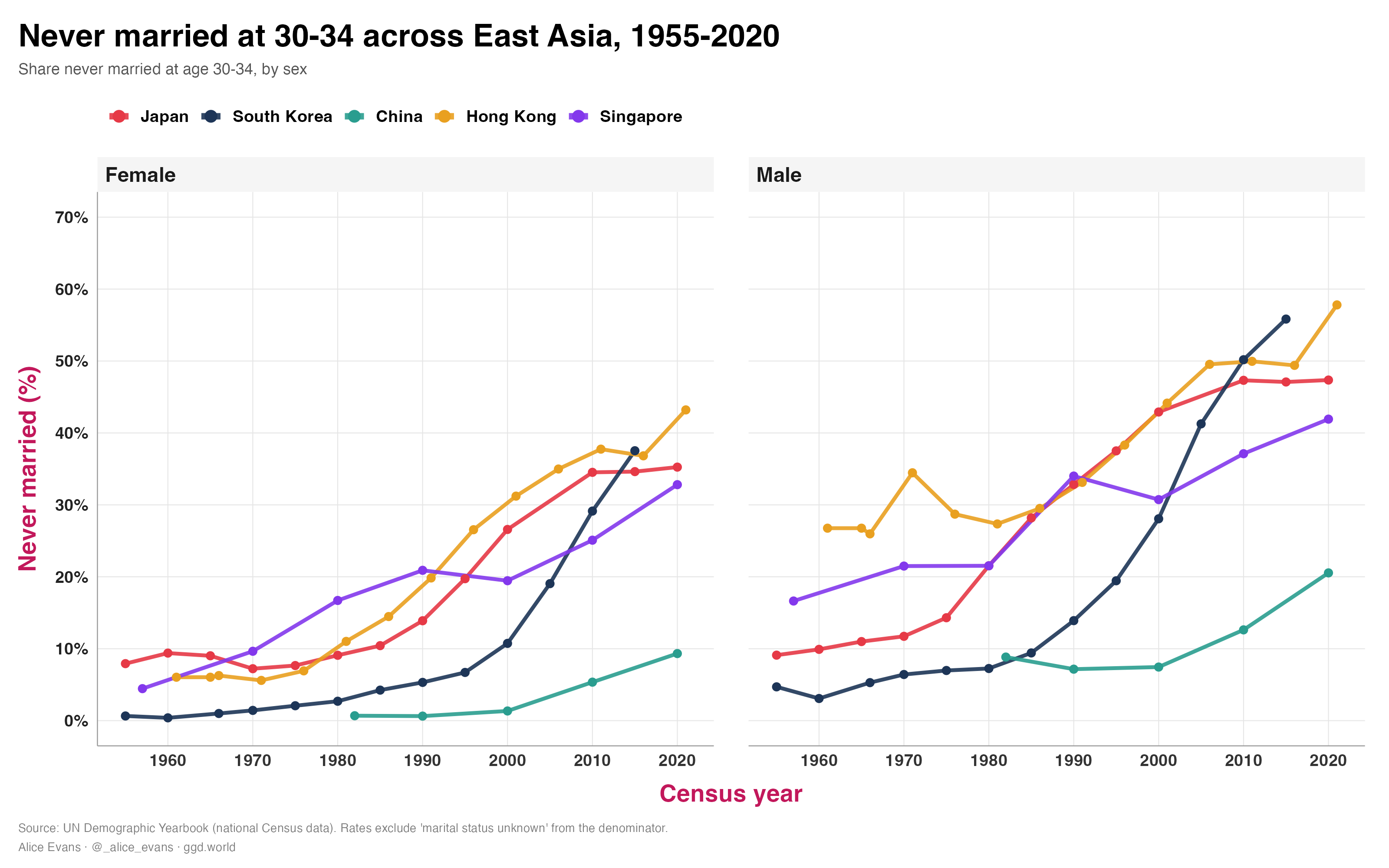
Some men still form families, of course. This may be because they are exceptionally charming, providing women with such love and care that they eagerly want to form a family together. Others may offer highly attractive terms on other dimensions. Meanwhile, in conservative communities, marriage may still be paramount for social respectability. But in East Asia’s big cities, where women can stay single and stigma-free, then the most disagreeable men on lower incomes generally struggle to attract.
Falling fertility has major macroeconomic implications
While AI could enable a massive boom in productivity, and may reduce the economic benefits of a larger workforce, East Asian growth could be slowed by ageing populations, rising dependency, higher savings and weaker domestic consumption.
Japan illustrates these headwinds. Between 1991 and 2019, Japan’s economy grew by just 0.83% annually, while the US achieved 2.53%. Many economists blamed Japanese monetary policy. But Fernández-Villaverde, Ventura, and Yao look at GDP growth per working-age adult; by this metric, Japan’s performance (1.39% annually) comes close to that of the United States (1.65%). Japan’s macroeconomic malaise is partly a function of its shrinking working-age population.

Is Female Emancipation Good for Growth?
When women are permitted to work, the labour force expands and this boosts aggregate GDP. If women also ditch low-productivity agriculture and bustle into more productive sectors (factories, hospitals and offices), then rising female labour force participation also means higher GDP per worker. East Asia thus prospered by mobilising women’s labour.
But this was only partial emancipation: East Asian patriarchs still instilled female sacrifice and filial piety to motivate marriage and social reproduction. In short, they extracted patriarchal rents.
As women forged careers, they also started rewriting the script, challenging sexist ideas of deference and duty. Many became more selective. Since men have often been unwilling to offer more egalitarian terms, women around the world appear to be going on strike, refusing patriarchal rents.
Modernisation thus unleashes something once suppressed by patriarchy: a fundamental mismatch in men and women’s preferences. For this reason, female emancipation is good for women’s welfare, but whether it increases long-run aggregate GDP really depends on men’s reactions. When women are free and prioritise their own happiness, they seem more inclined to make long-term investments with collaborators who offer more attractive terms. ❤️
Related Essays
Feminism:
Misogynist backlash
East Asian culture:
Singles and fertility:
This was a joy to read, but i would love to take this discussion ahead, i don't know exactly what, but so much is coming to my mind, i will sieve through my thoughts, and hopefully write something meaningful and worthwhile.
Thanks alot for writing this.
Good essay!But how do the labour、marriage and fertility affect GDP?I want to add another evidence which approve the young ladies own a greater choice:On e-commerce platforms, young women are the demographic with the strongest purchasing power. With their high spending power, the market targeting young women in China is extremely robust. On social media platforms, influencers with a high proportion of female followers typically charge 3 to 5 times more for advertisements than those with a predominantly male following. For example, a beauty influencer on Douyin with 300,000 followers might charge up to six figures in RMB per ad, while a military-themed influencer with the same number of followers might charge only a few thousand RMB.