

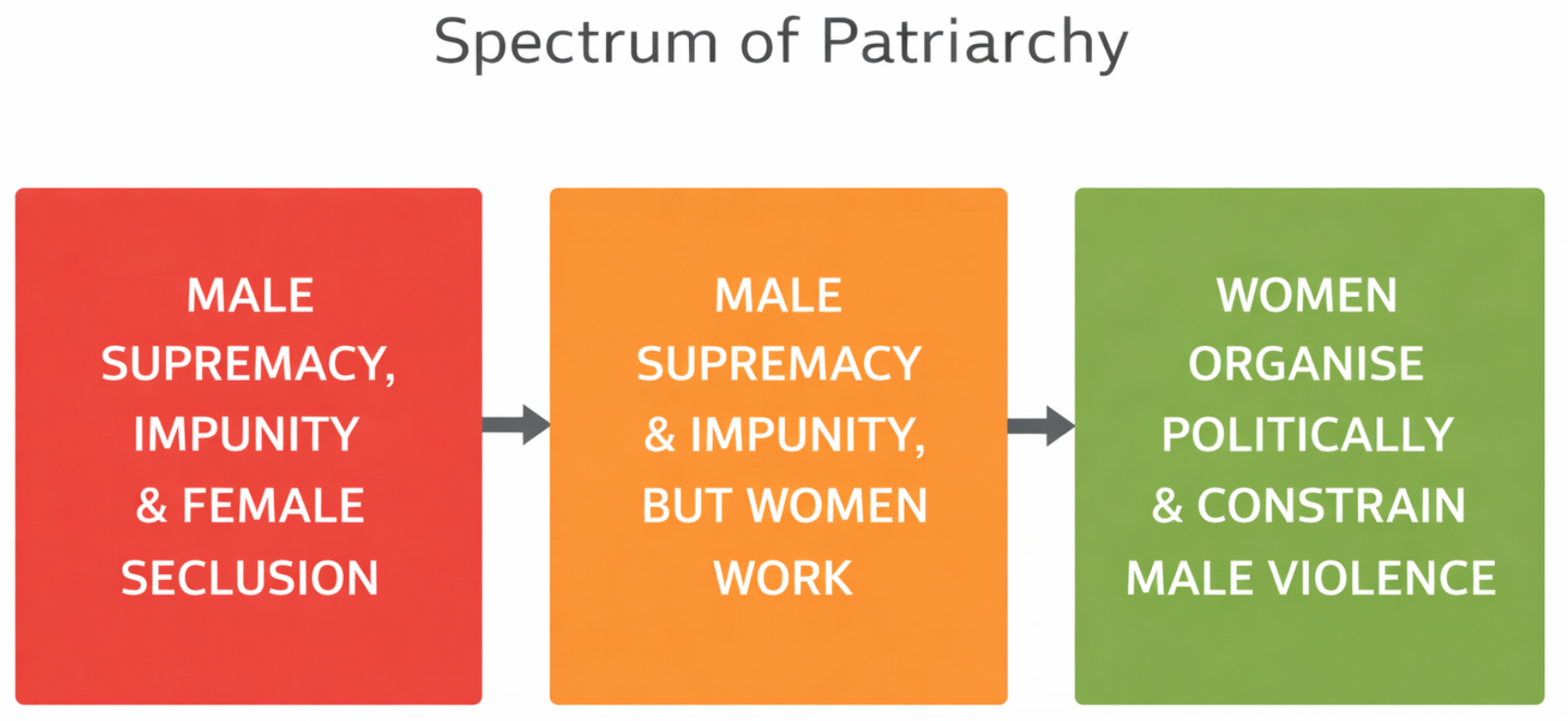
Female education is often sold as the great equaliser: expanding skills, leveling the field. But are institutions really so meritocratic? Global history suggests that even when women surpass men in higher education, they may still be blocked. In seclusion patriarchies (like Iran and India), female respectability hinges on staying apart from unrelated men, so men almost monopolise the competition for jobs and political prominence. In fraternal patriarchies (such as China, South Korea, and Russia), men let women work, but still guard the gates to state power and prestige.
A tremendous new paper by Xiaoxia Huang, a PhD candidate at Syracuse University, shows this operating within the Chinese civil service.
Xiaoxia Huang uses administrative data from the Chinese National Civil Service Examination, covering 238,086 job ads, application records for 100,931 postings, and 742,563 shortlisted candidates.
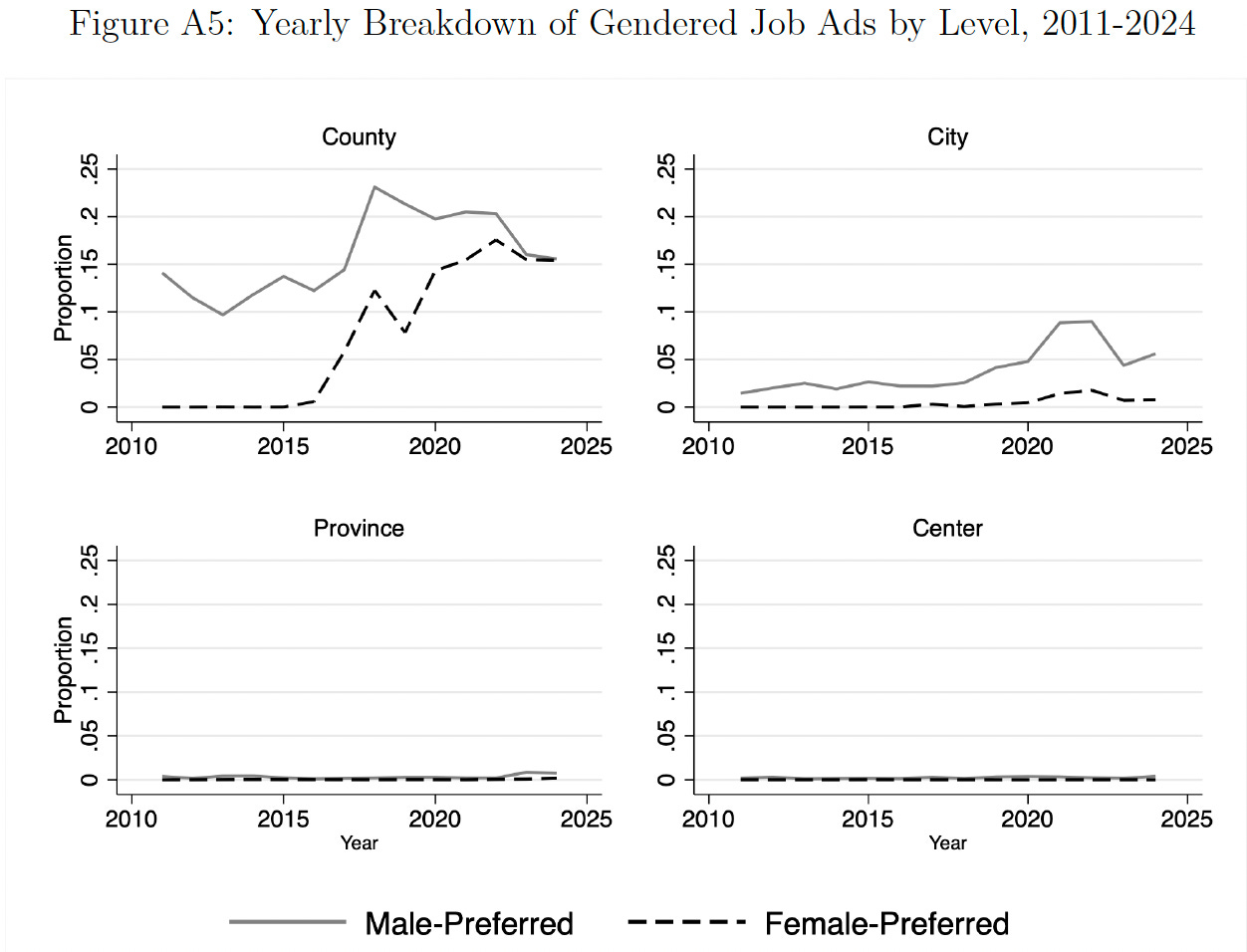
From 2005 to 2015, the share of job adverts explicitly preferring male candidates grew from 0.05% to 15%, with virtually no postings preferring women. From 2016 to 2024, adverts increasingly preferred male candidates, reaching a high of 30%. There were also some adverts for women, but these were usually paired “split-gender” postings, for otherwise identical jobs.
What led to this shift?
In 2009, women outpaced men in college degrees, and often applied to the public sector. But rather than welcome new talent, many hiring units appear to have reaffirmed male bias.
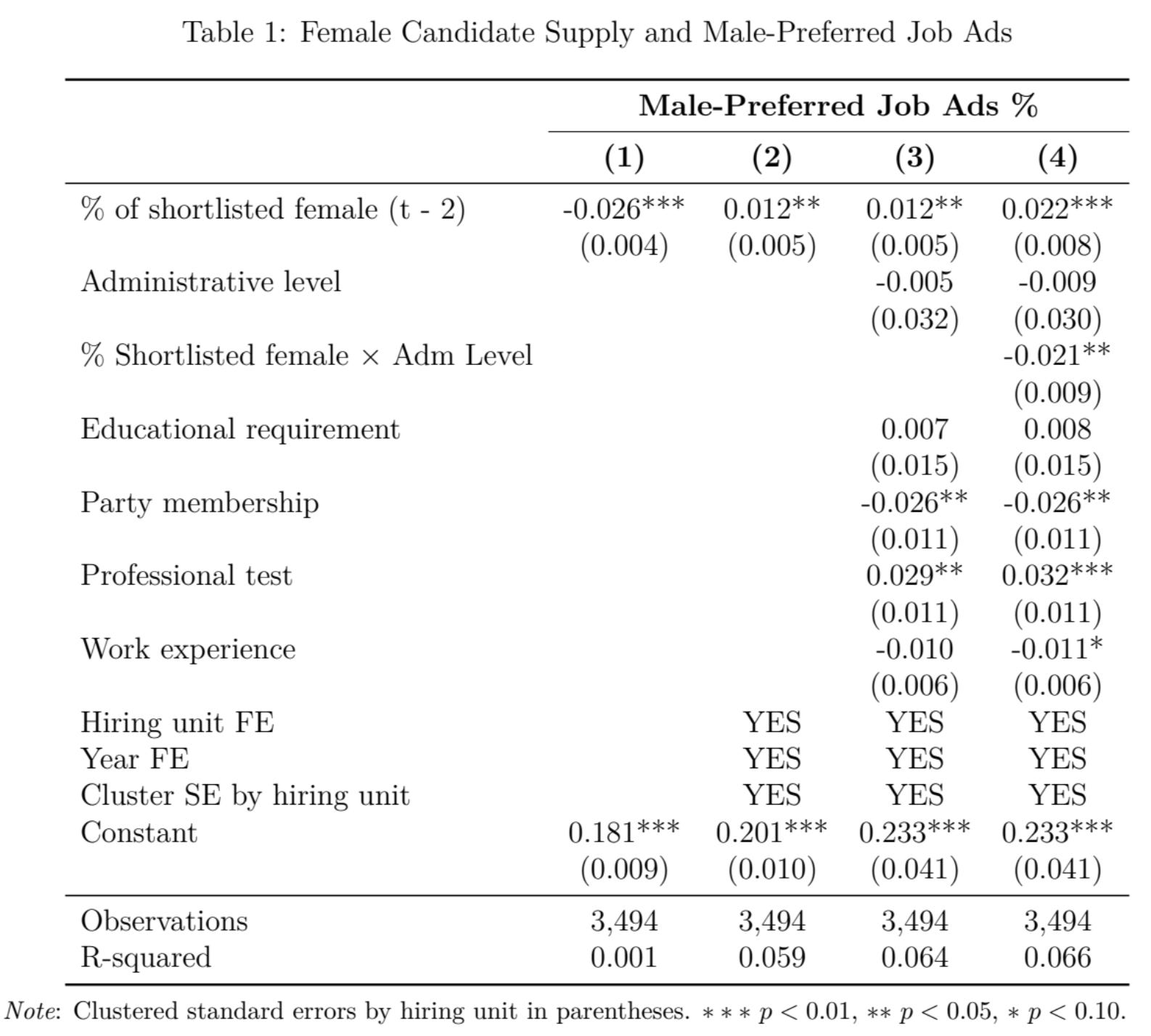
Huang finds that as women’s share of shortlisted candidates rose, hiring units subsequently issued more adverts for men. Importantly, this pattern does not appear in the pooled cross-sectional comparison. It only emerges once Huang compares each hiring unit to itself over time, using hiring-unit and year fixed effects.
This effect was especially pronounced in lower-level bureaucracies, where about a quarter of county and city level adverts expressly preferred men.
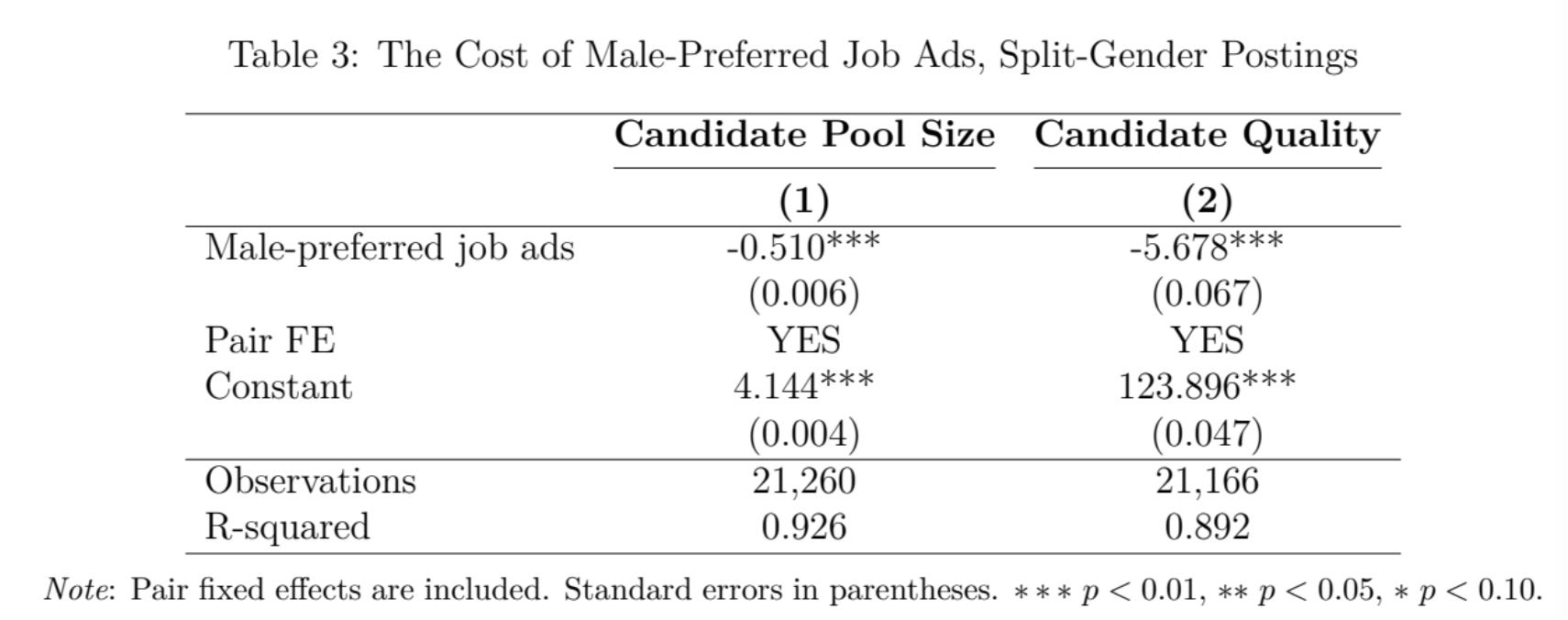
A rise in male-preferred job adverts is associated with 40-45% smaller candidate pools, and with 4-5% lower exam cut-offs.
Xiaoxia Huang thus offers striking evidence of how the Chinese civil service has consolidated male advantage by blocking female competition.

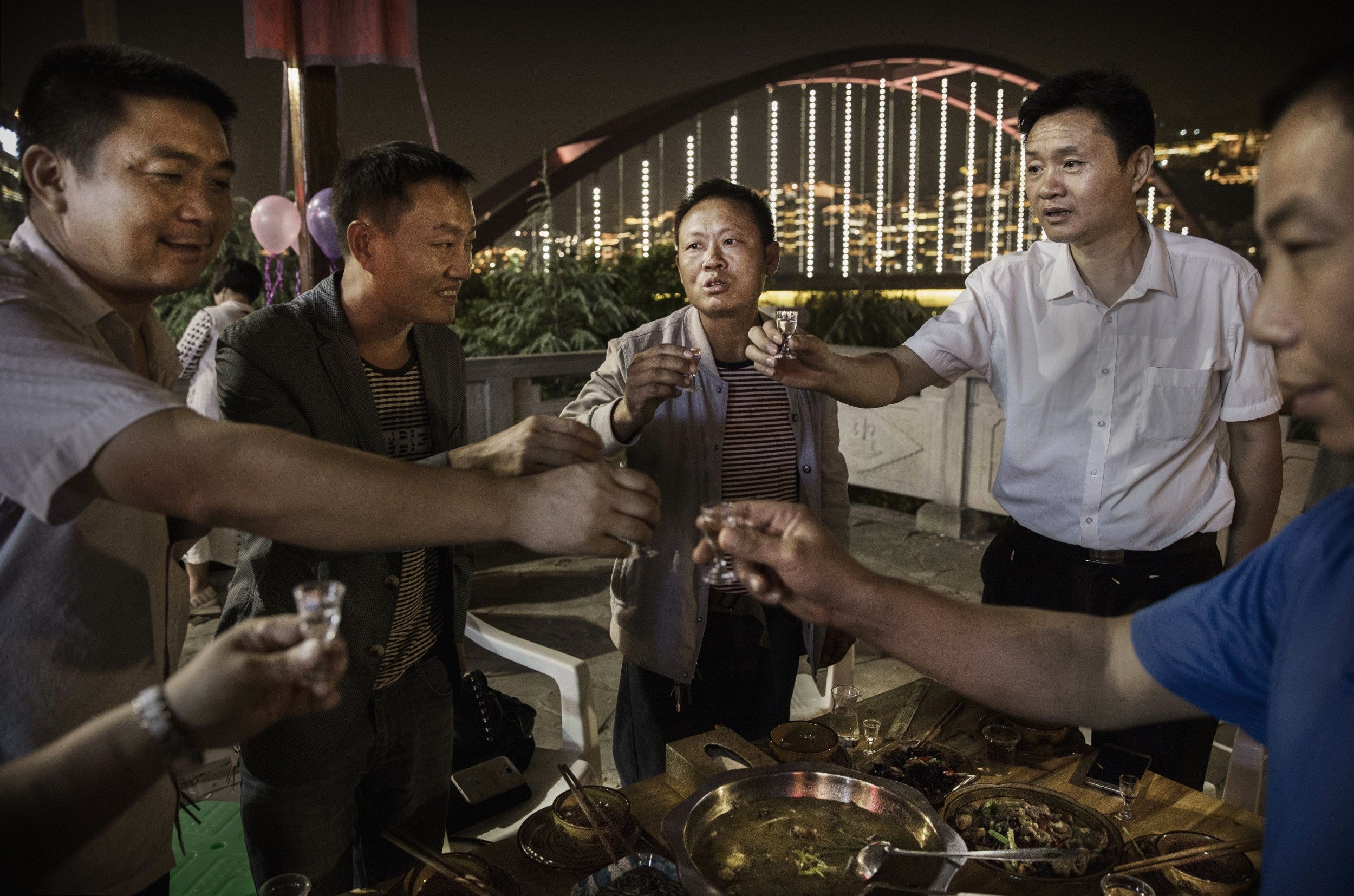
Building Networks in China - Baijiu, Karaoke, and Sexy Ladies
Another important mechanism, explored in my earlier essay, is that Chinese companies explicitly seek men for outward-facing sales jobs, where they are expected to feast with clients so as to forge camaraderie and reciprocity (‘guanxi’).
Private and public sector fraternities are then mutually reinforcing. By drinking baijiu, banqueting and singing karaoke, men affirm networks of loyalty and reciprocity.
Chinese Social Media Feminism
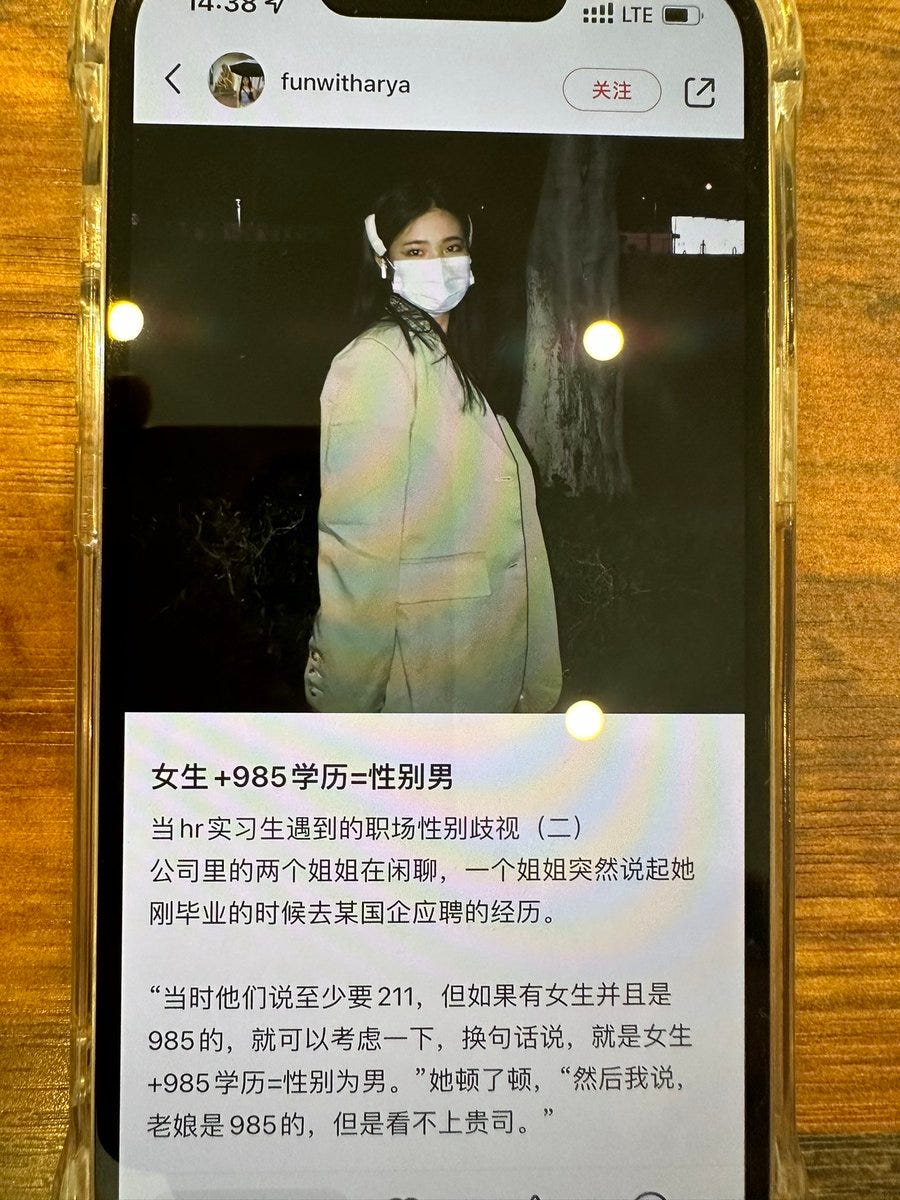
Can women fight back? In my own interviews, Chinese women have shared how users increasingly decry sexism and validate righteous resistance on Xiaohongshu (“Little Red Book”). In the post below, one poster says “A woman + 985 = male”.
985 means a prestigious university.
So an exceptionally clever and qualified female is equal to a mediocre male.
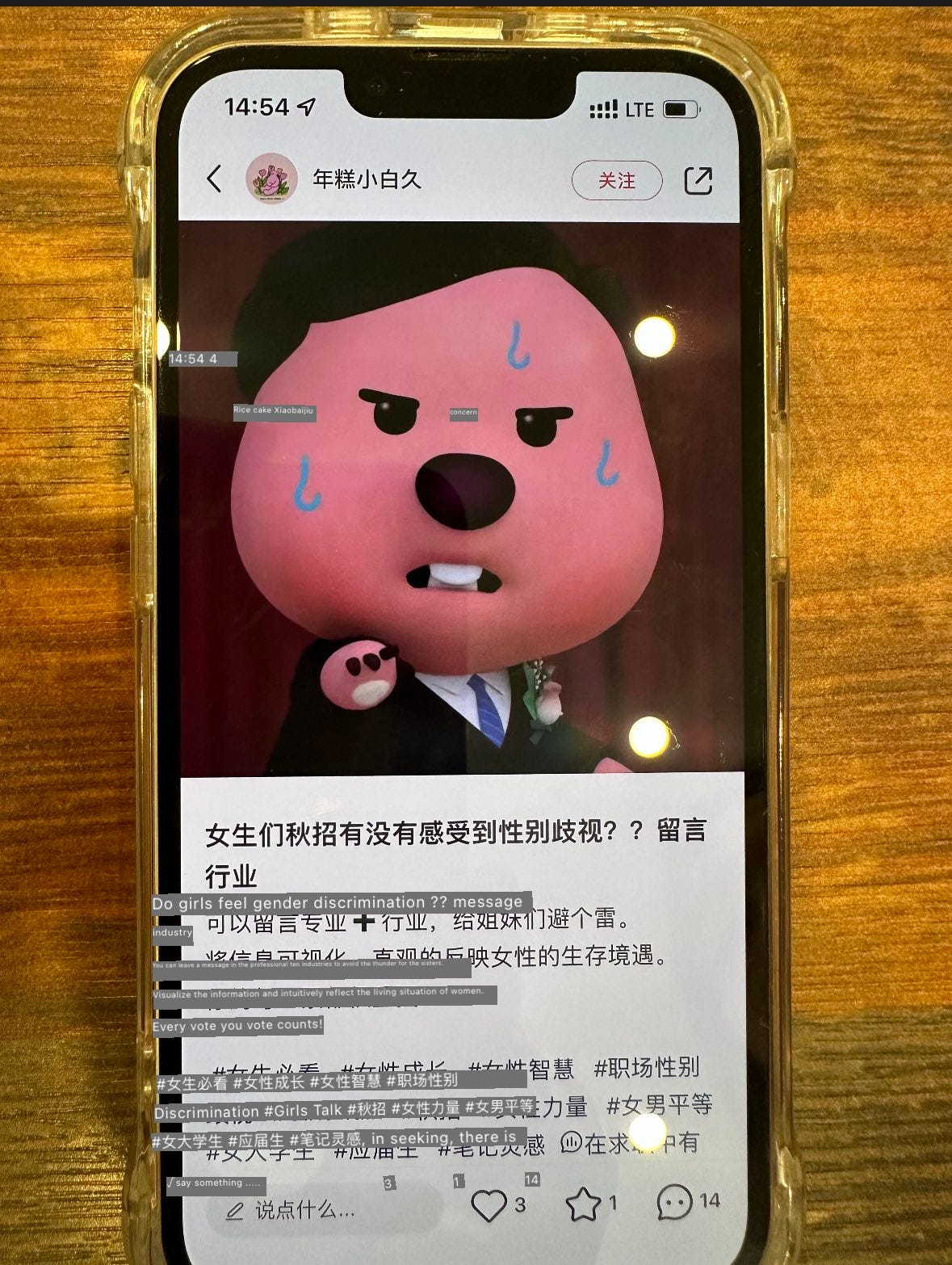
Another user invites women to share their experiences of employment discrimination. One replies that she went to a recruitment fair where they openly told women, “don’t bother applying” (i.e. we want men).
Meritocracy requires Countervailing Power & Persuasion
While social media enables women to highlight unfairness and legitimise feminist consciousness, these conversations tend to remain trapped in their own echo chambers, while men vent on Baidu Tieba. Resistance is further constrained by authoritarianism, and the CCP’s tendency to preserve social harmony by repressing dissent. Seldom seeing successful resistance, many women remain despondent. Absent independent organisations, women have little option but to navigate around bigotry.
Western feminists operated in far more permissive environments. The 1960s-70s counter-cultural movement and civil rights, condemned structural discrimination and condemned bias as categorically unfair. Harnessing this moral crusade, feminists persuaded their peers to regard sexism as similarly unjust. Liberal democracy proved equally crucial: turning to investigative newspapers and independent courts, women secured legal victories, won public support and created powerful deterrents. Because mass media had relatively high barriers to entry, these ideas became part of the wider cultural tide. By persuading the state to uphold merit and punish discrimination, female education thus became politically consequential.
But herein lies the Great Gender Divergence… In much of the world education does not break patriarchal gatekeeping, because men either discourage women from leaving the house or by closing ranks at the top.
(Xiaoxia Huang presented her paper at The Empirical Gender Network Conference, organised by Sole Prillaman, hosted at Stanford’s King Center on Global Development).
I can’t confirm that this is true, but I suspect that the hiring behavior is rational, at least broadly speaking, and so will be hard to change. My impression is that the hiring decisions are based on an expectation not just that men will be better at cultivating guanxi for the organization, but also that they will be more valuable members of the professional network for the individual people hiring them. Which isn’t wrong, so it is a self reinforcing system. I think that so long as who you know is more important than what you know that kind of discrimination will persist. I’ve definitely heard that married women are discriminated against in hiring, due to the expectation that they will have children and quit. In an environment where the purpose of hiring someone is their work product, that’s okay, you can just hire someone else. But if a significant part of what you hire someone for is to bring their own network along with them, and enhance their coworkers network, someone who you think will take a career break upon having kids is a much bigger risk, as if they do take that break then you lose their connections. My spouse even worked with one woman who flat out lied about being married just to improve her chances of being hired.
Due to a lack of protections for workers and the absence of labor inspection mechanisms at the institutional level, discrimination in China is severe not only against women but also against older individuals. For example, it is very common to see requirements stipulating that master’s degree candidates must be no older than 28 and bachelor’s degree candidates no older than 24. Additionally, China is home to the well-known “35-year-old crisis,” whereby individuals over the age of 35 who have not advanced to management positions face a risk of unemployment. Furthermore, when faced with two candidates of equal ability and educational background, many organizations seem to consistently favor male candidates. Voices speaking out against such practices are not widely accepted by the mainstream. In fact, to put it somewhat bluntly, most middle-aged and older men likely view feminism as a political tool of the U.S. Democratic Party or the dominant ideology of Western society.