


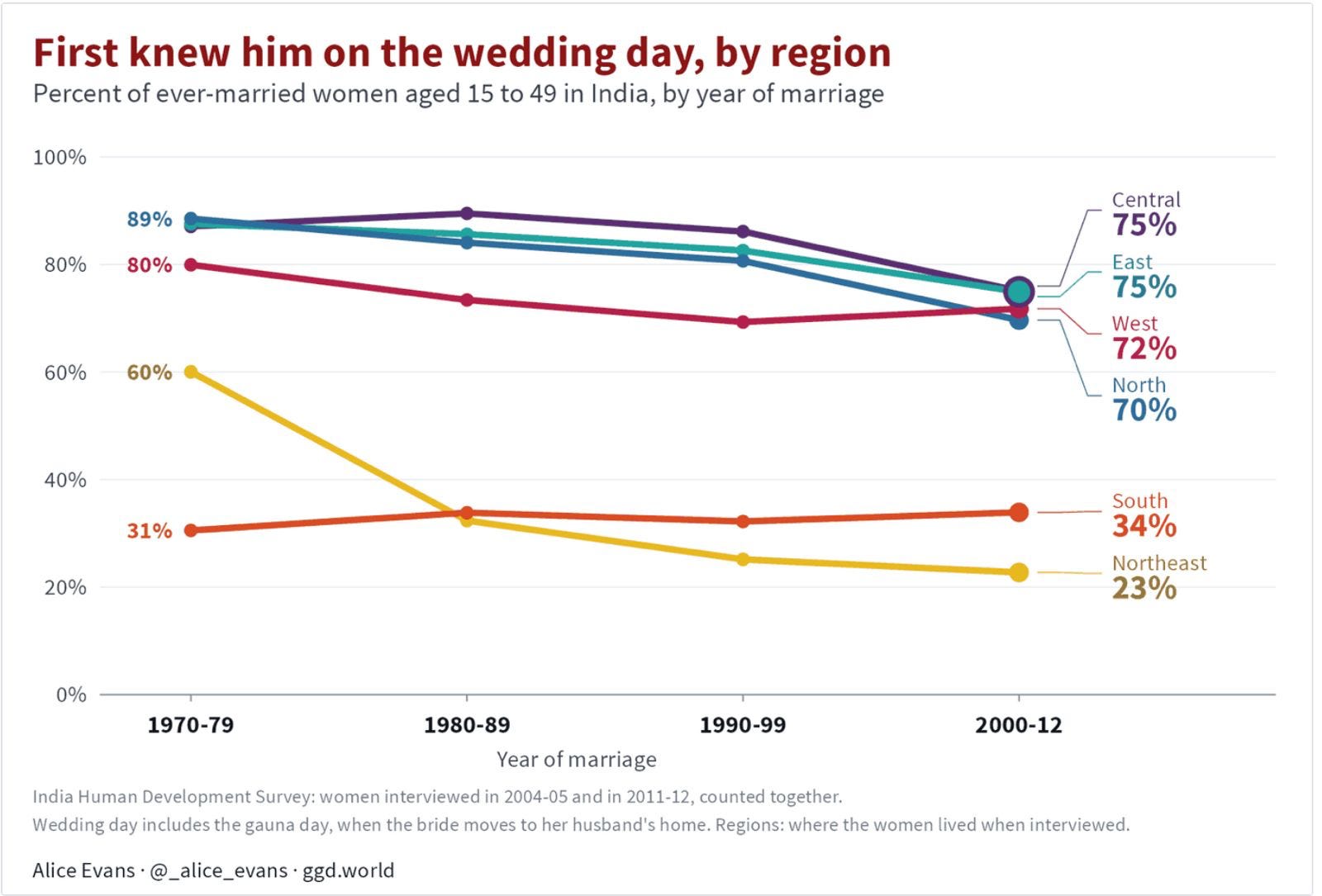
63% of Indian women who married in 2000-2012 first met their husbands on the wedding day. Others usually met a few days or weeks beforehand. Arranged marriages have declined across other world regions, so why do they remain pervasive in South Asia?
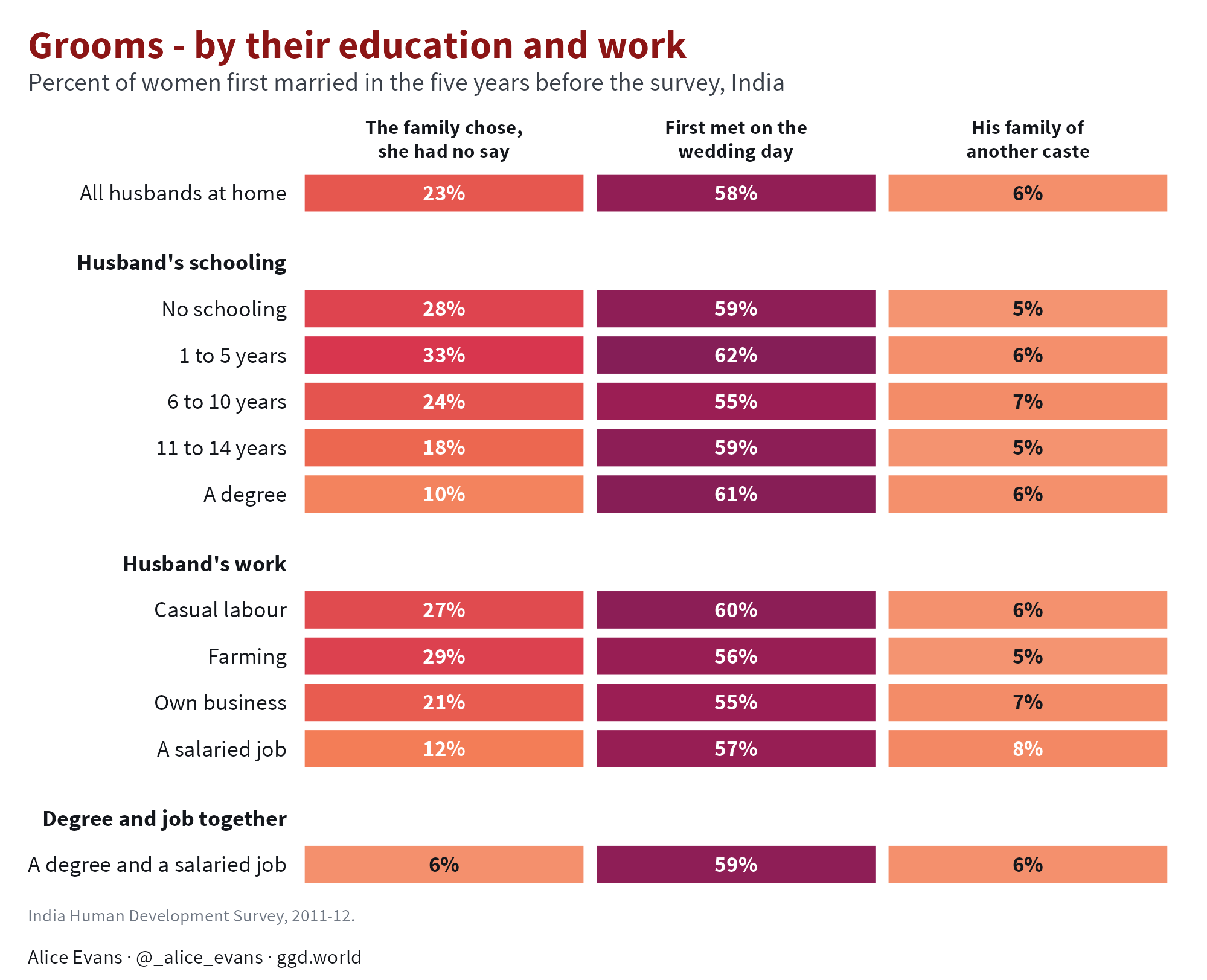
South Asia’s pervasive poverty, informality and dearth of secure employment may be part of the explanation, reinforcing dependence on kinship networks. But even as modern young men venture to university, migrate to cities and get salaried jobs, many still defer to their parents’ choice of bride. As you can see in the graph below, even if an Indian man is highly educated or salaried, he is scarcely more likely to meet his bride before their wedding. Why is this? Why doesn’t earning your own living bring the freedom to choose your own wife?
Duty is revered - by families, communities, religion and Bollywood movies. Growing up, boys are praised for loyalty and sacrifice, while those who pursue their own desires may be chastised as selfish. Caste and kinship are not reducible to financial insurance; they may also provide pride, identity and belonging.
South Asia’s modernizing reformers certainly pushed for sweeping changes - condemning egregious harms such as sati, child marriage, polygyny, and enforced widowhood, while championing later marriage, female education, and conjugal companionship. But they often accepted, or even praised, reverence for parents and kinship endogamy. Transgressions, however slight, often provoked vicious attacks.
Economic growth might reduce arranged marriages, as more young people choose their own spouses while honoring their duty to marry within caste. But men are still restricted and women are even more so. A 21 year old woman, Kaushalkumar Patel, was allegedly strangled to death by her father last week, after refusing to end a relationship with a man from a different caste.
The Spectrum of ‘Choice’
Across East Asia, Central Asia, South Asia, the Middle East and North Africa, families historically monitored their daughters - fearing impropriety, pregnancy and social disgrace. Arranged marriages not only consolidated trusted networks but also prevented pre-marital sex. The stronger the opposition to free-mixing, the greater the incentive to arrange marriages. While parents may now loosen some constraints, they may still impose guard-rails - such as by keeping girls cloistered, arranging suitors, or preventing correspondence till the wedding day.
Thus before digging into the data, we must clarify: what does it mean to ‘choose’ a spouse?
Our choices reflect our internalized ideologies, social expectations, and information about prospective partners. Combined, these shape the scope for choice. At one end, parents may praise clan or caste loyalty and condemn individualism - motivating daughters to acquiesce. She may only meet suitors arranged by her parents, under their supervision. Even if she goes to university, she may be so chaperoned that she has little opportunity to really learn about men. Head over heels, she falls desperately in love with the first guy who calls her ‘pretty’, without really knowing him at all. At the other end of the spectrum, she may be encouraged to mix and mingle with a wide range of men, develop friendships over a longer period, carefully assess suitors and learn to recognize warning signs.
Thus even if women can reject a suitor, they may be blocked from doing a full inquiry, or comparing alternatives. It’s a bit like going shopping in the USSR: yes, you chose to buy the sausage and brown jumper, but communist planners decided what was on the shelves.
Choice thus depends on who can veto a match, who is considered acceptable, and whom young people can befriend.
The Imperial Patriarchal Alliance
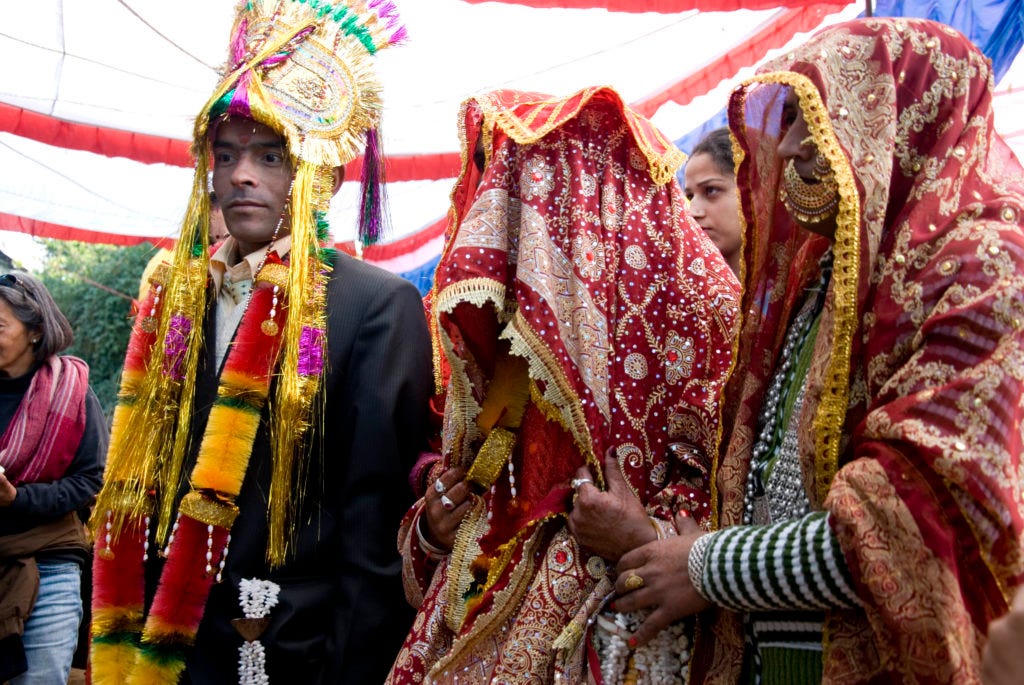
Colonizers governed vast territories by building alliances with local authorities, and were often cautious to avoid attacking their customs, for fear of jeopardizing support. Accordingly, they struck an imperial-patriarchal alliance in order to preserve men’s support. But this precise bargain varied by the nature of patriarchal rents that local elites sought to extract - in Sub-Saharan Africa, chiefs sought control over women’s labor and fertility.
In India, the British needed princes, zamindars, taluqdars and other landed authorities to collect taxes, coerce labor and keep order. And that alliance could be jeopardized by aggressive interference with men’s control over women.
Pandita Ramabai, a pioneering social reformer, put it best:
“British colonial authorities had forged an “agreement.. with the male population of India”. If England were to protect “a helpless woman against the powers and principalities of ancient institutions, Mammon would surely be displeased and British profit and rule in India might be endangered…
Success [was] at the sacrifice of the rights and the comfort of over one hundred million women..
Christian missionaries petitioned the Government to abolish this inhuman custom [sati], but they were told that the social and religious customs of the people constituted no part of the business of the Government, and that their rule in India might be endangered by such interference” (Ramabai 1887, 37, 42-44).
The East India Company expressed precisely these fears: intervening in local customs would trigger communal retaliation. Discussing the suppression of sati in 1819, Mountstuart Elphinstone weighed the risks: “If we succeed we save 100 or 1,000 victims from voluntary immolation. If we fail we involve sixty millions in all the horrors of war and revolution” (Metcalf 2016, 6).
In 1857, Indian soldiers shot their superiors and marched on Delhi. After decades of imperial annexation, coercion, interference and proselytizing, Hindus and Muslims were angered by rumors that new cartridges were greased with cow and pig fat. The Gangetic plain became engulfed in rebellion. After a year of fighting, the East India Company was abolished.
In 1858, the British Crown assumed authority and pledged not to interfere in India’s cultural and religious matters. Officials urged caution. Past reforms, like the Widow Remarriage Act, were now strongly criticized. Disraeli stated it had “disquieted the religious feelings of the Hindus”. Upper caste Hindus, remarked one District Officer, “regard it with extreme aversion and deprecate Government interference in what they declare to be directly a matter of religion”.
Empire took priority. John Lawrence, Lieutenant-Governor of the Punjab, wrote in 1858 that polygamy and child marriage, though “socially very objectionable”, could not be suppressed because people “would shed blood for their sake” (Metcalf 2016, 105). In 1884, Behramji Malabari declared, “Suttee, infanticide, the rolling of the Juggernaut Car: the suppression of these raised a howl of indignation at the time. Government were threatened with mutinies and rebellions”.
In 1900, Kanpur witnessed a five-day riot after medical authorities removed a Bania widow diagnosed with plague - a violation of purdah. As Charu Gupta explains, this was a violation of purdah. To placate massive social unrest, the colonial government stepped back, making exemptions for ‘respectable’ women.
But what cultural interventions triggered such communal backlash? Here, we need to understand prevailing nature of gender relations.
Pandita Ramabai’s Analysis of Caste & Patriarchy
In 1887, Pandita published “High-Caste Hindu Woman”, which sold 9,000 copies internationally within a year. I recommend this book, perhaps more than any other, for its astute analysis of Indian patriarchy - attributing it to wide acceptance of patriarchal religion, caste policing, and the colonial alliance.
She details that high-caste families tended to arrange their daughters’ marriages while she was still young, so as to preserve their reputation for chastity. After marriage she was often kept in seclusion. The “child bride is brought to be for ever confined.. breaking the young bride’s spirits is an essential part of the discipline of this abode. She must never talk or laugh loudly, must never speak before or to the father.. unless commanded to do so”. “High-caste women, unless their families are actually destitute of means to keep them, are shut up within the four walls of their house” (Ramabai 1887, 56).
Ramabai argues that in the absence of marital consent, men did not necessarily love their wives, and hence inflicted beatings:
Since “marriage is conducted without consent of either party… I have several times seen young wives shamefully beaten by brutal young husbands who cherished no natural love for them”. In the rare cases of a happy couple, she attributes this to their being in love (Ramabai 1987, 26).
Religious texts, like the Manusmriti, promised women blessings for obeying and worshipping their husbands as a ‘god’. Widowhood was regarded as punishment for her crime in a past life, such as disobedience or disloyalty to her husband (Ramabai 1987).
British Courts affirmed Arranged Marriage
Pandita Ramabai blamed arranged marriage on the caste system, though also criticized the colonial-patriarchal alliance for upholding men’s prerogatives.
One of Pandita’s relatives had recently been betrothed in childhood, but the man had grown up to become a “dunce” while she was “accomplished”. He wished to marry her, then collected funds from conservatives and sued in the British Court of Justice, which concluded in his favour, forcing her to marry.
In a landmark legal case (1884-88), Rakhmabai refused to marry the man to whom she had been betrothed. When taken to court, Rakhmabai argued that she should not be forced to live with a man against her will. The presiding Justice Pinhey agreed, but this triggered massive patriarchal backlash. As Pandita Ramabai records,
Tilak and other nationalists organized a public meeting, to quell defiance - so that ‘no Rakhmabais or Ramabais threatened to disturb the peace of the community’.
They called on the British ‘to again invest with the power of excommunication’. Citing all authorities on Hindu law, they asserted that ‘the greatest possible care should be taken to guard or watch over women, they are incapable of independent existence both by virtue of their physical inferiority and their situation in life’… ‘women are to live with their husbands though devoid of any merit and should seldom entertain the idea of separating themselves from their husbands, father, and sons otherwise they would bring both the families to disgrace’.
‘Rakhmabais should be punished for the same reason as there is punishment for thieves, adulteress and murderers’. Her refusal to live with her husband was likened to theft, adultery and murder. (Rao 2008, 164)
Tilak criticized British colonizers for emancipating Indian women: ‘Manu says that women should always remain under the guardianship ... the government has surpassed Manu. They have liberated women’. In his view, India’s independence was necessary to reassert patriarchy and prevent women’s entry into the public sphere.
Going back to the legal case… the groom Dadaji appealed and secured a retrial. Justice Farran ordered Rukhmabai to go to Dadaji’s house. Defiant, she said she would rather go to jail. Eventually, they brokered a financial settlement and paid him off.
Any transgressions or infractions invariably triggered colossal backlash and antagonism. Men and women who pushed for free-choice were condemned as selfish and individualistic (Majumdar 2009, 109). Reformists repeatedly noted that their peers felt unable to deviate, or else be relentlessly attacked.
“The higher classes of Hindus, the more educated amongst them, feel the necessity of discountenancing child marriage; and most of these would undoubtedly act up to their convictions if they only could. But caste is too powerful even for men in that position” (Behramji Malabari 1884, 3 - author and reformist)
“The Hindu ideal of marriage has no regard for individual taste or inclination - it is, rather, afraid of them” (Tagore 1926, 104 - Bengali polymath and Nobel Prize winner).
Child Marriage
In 1889, a ten year old girl, Phulmoni, died during intercourse with her 30 year old husband. Reformists called it “rape murder of a child-wife”. Under the Penal Code, her husband was only convicted of a rash and negligent act, so served just one year (Sarkar 1993).
The Age of Consent Bill would raise the limit for sexual intercourse from 10 to 12. Conservatives hit back, accusing reformists of “perverting the Shastras”. Orthodox Brahmins said that this would violate the shastric injunction to consummate marriage within 16 days of the bride reaching puberty, if that occurred before she was 12. The husband would then face the choice of hell or jail (Kosambi 2016, 183).
Opposition also came from nationalists. Tilak objected to foreign interference over Hindu families (Metcalf 2016, 116). He further argued that ‘the reformers are bent upon bringing women out of the house to which the Hindu lawgivers had confined her to” (cited in Rao 2008). The Act ultimately passed in 1891, but was seldom prosecuted.
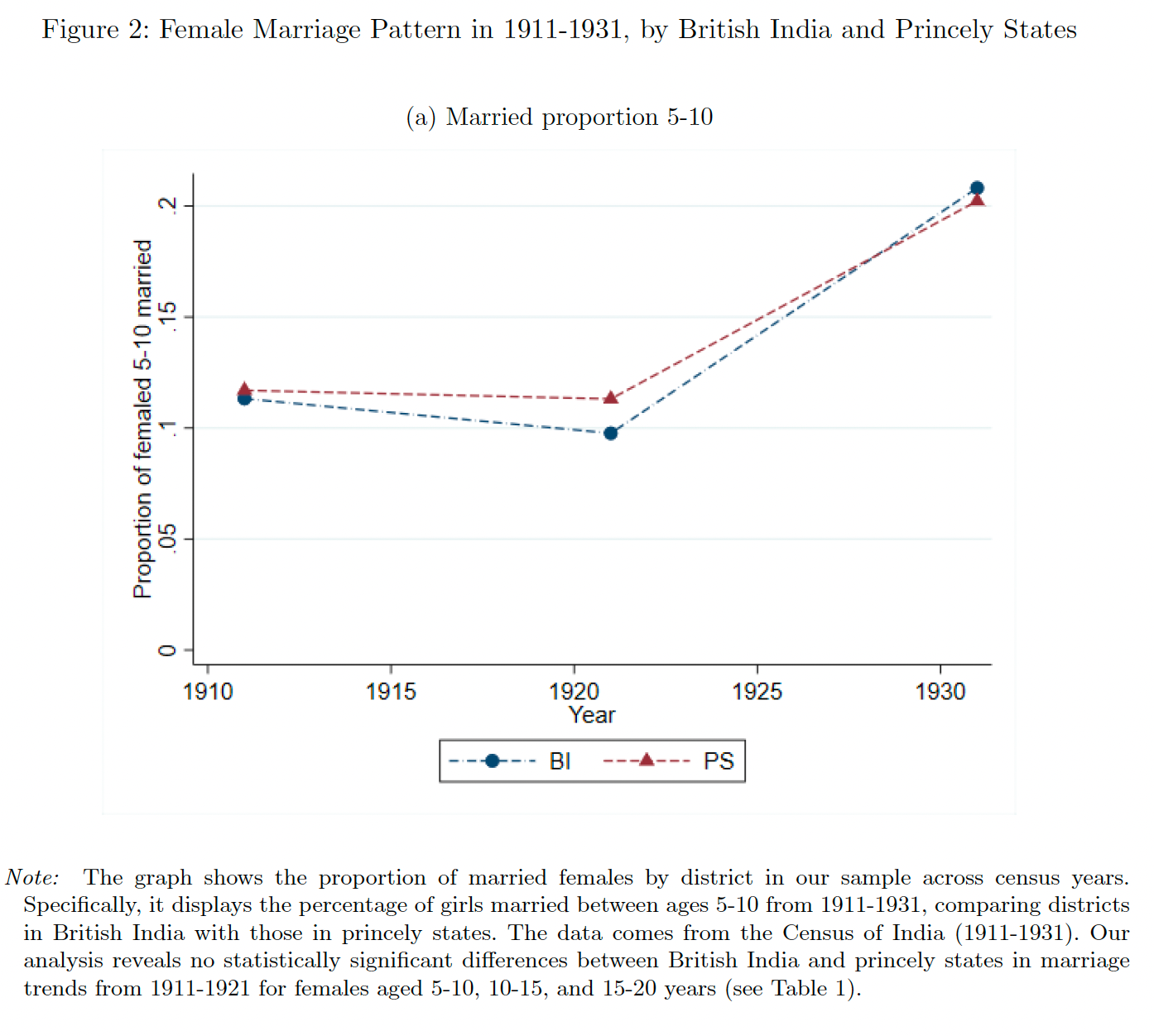
In 1929, Har Bilas Sarda’s Child Marriage Restraint Act set the minimum age of marriage for girls at 14. The Act was announced in September, enforced from April 1930. Racing to beat the deadline, families hurried to get their daughters married - resulting in a higher share (20%) of girls under 10 being married.
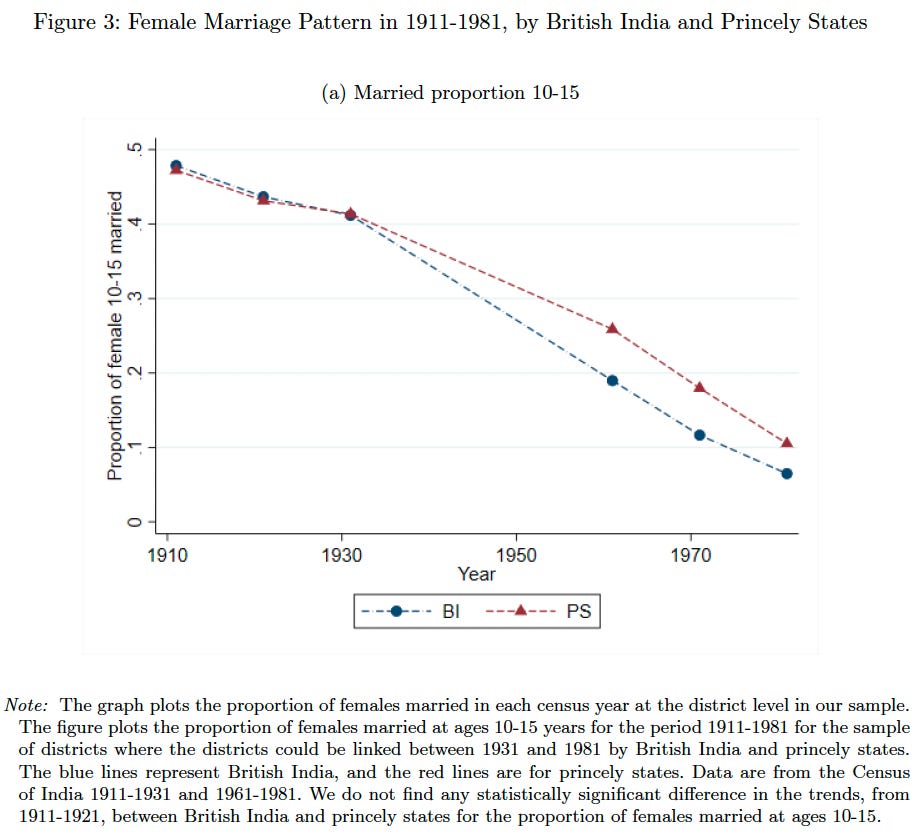
The Act only applied to British India, not princely states. Over the 20th century, both sets saw a decline in child marriage. The decline occurred slightly more rapidly in British India (Roy and Tam 2025).
The Emergence of Dowry
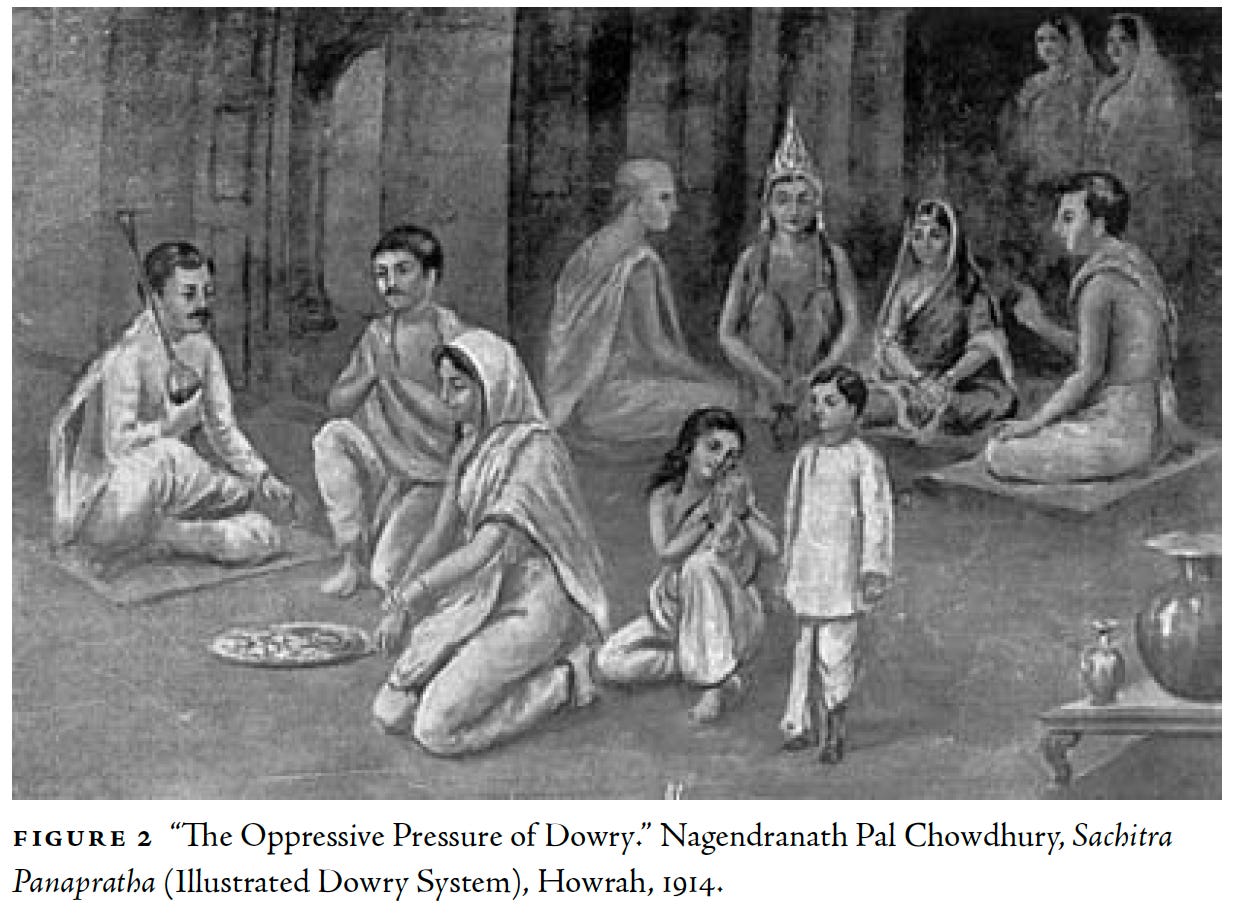
From the late 19th century, dowry (paid by the bride’s family to the groom’s) spread across India and continued to escalate - to much consternation. As some men gained education, salaried employment or successful businesses, this created male differentiation. Brides’ families then bid for ‘better grooms’.
Bengali journalists and plays often criticized this new “marriage market wherein bridegrooms were sold for a price by their parents” (Majumdar 2009, 61). The groom did not necessarily know (or select) his bride, while his parents often managed (at least part of) the proceeds.
Injecting Ideals of Companionship
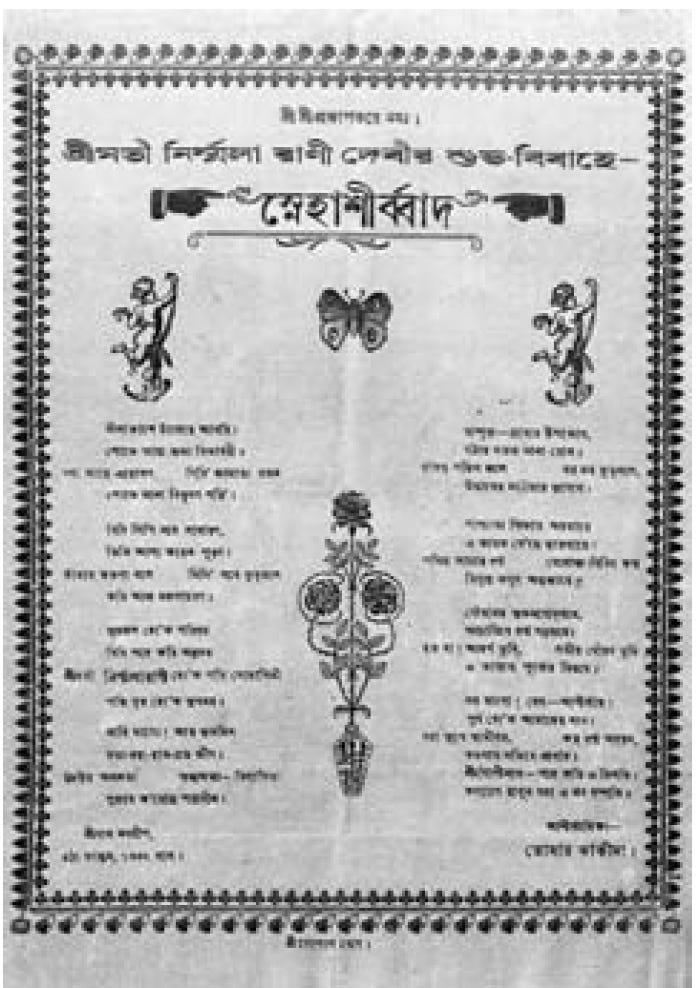
Rather than cede to pressures for Westernizing reform, some Bengali reformists carved a middle ground: injecting arranged marriage with ideals of post-marital love and companionship, incorporating poems for different rituals (priti upohaar). One grandmother penned a poem for her granddaughter’s wedding, including the lines,
“Today’s occasion is wrapped in a sweet romance [the English word romance was used in the Bengali version]
That fills your mind as you unite together, with the sacred fire as your witness” (translated, Majumdar 2009, 110)
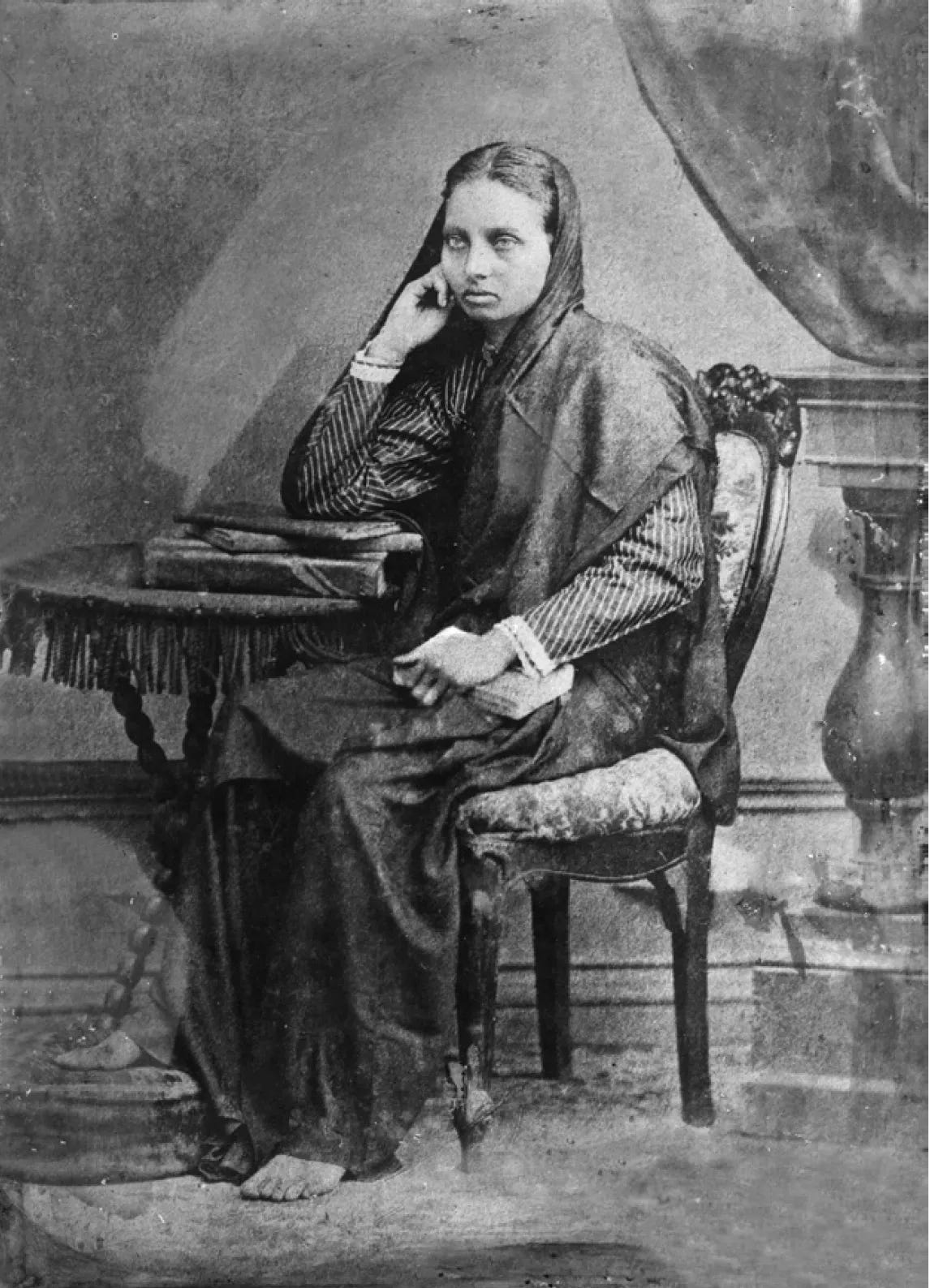
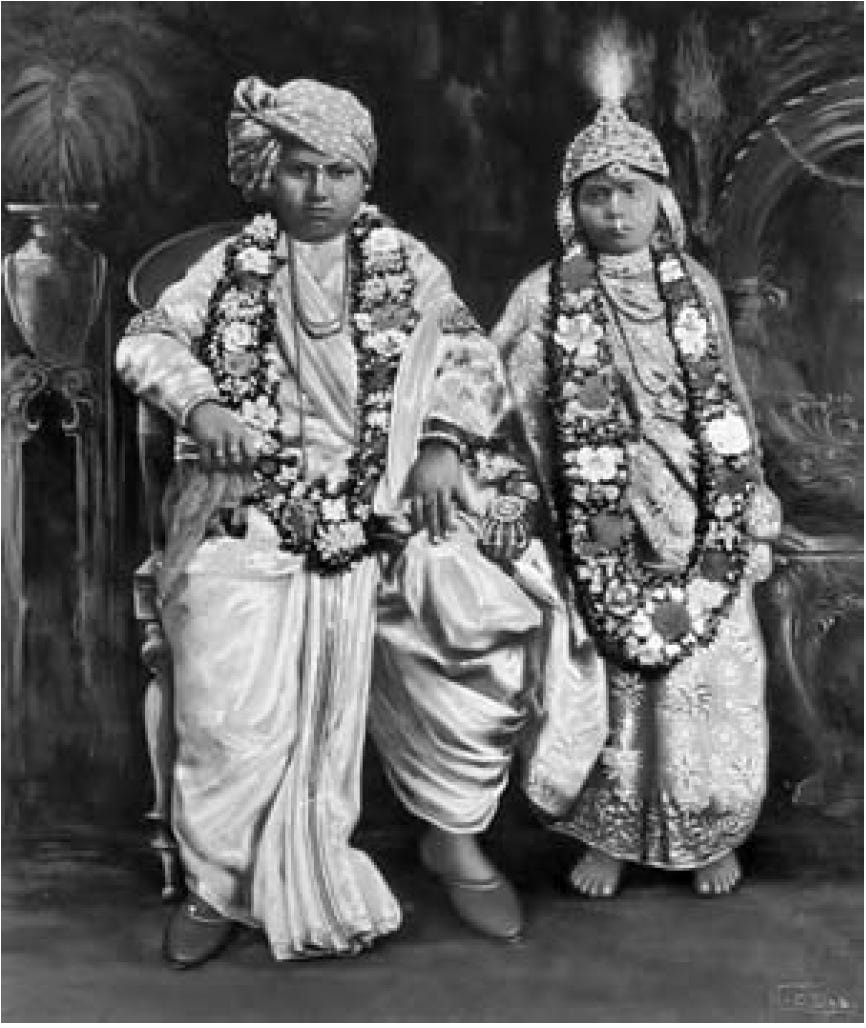
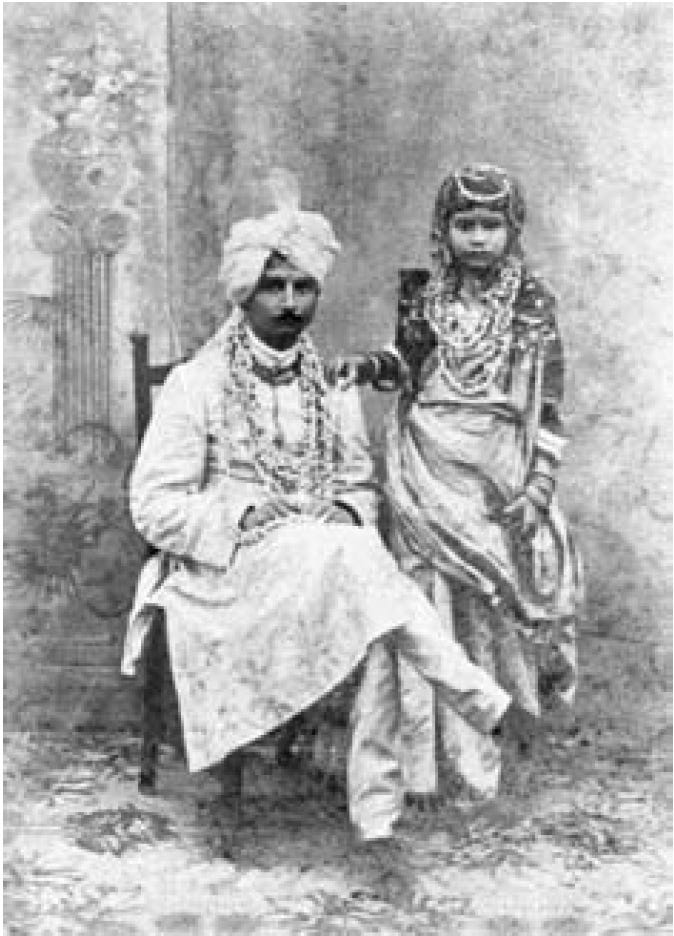
Another poem starts by pleading the god to “make Srimati Nirmalarani the recipient of her husband’s love”, while also encouraging her to “Practice dharma with enthusiasm… Become an ideal, the pride of satis”. Here, ‘sati’ is metaphorical; it means wifely devotion and sacrifice in the name of dharma (rightful conduct). Women were thus assured that if they totally dedicated themselves to their husbands, they too would be loved. In the late 19th century, urban middle class families sought studio portraits, showing themselves as couples (see photos below). (Majumdar 2009, 152-154).
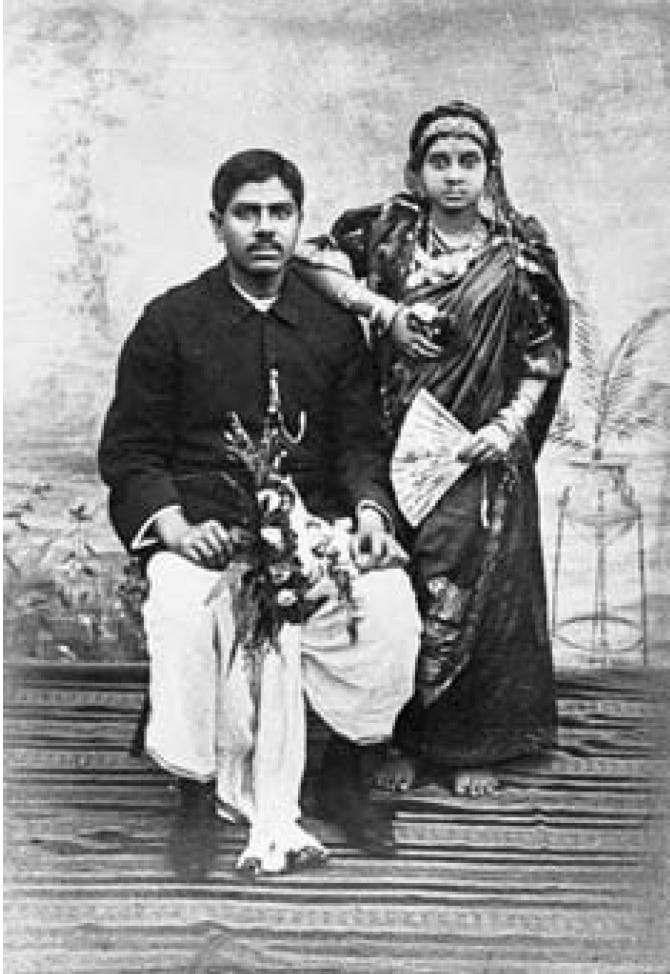
Dutiful Men
The men who would lead India’s struggle for independence often grew up in families where sons obeyed their elders and conjugal intimacy was stigmatized. Dr Rajendra Prasad, India’s first president, was married at age 12. When his wife contracted cholera, he wanted to see her, but
“it was considered bad form… to show much interest in one’s wife… I wanted to see her and get to know her, but could not ask anyone nor express the desire to do so. Perhaps it did not occur to my folks that I too was interested in her health [and her!]” (Prasad, quoted in Pandey 2025, 63).
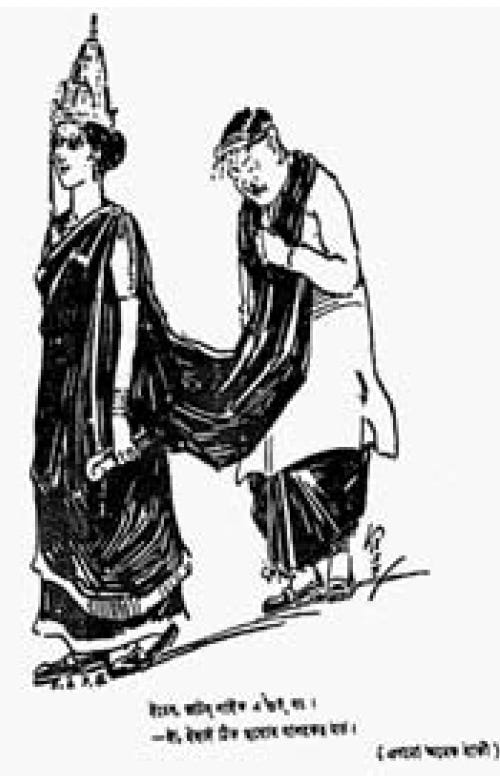
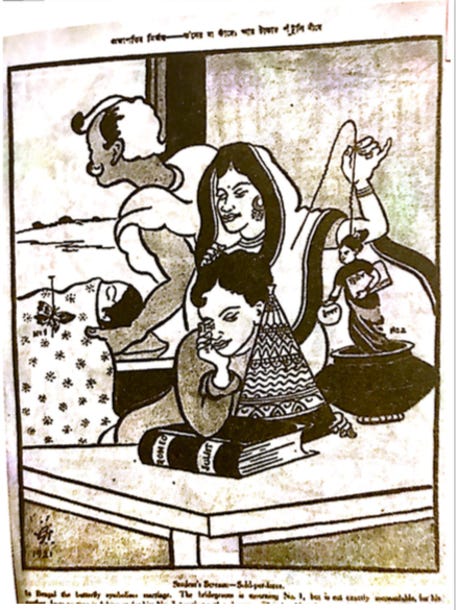
In Bengal too, many were uneasy with romantic love and the conjugal couple, as manifest in satirical plays, essays and cartoons, often featuring a man’s subordination (Majumdar 2009, 147).
Even as educated men strode out to study, travel, write and act in public, championing national freedom, many remained deeply suspicious of young people’s pursuit of pleasure (Pandey 2025, 82, 169). Premchand, a renowned Hindi-Urdu writer, cherished companionship, but nevertheless complained about young people’s frivolous free-mixing (ibid, 69).
Respectable families thus adopted later marriage, female education, and conjugal companionship, but overwhelmingly abhorred any notion that young people should selfishly pursue their own desires. Virtue was measured in service, sacrifice and familial loyalty; prioritizing personal happiness was often condemned as selfish and disrespectful.
Ambedkar
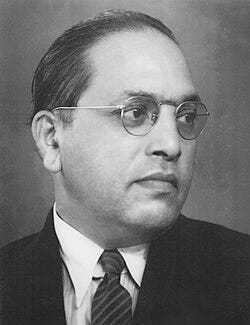
Ambedkar - first law minister of independent India and chief writer of the 1950 Indian constitution - stridently opposed the entire caste system. In the Annihilation of Caste (1936), he wrote that all reform begins with one individual standing up for his own beliefs, seeking to convert others, and this is more likely to occur if the wider community is liberal and tolerant. But in India, anyone who challenges the caste system is subject to torrential backlash:
“If the group is intolerant, and does not bother about the means it adopts to stifle such individuals, they will perish and the reform will die out..
Individual Hindus have not had the courage to assert their independence by breaking the barriers of Caste.
A caste can easily organize itself into a conspiracy to make the life of a reformer a hell... Caste in the hands of the orthodox has been a powerful weapon for persecuting the reformers and for killing all reform” (Ambedkar 1936).
What Stopped Muslim Social Reformers?
Ambedkar was puzzled: Indian Muslims aggressively resisted social reform. In 1930, Muslims had even initiated a campaign of Civil Disobedience against raising a girl’s minimum age of marriage to 14 on the grounds that it was against sharia. Islam alone could not explain this antagonism, since Turkey had undertaken “revolutionary” reforms. So why were there so few Indian Muslim reformists?
Ambedkar’s answer was communal insecurity.
As a minority in a primarily Hindu society, Indian Muslims feared cultural loss and political subordination. In his account, they closed ranks, suppressed internal dissent, and competed for representation. Ambedkar hoped that the formation of Pakistan would alleviate these tensions and create space for social reform (225-229, 237-238).
Ambedkar noted there was pressing need for reform: purdah, arranged marriage and caste hierarchy:
“Owing to purdah, a Muslim [man] has no contact with any women outside those who belong to his own household… Among the Muslims, purdah has a religious sanctity which it has not with the Hindus”… it reflects “deep-rooted suspicion of sexual appetites of both sexes” (221-222).
“No Muslim girl has the courage to repudiate her marriage.. No Muslim wife will think it proper to have a clause entered into her marriage contract reserving the right to divorce… She cannot escape the marriage tie” (216-217).
On caste, Ambedkar cited the 1901 Census of Bengal, which described divisions between Ashraf (noble, often converts from high caste Hindus), Ajlaf (lower ranks) and Arzal (degraded). The Report details that among Muslim Bengalis,
“These groups are often as strictly endogamous as Hindu castes. The prohibition on intermarriage extends to higher as well as to lower castes... If this rule is transgressed, the offender is at once hauled before the panchayat and ejected ignominiously from his community” (Census 1901, 441).
But was Ambedkar correct? Was the dearth of Indian Muslim social reformers due to their minority status, as distinct from their inheritance of the Hindu caste system?
Indian Muslims had developed revivalist movements, intent on preserving and purifying Islam by instilling scriptural learning and religious orthodoxy. In the early 20th century, Deobandis used printing technology to issue popular primers on proper piety, reaching homes, mosques and reading groups, urging deference to the ulama. From the 1920s, Tabligh-i Jama’at missionaries also went to smaller towns and villages, promoting orthodoxy (Robinson 2008; Ingram 2013). The All India Muslim Personal Law Board has also opposed moves towards a Uniform Civil Code, saying that Muslim personal law must be preserved.
Hindu nationalists certainly exacerbated that antagonism. Gita Press was founded in 1920s North India. It glorified Hindu nationalism, discipline and duty, while casting Muslims as foreign invaders, threatening Hindu women (Sinha 2017; Gupta 2001).
But minority status cannot be a full explanation.
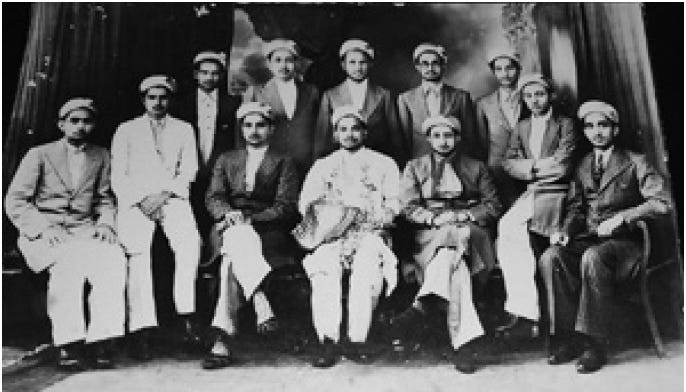
Indian Muslims tend to enforce occupational endogamy, just like Hindus. In the 1940s, young men from the Dawoodi Bohras stirred great controversy by shaving their beards, to which the local cleric responded by refusing them permission to marry. This business network thus maintained trust and credit through strict endogamy. Prosperity did not secure personal freedom.
Nor did Muslim-majority statehood eliminate organized resistance to reform. When Ayub Khan introduced the Muslim Family Laws Ordinance in 1961 (restricting polygamy and regulating divorce), Jamaat-i-Islami mobilized street demonstrations and circulated fatwa denunciations from ulama. Over the later 20th century, Pakistan saw an Islamic revival, entrenching religious conservatism.
Muslim-Majority South Asia in 2026
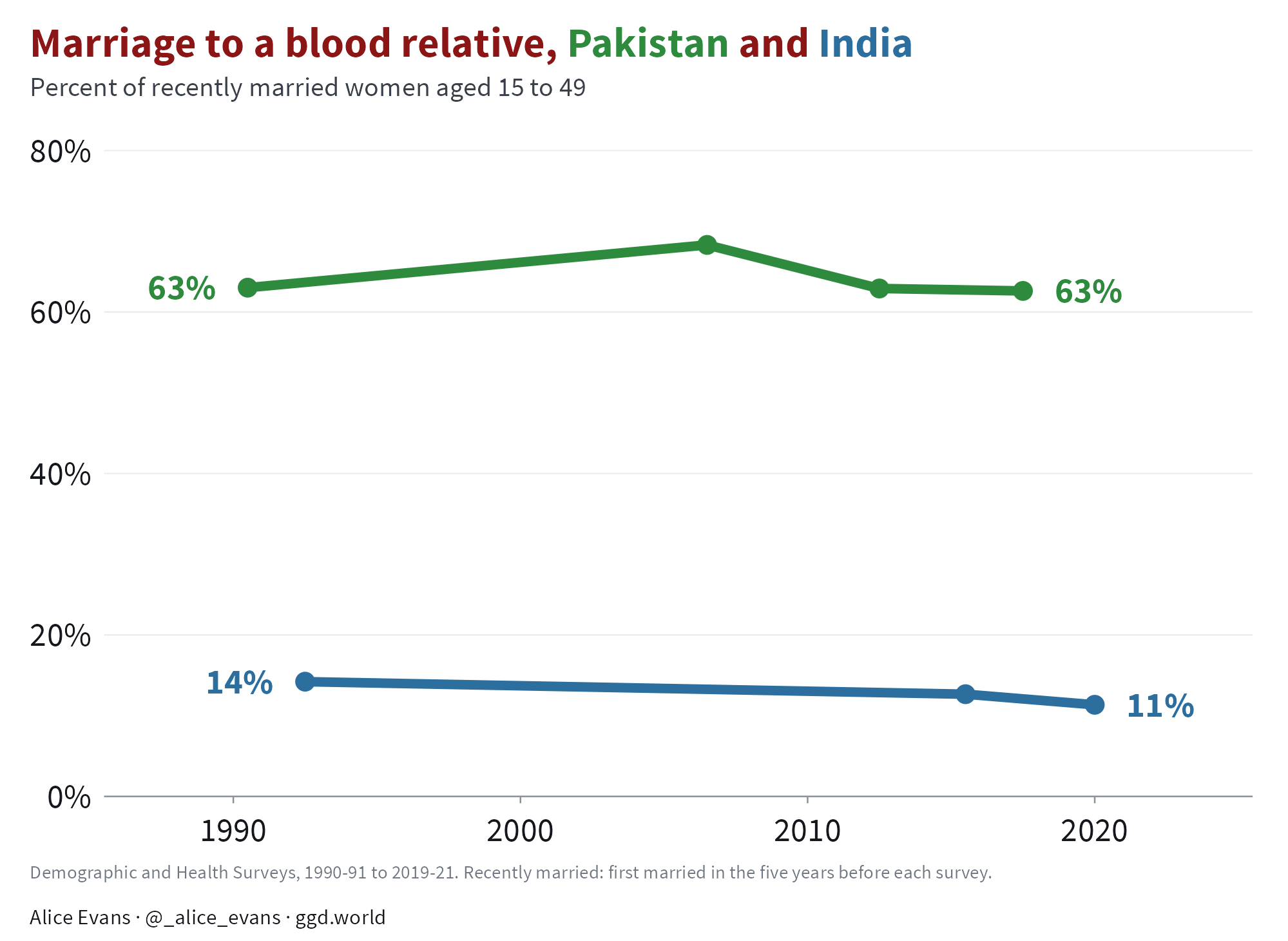
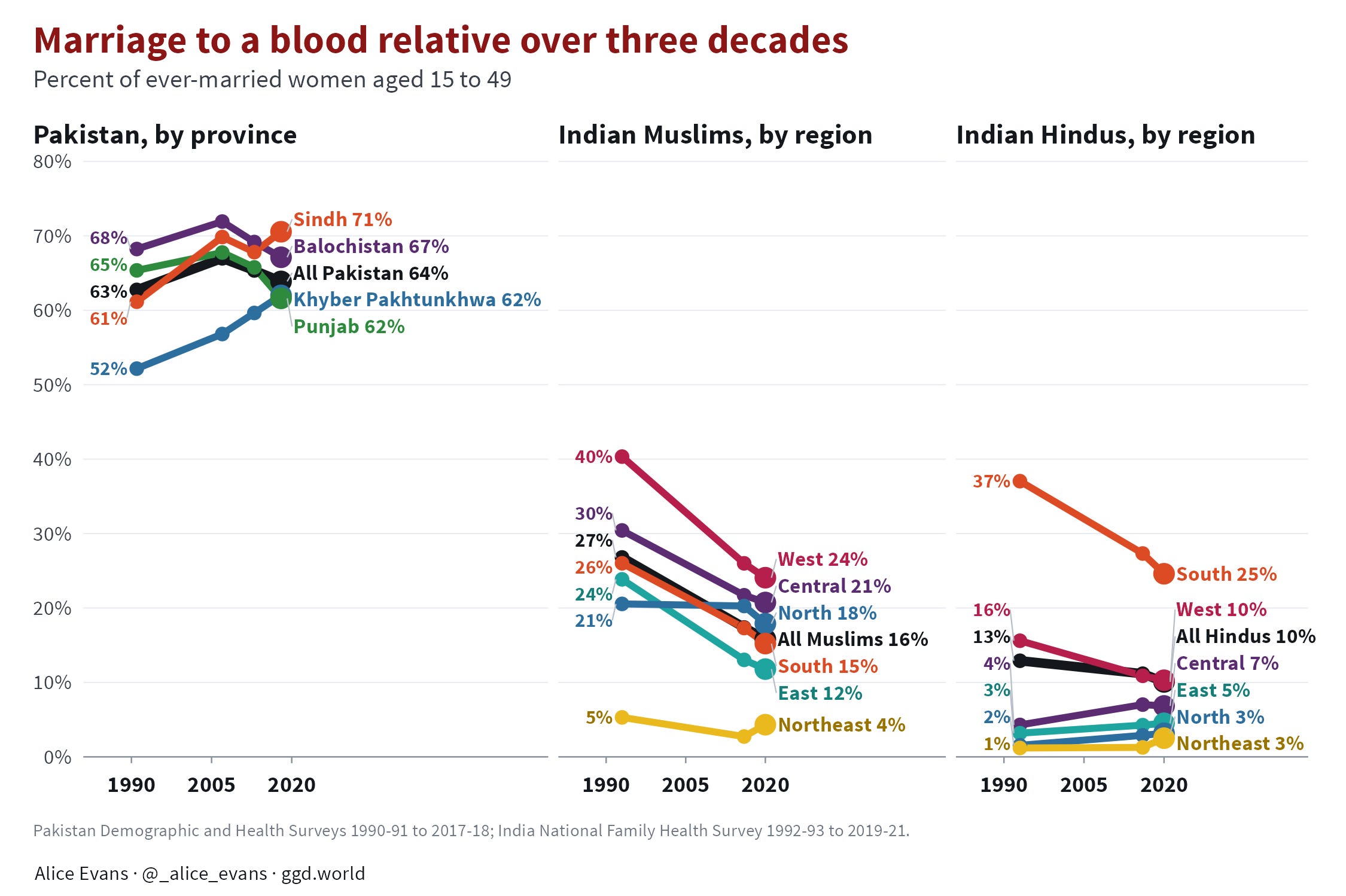
Fast-forward to Pakistan in 2017-2018, 63% of recently married women were married to a blood relative. By contrast, Indian Muslims are far less likely to marry a blood relative.
In 2001-02, only 12% of married young Pakistani women reported that they had expressed an opinion on who they would marry, and they felt heard. Just 27% had met their fiancé before the wedding, while 52% married a relative. Only 55% had actually discussed with their husbands how many children to have (Hamid et al 2011).
50% of married women surveyed in 2017-18 said their husband was a first cousin (NIPS and ICF 2019, 77). As long as parents seek to marry their children to close relatives, free-choice will likely be opposed.
In Afghanistan in 2006, almost 60% of female respondents were in forced marriages - without their consent, against their will. 39% said their husband had hit them in the past year (Global Rights 2008, 10, 14-15). Over 70% of Pashtuns justified honor-killings. Across cultures, honor-killings are more commonly justified among communities with high rates of cousin marriage - suggesting extremely strict policing of sexuality (Campbell et al 2024). In the Dari language, a man perceived as loving his wife and helping with the housework may be belittled as ‘zancho’ (Echavez et al 2016).
In Bangladesh, a 2006 survey found that 76% of young married women first met their husband at their wedding, compared with 82% of the older cohort. While the younger cohort was more likely to be ‘consulted’, this did not necessarily involve meeting the prospective spouse (Amin and Das 2008).
Parental control thus remains pervasive: neither men nor women have much information by which to assess prospective spouses.
India in 2026
Only 12% of Indian married women, aged 25-29, independently choose their own husband. While a rising share (67%) do report joint decision-making, this is often based on very little information. Only 44% of women aged between 25-34 said that, before marriage, they talked to their groom on the phone.
Sumit, an unmarried graduate student in his late 20s, shared that in his community, meeting before the wedding is impermissible, though someone may help orchestrate a secret phone call or meeting:
“Suppose my [engagement] ceremony is going to happen, and if I’m comfortable being frank with my sister-in-law… then I can tell her to ask for the girl’s number.... But parents can’t be told, on either side. So basically, it isn’t allowed” (quoted in Reed 2025).
Love marriages remain stigmatized. Young people often hesitate to pursue these matches, fearing loss of family support.
Regional Variation
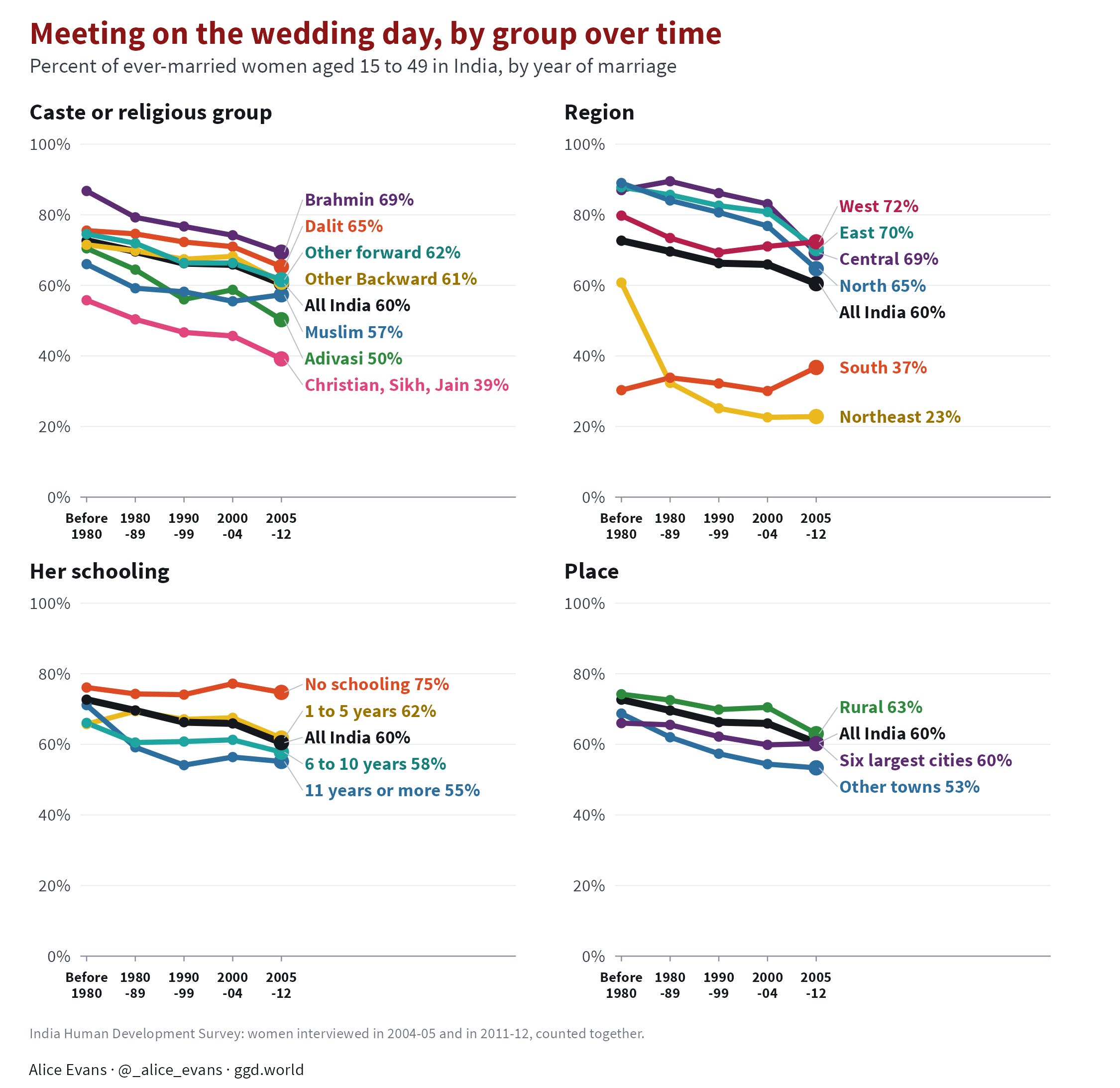
In North and Central India, 65-69% of recently married women interviewed in 2011-2012 met their husbands on their wedding day. In this same region, women typically say that men eat first. Combined, these indicate constraints on romantic love, with little selection before marriage and thereafter spending little time together.
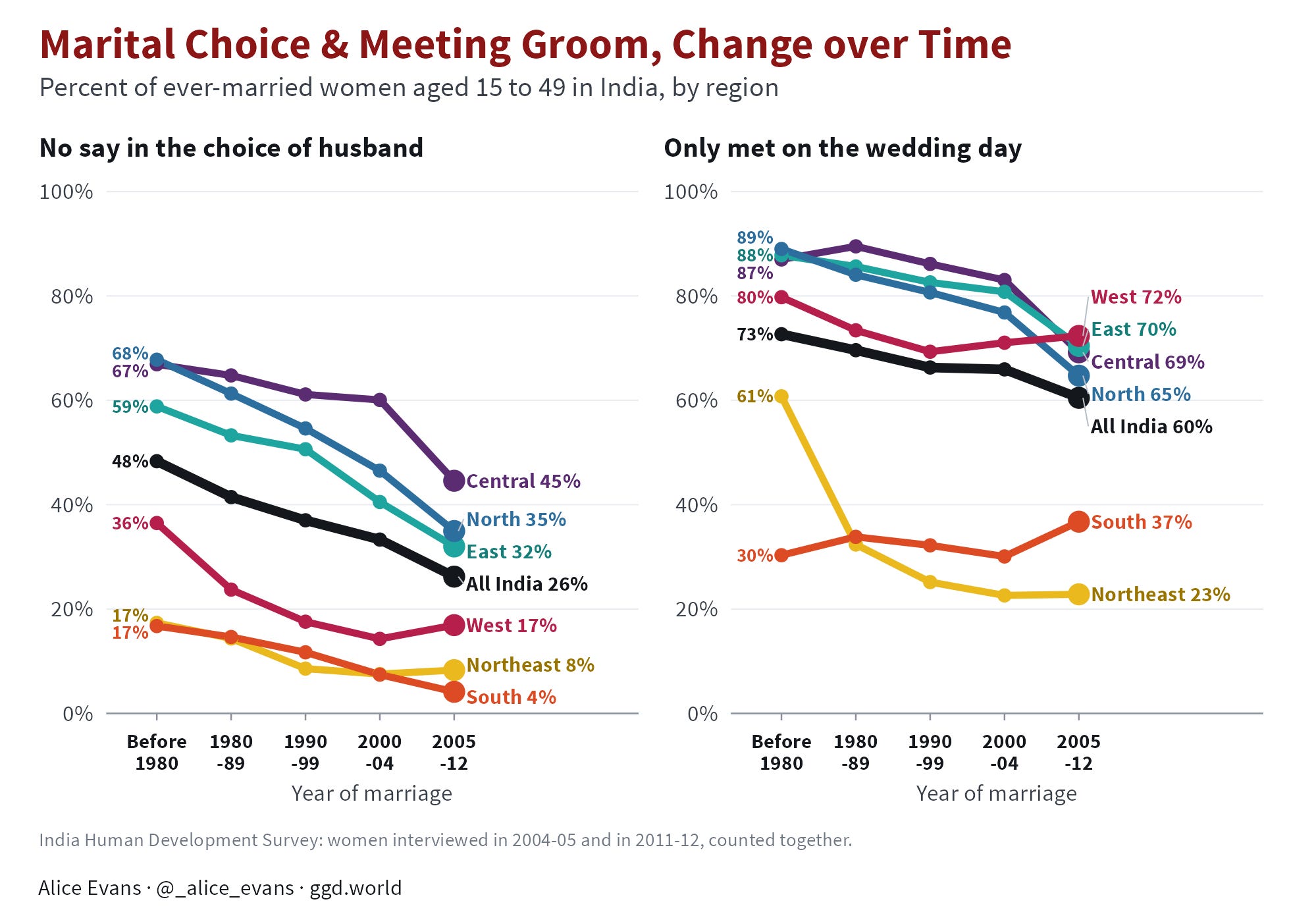

South Indian women are more likely to meet their husbands before the wedding and choose jointly with their parents - which sounds progressive. But this may partly reflect the greater prevalence of marriage to relatives.
24% of South Indian women who married in 2010-14 married a close relative, generally a first cousin. In societies where women’s movements are tightly restricted and kinship is highly revered, they may feel safer marrying a relative.
But pre-marital familiarity does not guarantee safety: 77–84% of women in Andhra Pradesh, Telangana, Karnataka and Tamil Nadu agreed that a husband could be justified in beating his wife. Since marriages are designed to consolidate kinship, divorces remain low - she cannot leave. Neelam, a Tamil man, explained that within an uncle-niece marriage,
“When they fight, the wife can’t go back to her mother’s house. What is the woman to do? Keep her daughter away from her brother?…
If the husband raises his voice, his wife forgives him. She tells herself, ‘He’s my mother’s brother; he has the right to grumble.’” (Clark-Decès 2014, 79).

Why is Arranged Marriage so Persistent?
Let us consider why arranged marriages remain so persistent, considering poverty, low media connectivity, and caste.
Poverty
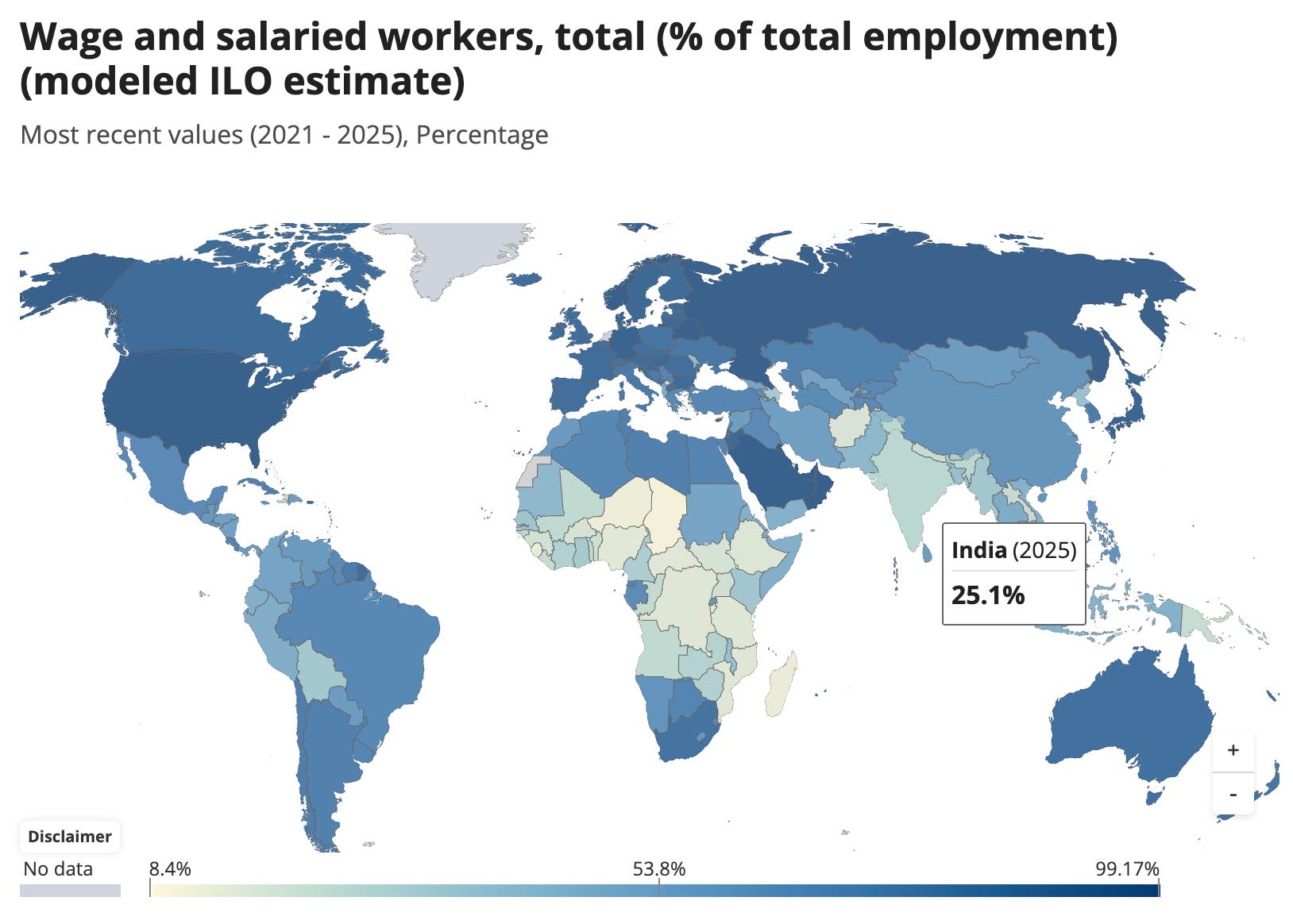
Only 25% of Indian workers have wages or salaries. Over 80% of Indian non-agricultural workers are in informal employment, lacking any kind of contract. Defying endogamy risks being outcaste: losing that vital safety net.
So what about cities? A 2022 survey of 1885 married women in 20 major Indian cities finds a rise in ‘self-arranged marriage’. 60% of respondents also expressed approval for their children entering self-arranged marriages.
Two notes of caution: (1) this data is not nationally representative, India remains 65% rural; (2) even self-arranged marriages were overwhelmingly within caste and religious boundaries (Torrisi et al 2026).
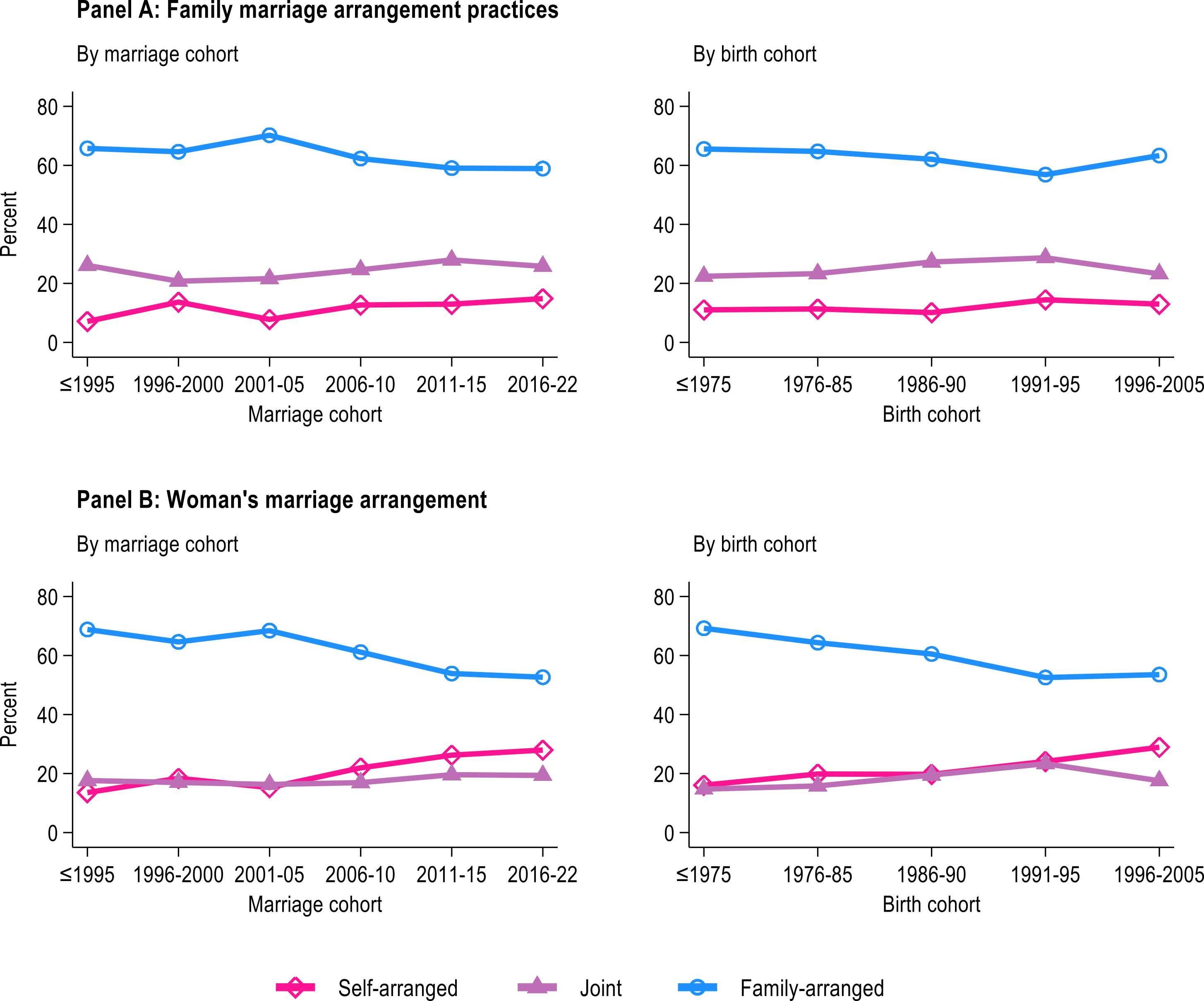
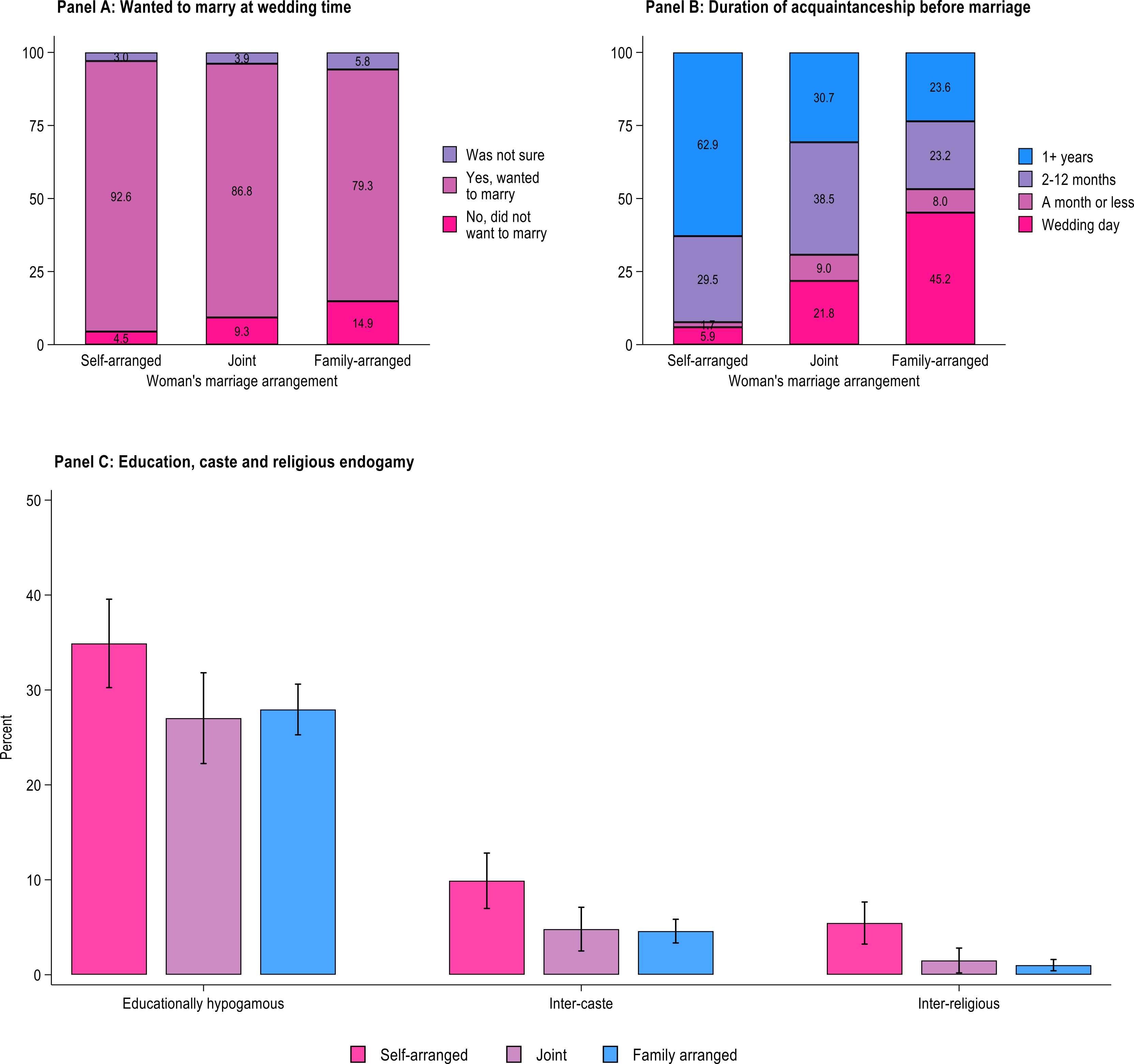
Looking at the data above, one might speculate that if India continues to grow and urbanize, then arranged marriages may wane. That remains to be seen.
Only 10% of India’s young married female college graduates (surveyed in the 2011 IHDS) had personally chosen their own spouse, without parental arrangement. Education made little difference to women’s proclivity to make an independent search - though they were more likely to be consulted, and have some input into an arranged marriage (Banerji 2023, 198).
Reviewing over 20,000 matrimonial adverts in a Bengali newspaper, and interviewing almost 800 people who had placed such adverts, Banerjee et al (2009) find that these people were predominantly educated and middle-class, but their searches were nevertheless managed by parents and older relatives. They had a strong preference for marrying within caste. Crucially, this did not involve an economic sacrifice, since suitable partners - with university degrees - could be found within caste.
Less Media Connectivity?
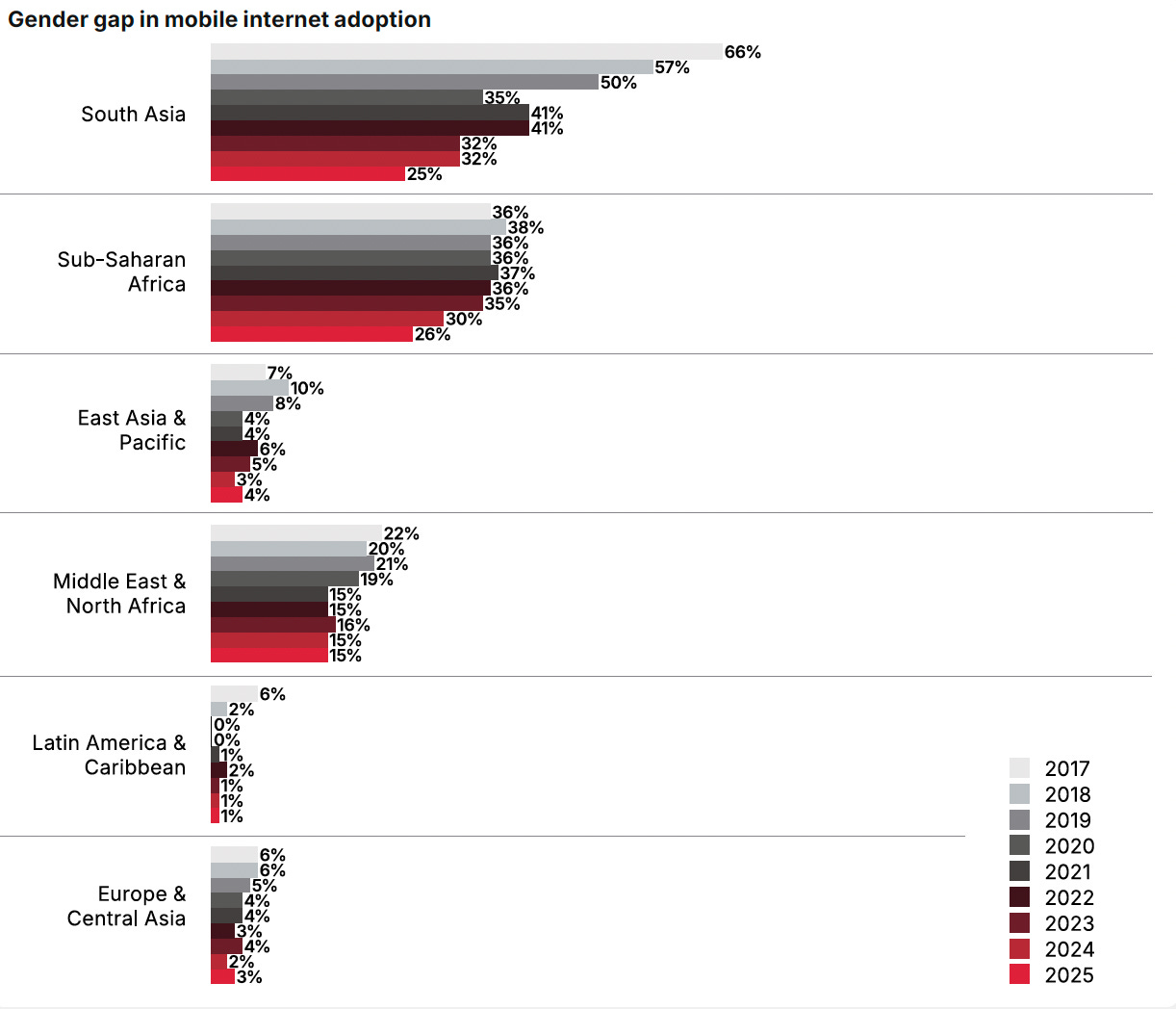
Mobile internet connectivity has also been relatively low in South Asia, with a marked gender gap. If women do not have their own phones, it’s much harder to culturally leapfrog and imagine alternatives.
On the other hand, it’s hard to know whether women’s lower share of smart phones is a cause or consequence of strict patriarchal controls. Denial likely reflects families’ desire to control what women see, imagine, and who they talk to.
Further, it’s not like Indians aren’t exposed to ideals of romantic love. Bollywood megastar Shah Rukh Khan is beloved by millions, embodying a gentler, kinder, compassionate masculinity. But as Shrayana Bhattacharya argues, women’s everyday realities are far more restricted.
Caste, Kinship and Communal Policing
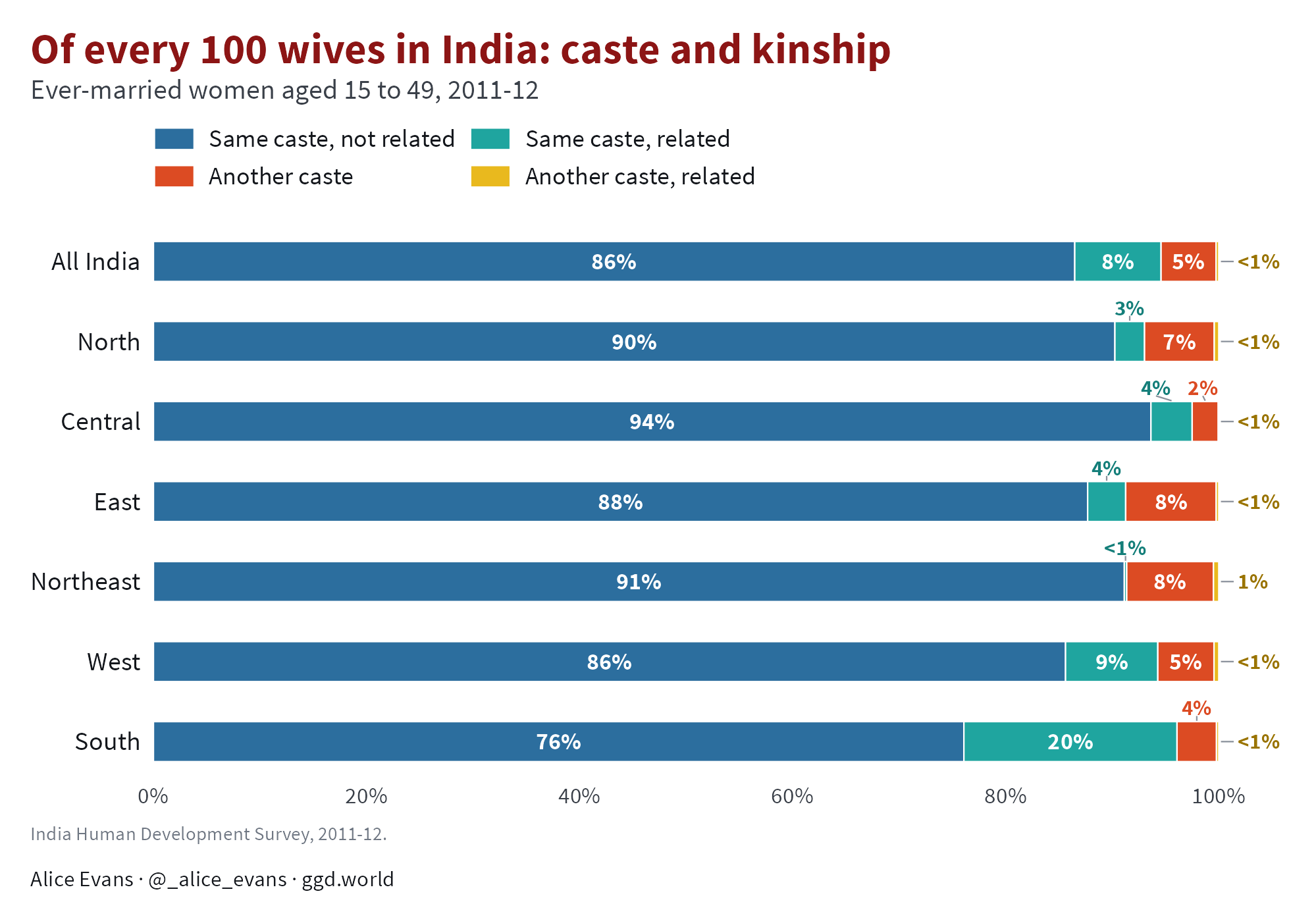
“In India, marriages are rarely private affairs. They are alliances of kinship, mergers of families, genealogical investments”, explains Harjant Gill (2026). “Parents seek matches not for love but for continuity, building networks, consolidating power... Love may follow, or not. But first comes caste, religion, and bio-data; these are the non-negotiables… Obligations to family and community override personal happiness or sexual freedom” (Gill 2026, 17). At odds with materialist explanations that emphasise economic insecurity, he maintains that caste is sustained by group pride, duty and policing.
In India, 62% of adults said it was ‘very important to stop men from marrying into another caste’. This opposition holds right across the caste hierarchy, though is strongest among rural residents, as well as those without college degrees, and those living in Central India. Indian Muslims were strongly opposed: 70% said men’s inter-caste marriages must be stopped.
Although Sikh Gurus extolled a caste free-faith, 59% of Indian Sikhs expressed opposition to men marrying across caste. In Punjab, Sikhs strictly regulate endogamous marriages, while land-owning Jats often feel intense pride, while belittling Dalits with slurs like chamar (leather-workers) (Gill 2026, 99).
But why do adults comply?
Family Duties - RL & Bollywood
89% of Hindus and 81% of Muslims said that respecting elders is very important to being Indian. This holds across ages, genders, and castes. In Central India, 94% say that respect for elders is integral. In Delhi, one young woman shared with me, “parents are gods”.
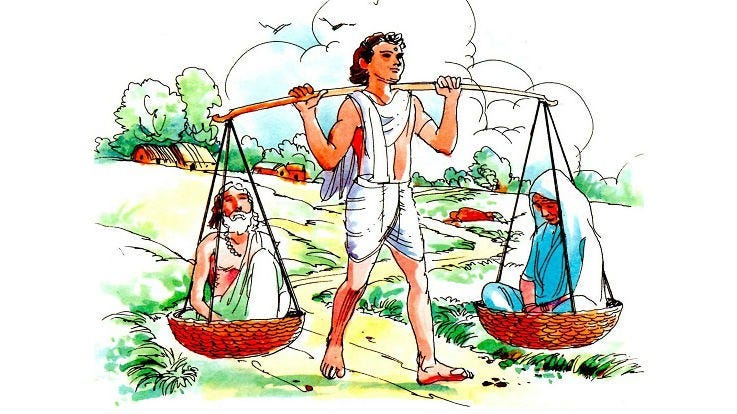
To instill obedience, Hindu children often learn the story of Sravan Kumar as the ideal son, carrying his two blind parents in two baskets, hanging from a pole across his back.
After Yogesh finished high school in Tamil Nadu, his parents insisted that he get a factory job in the UAE to pay for his sister’s dowry. Sharing a one-bedroom apartment with 8 men, he lived thriftily and saved 75% of his salary to buy gold for her wedding. He also supported his brothers, brothers’ wives and brothers’ children - as part of the joint family. He said he felt “phans gaya” (trapped). Other Hindu and Muslim Indian migrant workers typically explained that sending money home was their farz or karm - duty (Wright 2020).
Such mentalities are not a preserve of the poor. Ramkrishna, an upper-caste software engineer in Amsterdam, explained that he would “go for the girl of their choice… They are my parents so they know what is best for me” (Upadhya 2016).
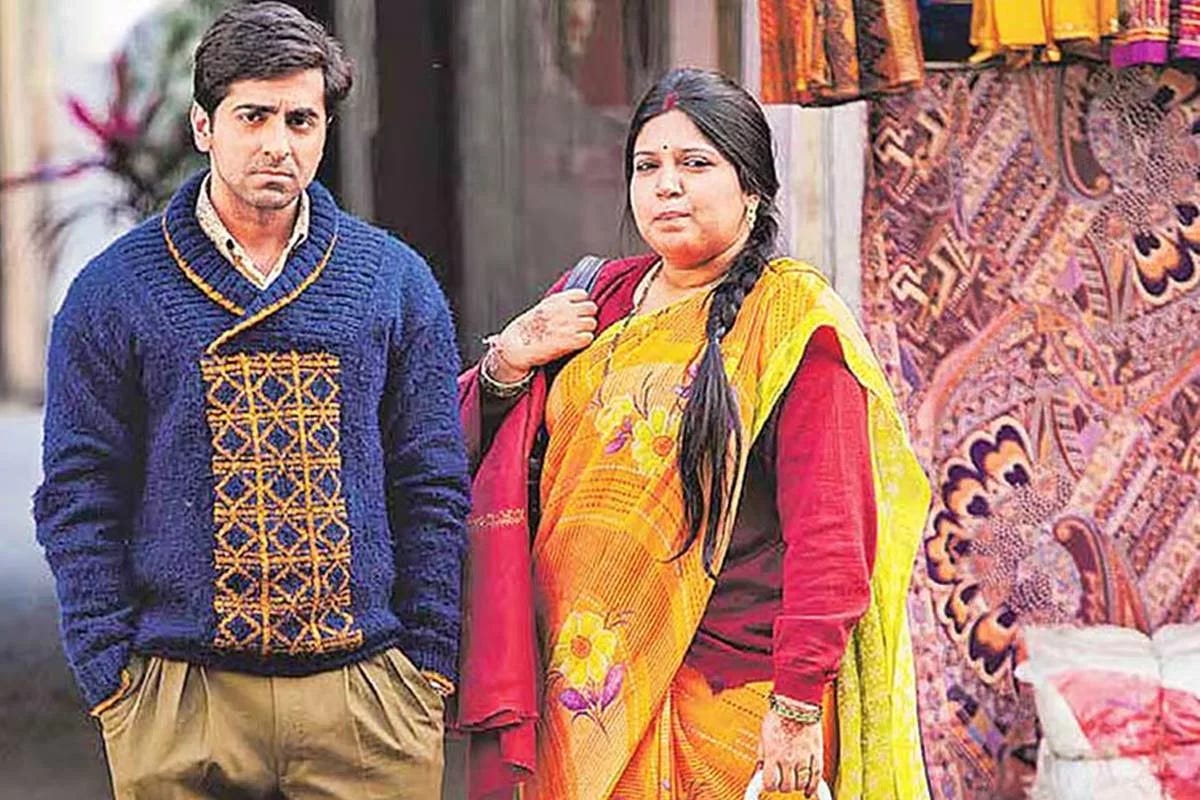
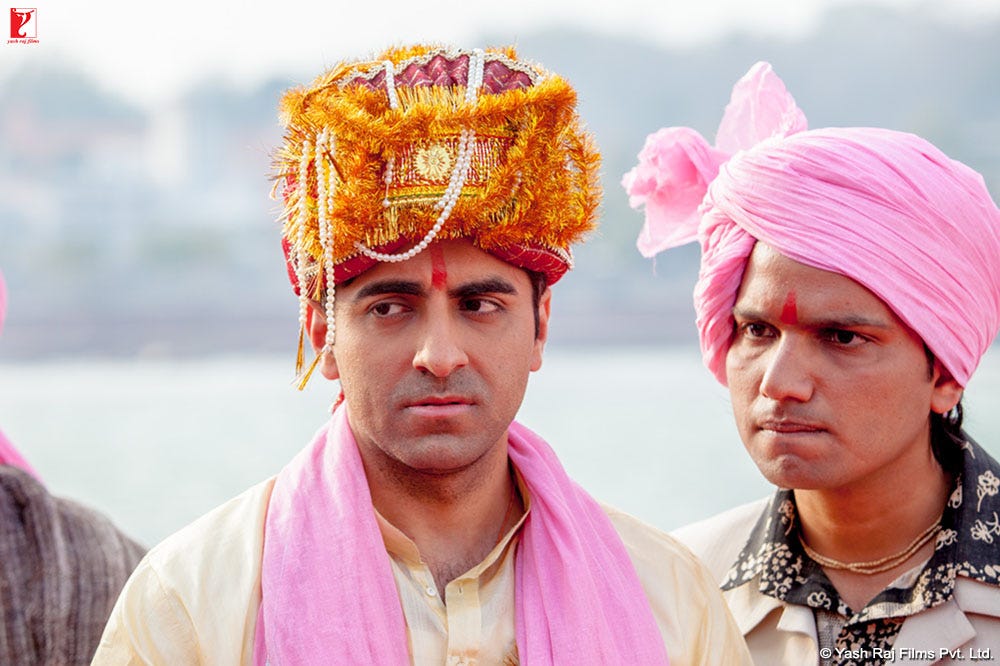
Analyzing Bollywood plots, Rai and colleagues find that films usually revere collective glory, taking pride in the nation, family honor and a son’s success. India’s on-screen heroes please and provide for their parents, fulfilling their father’s dreams. Even in DDLJ, where two young British Indians fall in love, the hero insists on winning her father’s approval - elevating this as sacrosanct.


Social Surveillance
While some may seek greater freedoms, deviants may be harshly punished. In both Hindu and Muslim-majority slums of Mumbai and Hyderabad, child gangs often go out on patrol - aggressively shaming and physically beating any women who transgress communal boundaries. Common terms include nigahe rakhna (keeping an eye), jagruk rehna (being alert), peecha karna (stalking), bhrast/buri auraton ko saja dena (punishing bad women) (Sen 2018).
Shaming doesn’t just extend to unmarried couples. A Hindi slur belittles a man with ‘joru ka ghulam’, ‘servant of the wife’.
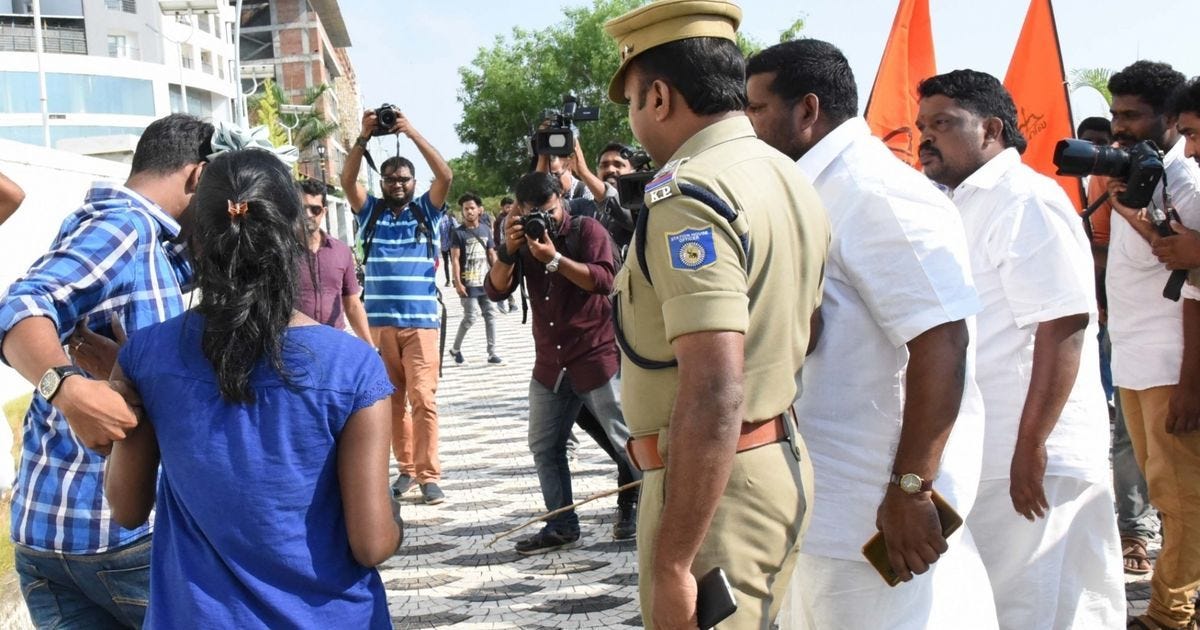
In Kolkata, young men remain tightly surveilled. As Mukul (a 21 year old taxi driver from Gaya district) remarked, “Even if news of a small matter about something that I have done here goes back home, my parents will commit suicide out of shame. So I stay clear of wrong paths” (quoted in Chowdhury 2023).
In Delhi, young middle-class men often desire personal freedoms, but feel closely monitored. Raj only goes out drinking and dancing on Saturday afternoon - returning home for an evening meal with his parents. He’s been dating his girlfriend for over a year, but keeps it secret to preserve her respectability (izzat) and also fears for his safety: “They’ll beat me to death, her brothers and family (gharwale)”. Aman (a 24 year old bank employee) is dating his girlfriend secretly, saving her number under a male name (Philip 2022).
Young men are at least free to roam around, explore their cities, stay out late, loitering with other guys, sometimes eve-teasing pretty girls (Phadke et al 2011; Philip 2022; Gil 2026). Restraints on young women are invariably stricter. Fearing male predation and loss of family honour, brothers surveil their sisters, keeping them close to the home (Gill 2026, 179).
But Gill insists, this patriarchy is like a pyramid scheme. Patriarchs at the top “sell the dream: of authority, respect and legacy”, by continuously persuading others to obey the rules in the hope of gaining status. But few men actually reach this summit, instead they embed themselves in a system with strict obligations and emotional restraints (Gill 2026, 29). As 27-year-old Sardeep wrote in his suicide note,
“If I refuse marriage, our society would have made my life miserable. It seems to me that my parents brought me into this world only to get me married...
In other countries no one cares about one’s marital status. The decision to marry or not is left up to the individual.. Parents must accept this; just because you’ve birthed your child, he is not your slave” (quoted in Gill 2026).
Conclusion
Arranged marriage has declined worldwide, except in South Asia. What explains this change over time and regional exceptionalism?
I suggest that from the late 19th century, Western industrialization, imperialism and connectivity triggered major debates across all world regions. Reformists often sought to emulate Western economic, political and cultural practices so as to secure their own society’s prosperity. As aspiring male elites joined these struggles for modernization, independence, and progress, they too sought self-mastery and personal freedoms.
Yet, cultural assimilation was not a one-way street. It was mediated by local kinship and religion. In China, revolutionaries stridently campaigned for free-choice marriage. Filial piety remains primary, but parents often put higher weight on maximizing income and achieving upward prosperity, thus encouraged their children to go further afield. Further, exogamy (marrying outwards) meant far weaker social surveillance.
In Egypt, Iran and Turkey, men also pushed to choose their brides. Islamic prescriptions of female seclusion certainly restrained mixing and mingling, but as ideals of Islamic brotherhood expanded the pool of acceptable marriages, men gained the prerogative to choose their own wife.
In South Asia, modernizing reformists condemned egregious harms such as sati, child marriage, polygyny, and enforced widowhood, but transgressions against communal boundaries have triggered antagonism. Across the caste hierarchy, groups have defended their power, prestige and purity through strict border control, preventing matches they regarded as degrading. Since each jaati positions themselves as superior to Untouchables, none would permit free-love.
South Asian communities have thus instilled an ethos of duty and loyalty, binding sons to work in family business, hand over earnings, and marry a particular woman. Pursuing one’s own wants and desires is often stigmatized as selfish and shameful.
A South Asian man can thus provide for his entire family, yet still not choose his own bride.

Great article. It’s a bit confusing but it seems like you are positing rakhmabai (who was the first woman to legally get divorced in India) and pandita Ramabai were cousins? Thats quite impossible since the former was from a Suthar (carpenter caste) and the latter was a Brahmin.