

The Global Islamic Revival represents one of the most significant sociopolitical transformations of the past half-century. Muslims increasingly came to disavow secular or syncretic customs, instead studying scripture, abiding by the Quran, maintaining gender segregation and condemning deviation. Yet existing theories cannot explain its timing or global spread across diverse economies, geographies, and political systems. Why did this movement gain traction from the 1970s onward, transforming societies from Egypt to Indonesia to Britain?
In talk at Stanford, I synthesize cross-regional evidence to assess competing explanations, then offer a novel theory on the Global Islamic Revival.
To persuade you of this topic’s importance, let me share some new graphs on how Muslim-majority countries differ in terms of religiosity, beliefs towards gender and sexuality, as well as women’s economic outcomes.
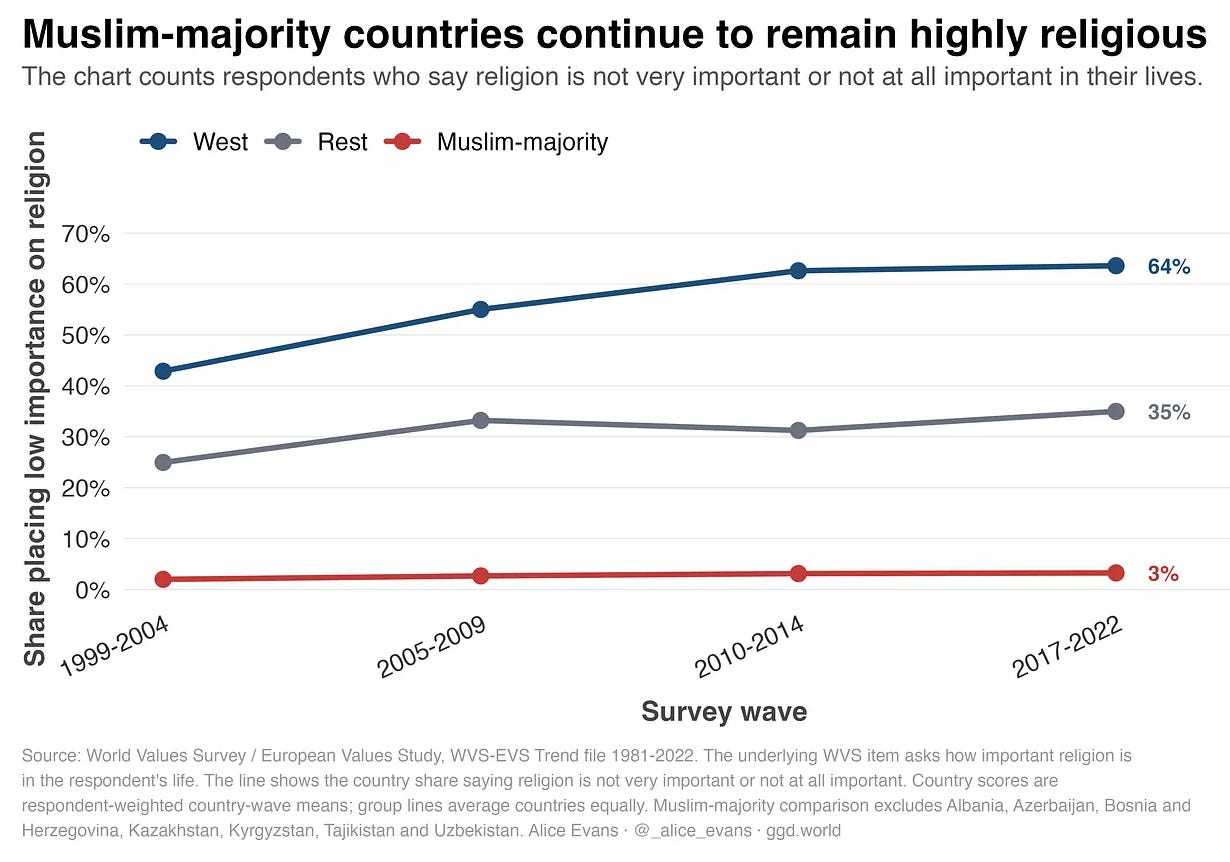
Muslim-majority countries are exceptionally religious
Only 3% of Muslim-majority respondents say that religion is not very important.
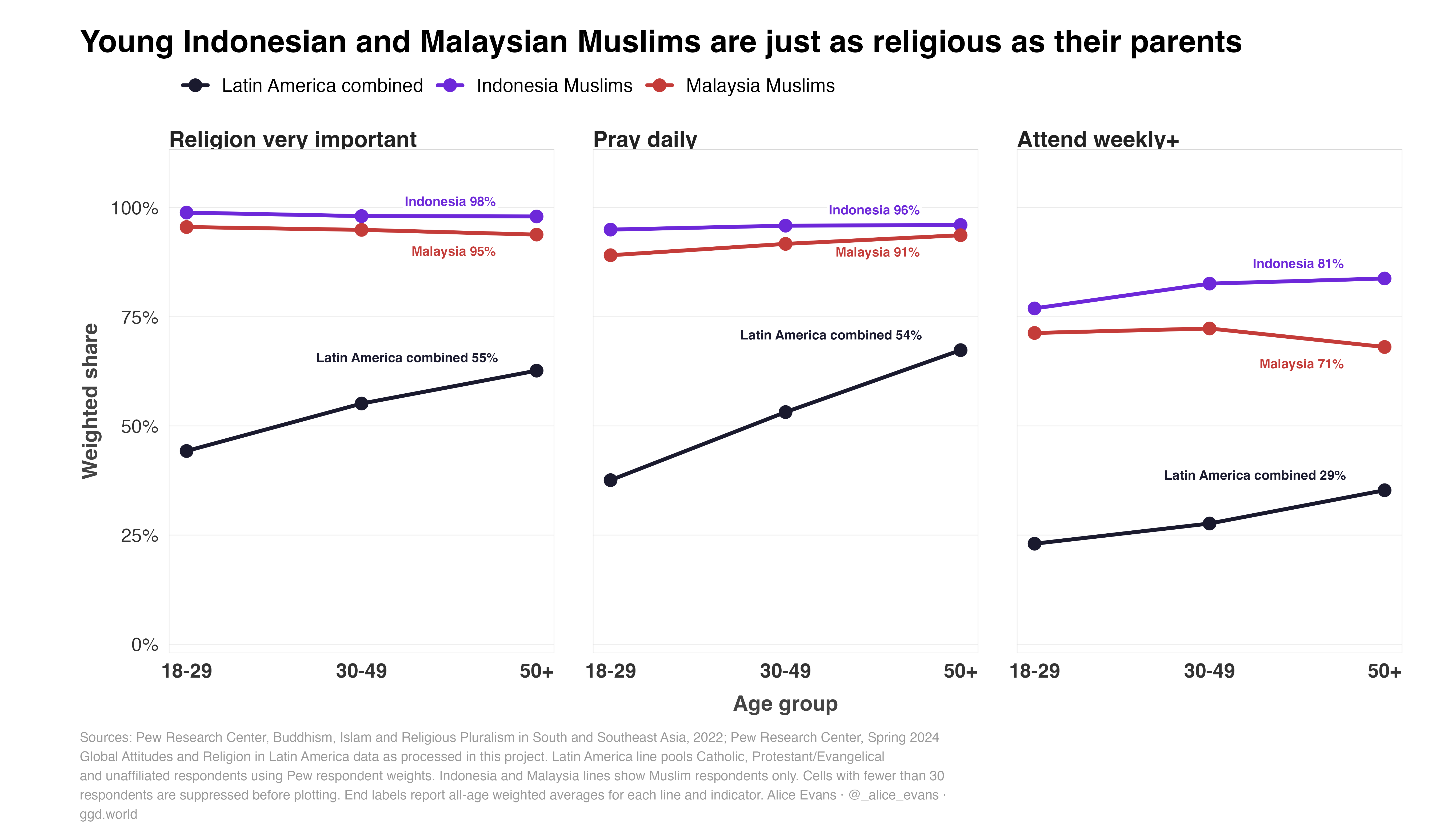
Besides tracking beliefs over different waves, we can also compare by age.
Young Latin Americans are increasingly leaving their faith, becoming less likely to say that religion is very important, pray daily, and attend weekly church. By contrast, Indonesian and Malaysian Muslims show no such departure, they are just as religious as their parents.
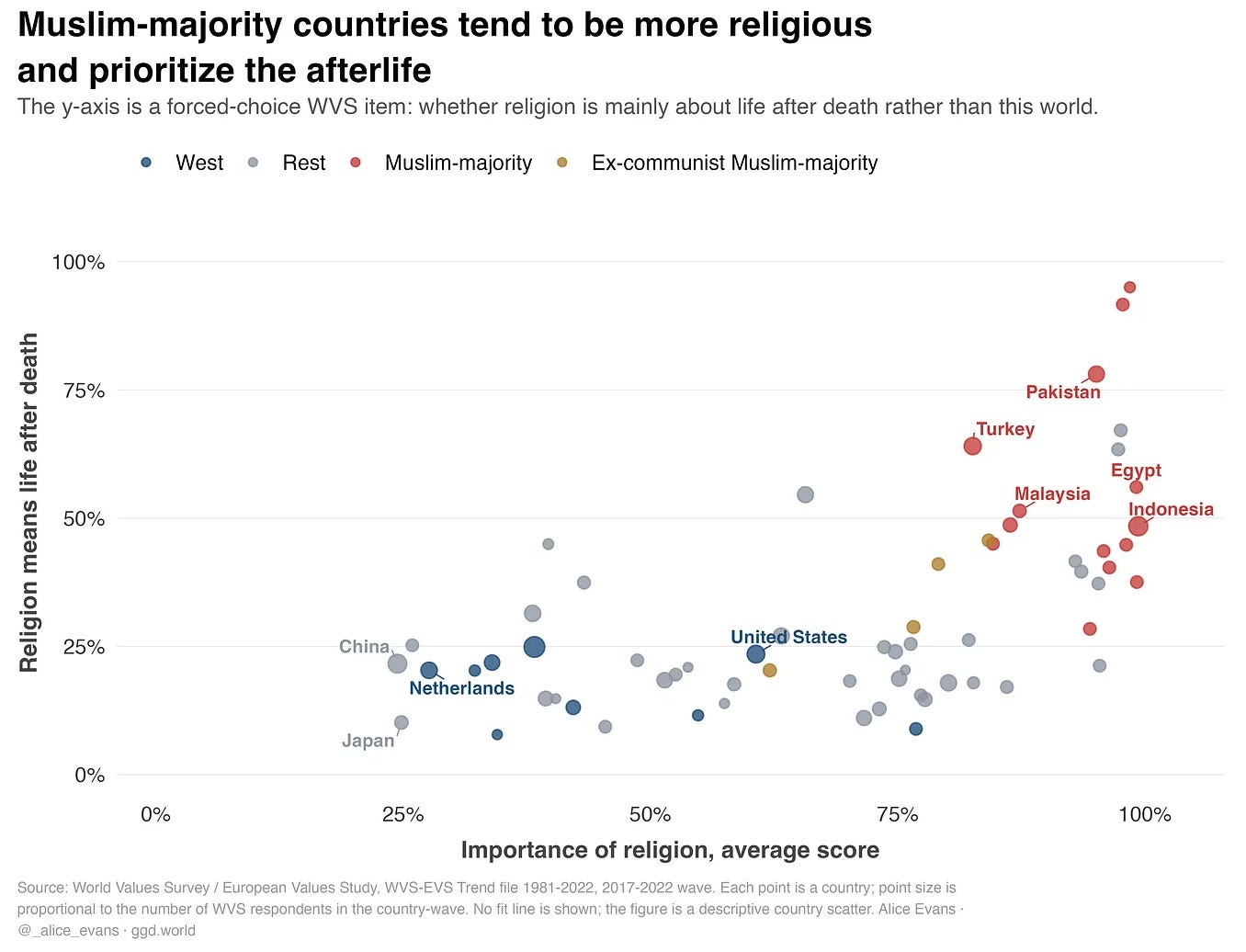
Muslim-majority countries place far greater weight on the afterlife.
In the graph below, I distinguish between Muslim-majority and ex-communist Muslim-majority countries, since in the latter Islam was heavily repressed. Multiple generations were not free to practice their faith.
In my interviews, Muslims repeatedly tell me that this life is “temporary”:
In Mumbai, Abdul told me that when a fellow market trader was economically distressed and brought his wife to work, he intervened saying, “this temporary life is just a drop in the ocean, endure whatever hardship”, keep the wife in seclusion so as to get to eternal paradise.
In Luton, Hassan (a restaurant owner) translated the Quranic sura on the wall, adding “our time on earth is just like a bird perching on a branch, before making its journey”.
In London, Zainab warned her nephew, “Don’t let your dunya be your akhira” (meaning don’t prioritise the temporary life over eternal paradise).
Believers may forgo material rewards in order to maximise utility over eternity. I call this “the paradise premium”.
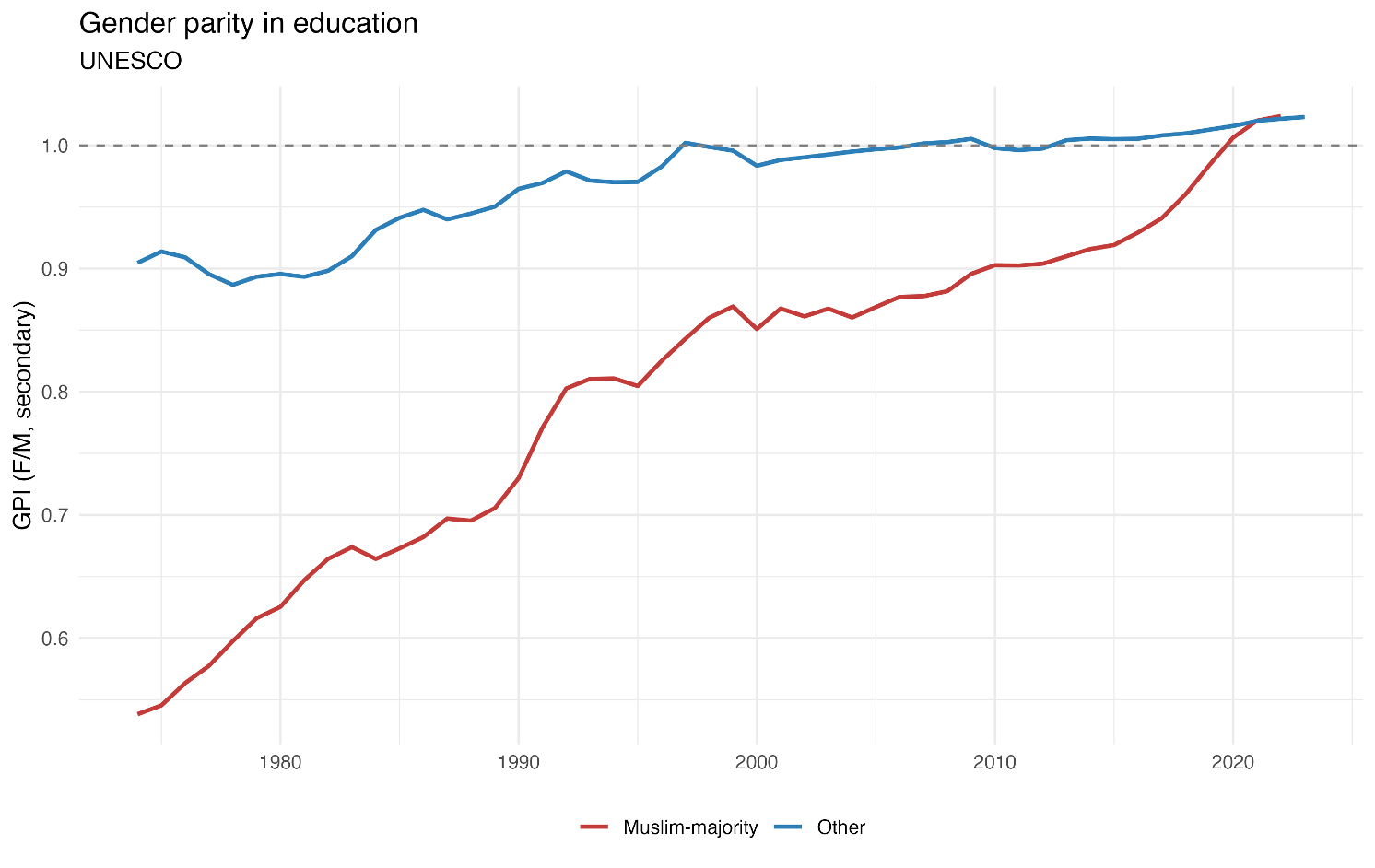
Muslim-majority countries have closed gender gaps in education
Back in the 2000s, international development agencies championed female education, hoping that this would spur higher female employment. The good news is that Muslim-majority countries have belatedly closed the gap in schooling. However…
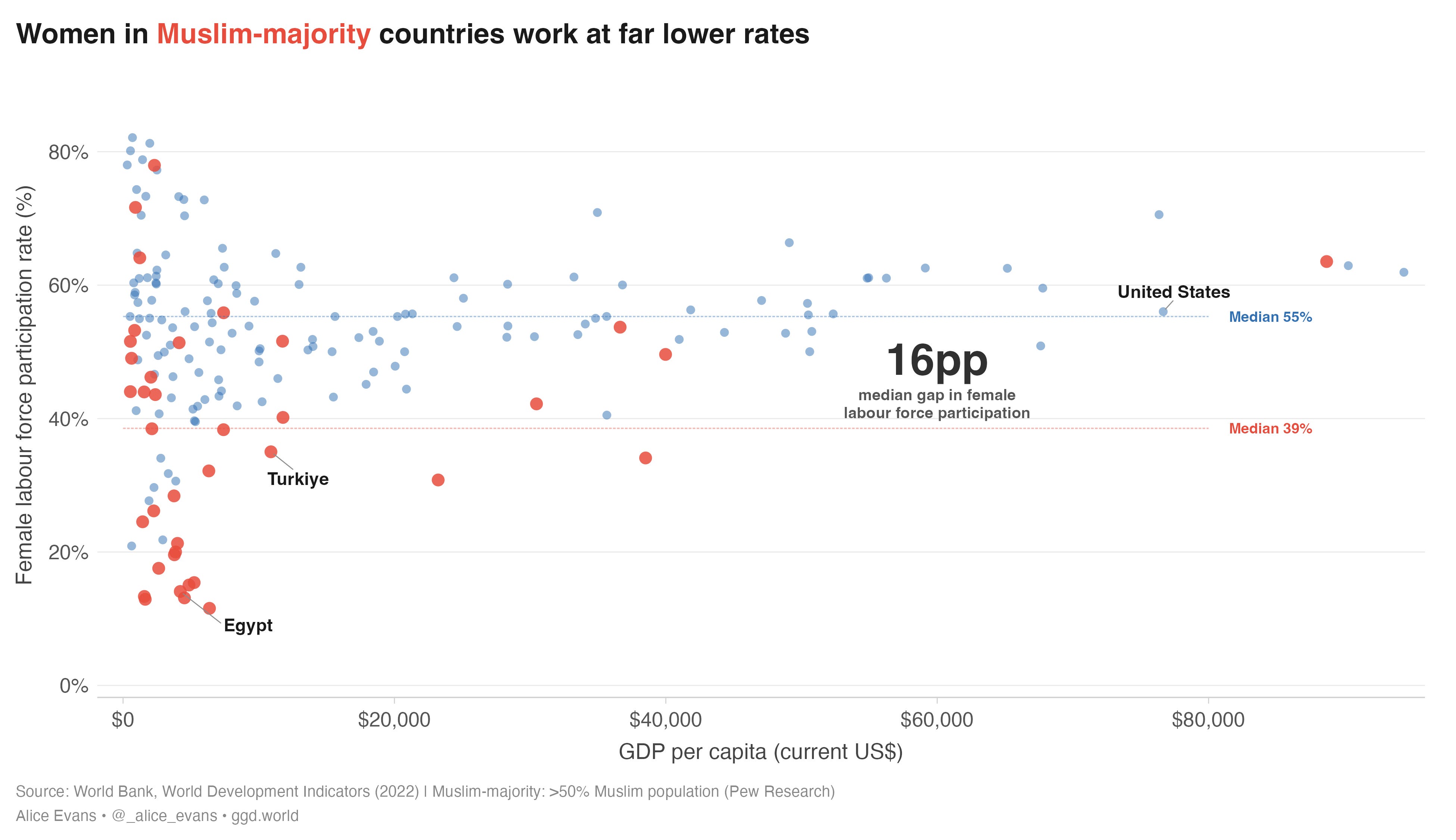
Female labour force participation is still 16 percentage points lower in Muslim-majority countries.
The exceptional high scorers include Sub-Saharan African countries like Mali and Niger (where women work in agriculture) as well as Qatar (which is mostly immigrant).
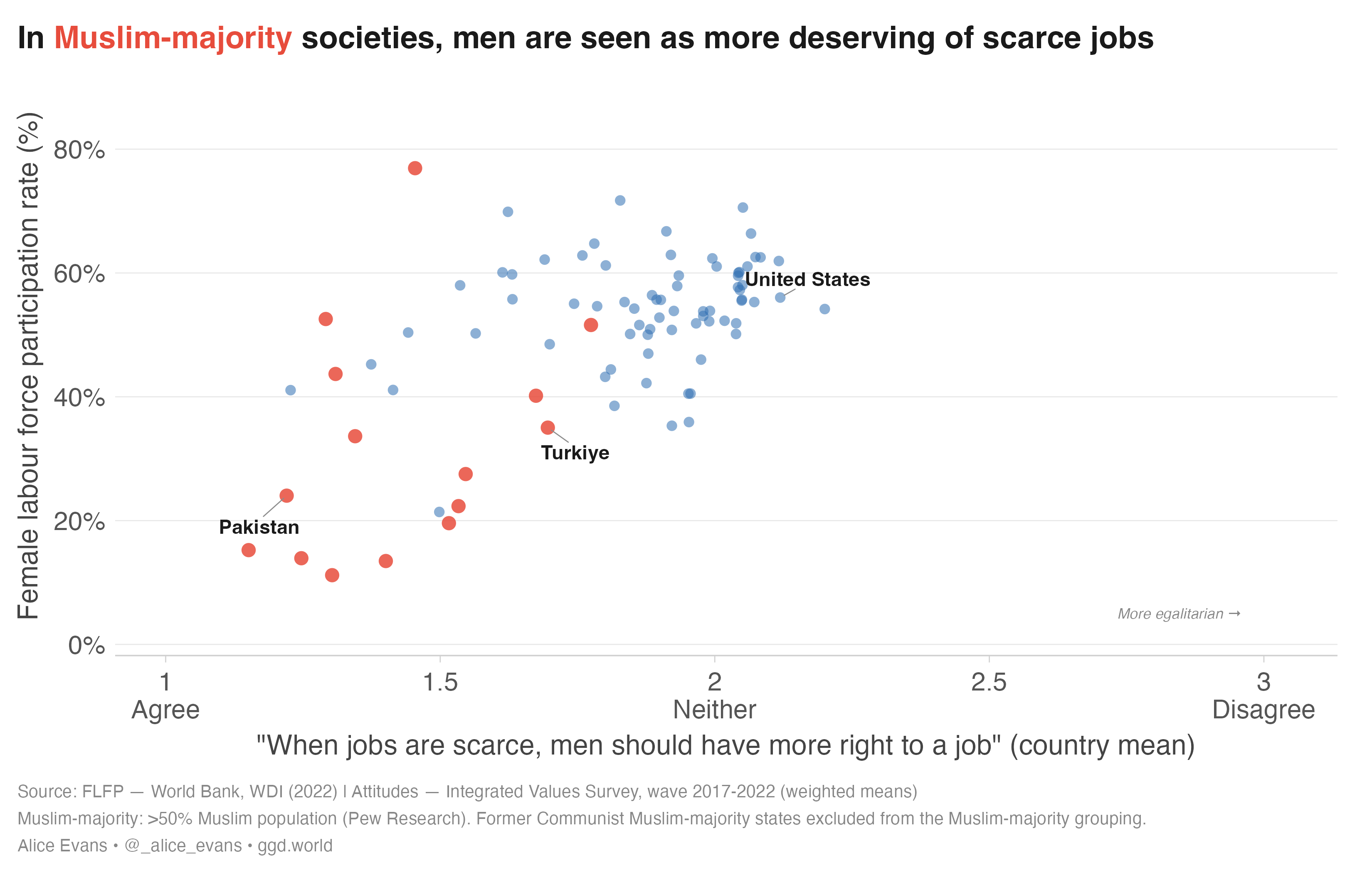
Muslim-majority countries tend to affirm male supremacy
Muslim-majority countries cluster in agreement that when jobs are scarce, men have more right to a job.
The Afterlife Penalty
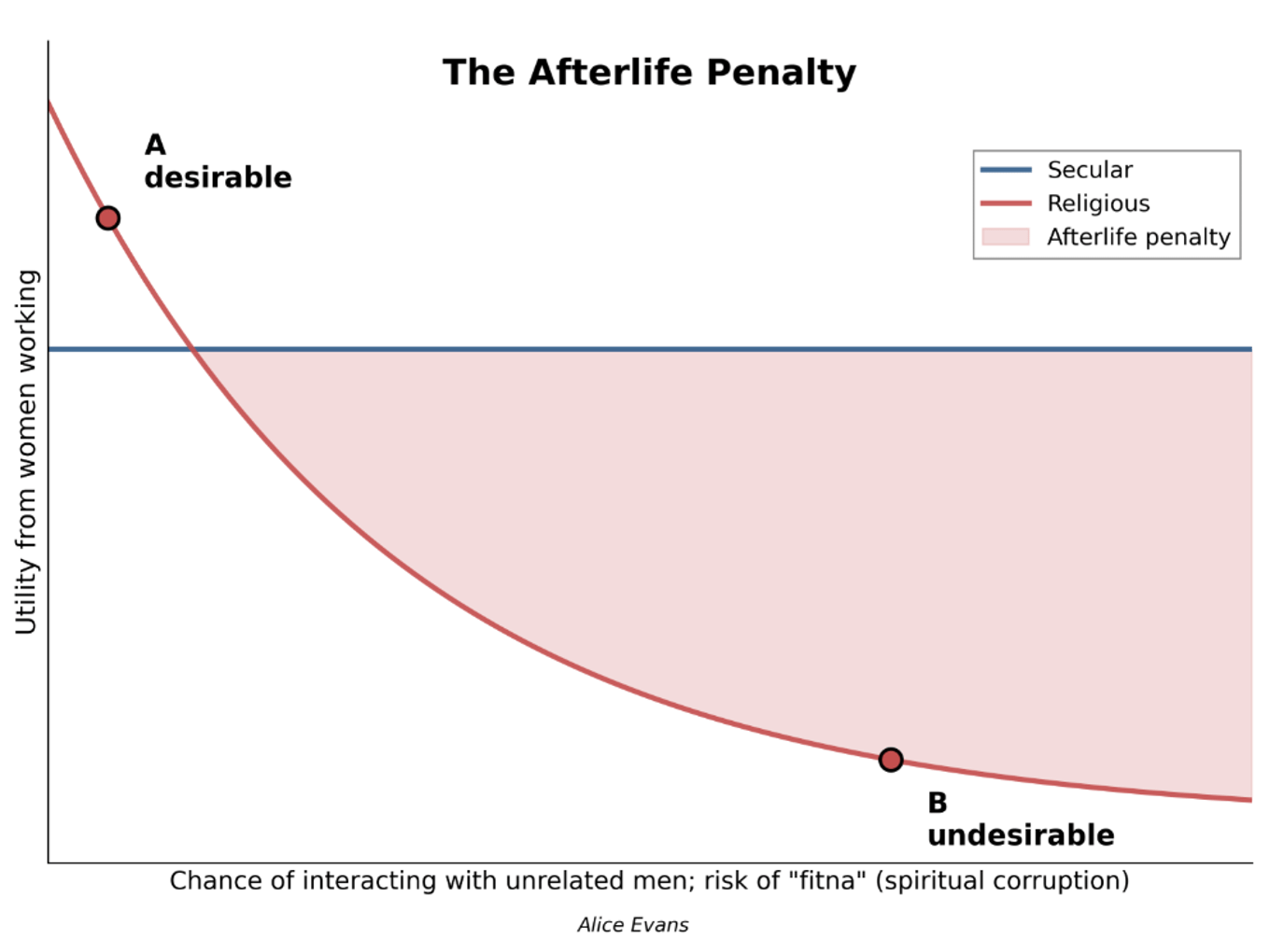
To theorise how strong religiousity, belief in the afterlife and concern for gender segregation may suppress female employment, I’ve made a little visual.
Below, I show how the utility gained from women working alongside men varies by religiosity and concern for ‘free-mixing’.
For secular people, even as there is a greater likelihood of mixing with unrelated men, women’s work generates the same utility. This blue line is flat.
For religious believers, women working alongside unrelated men generates much much lower utility. The red line slopes downwards.
This visual is downward sloping because (1) some religions care more than others about interactions between unrelated men and women; and (2) even within the same religion, there is still significant variation (e.g. Indonesia versus Egypt).
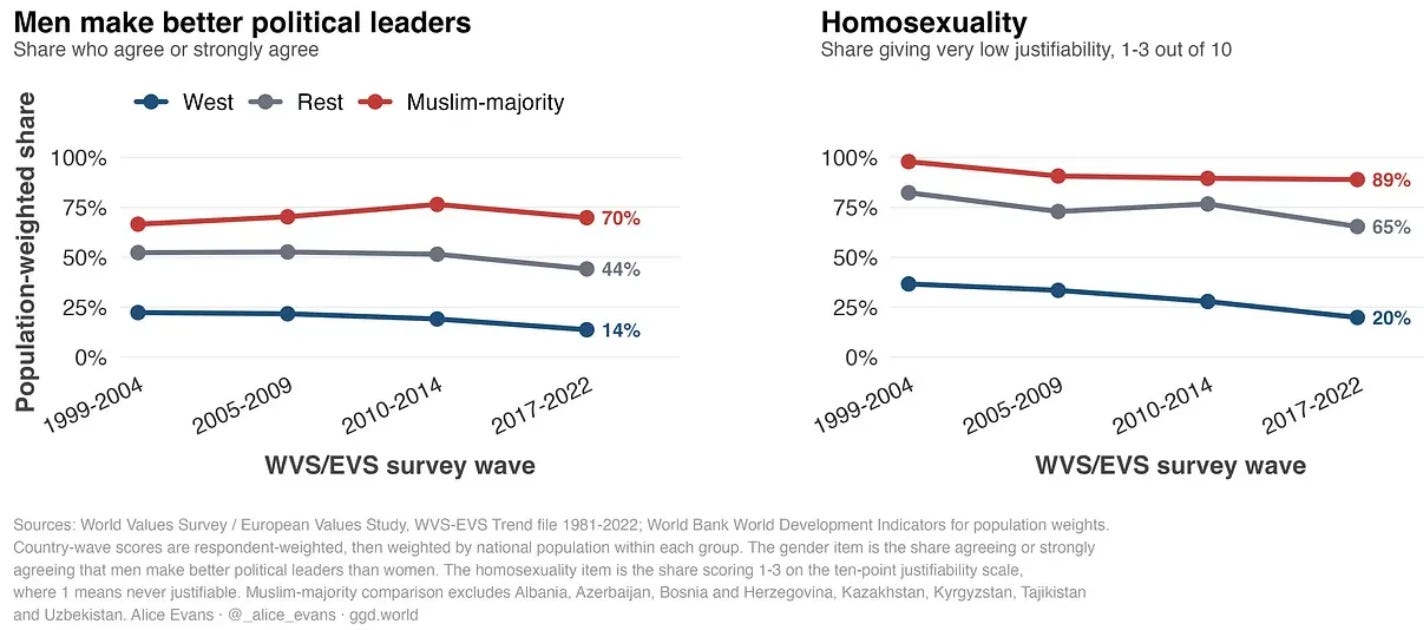
Muslim-majority countries tend to prefer male leaders and condemn homosexuality
For those interested in cross-cultural variation, these differences are rather large, and worthy of further study.
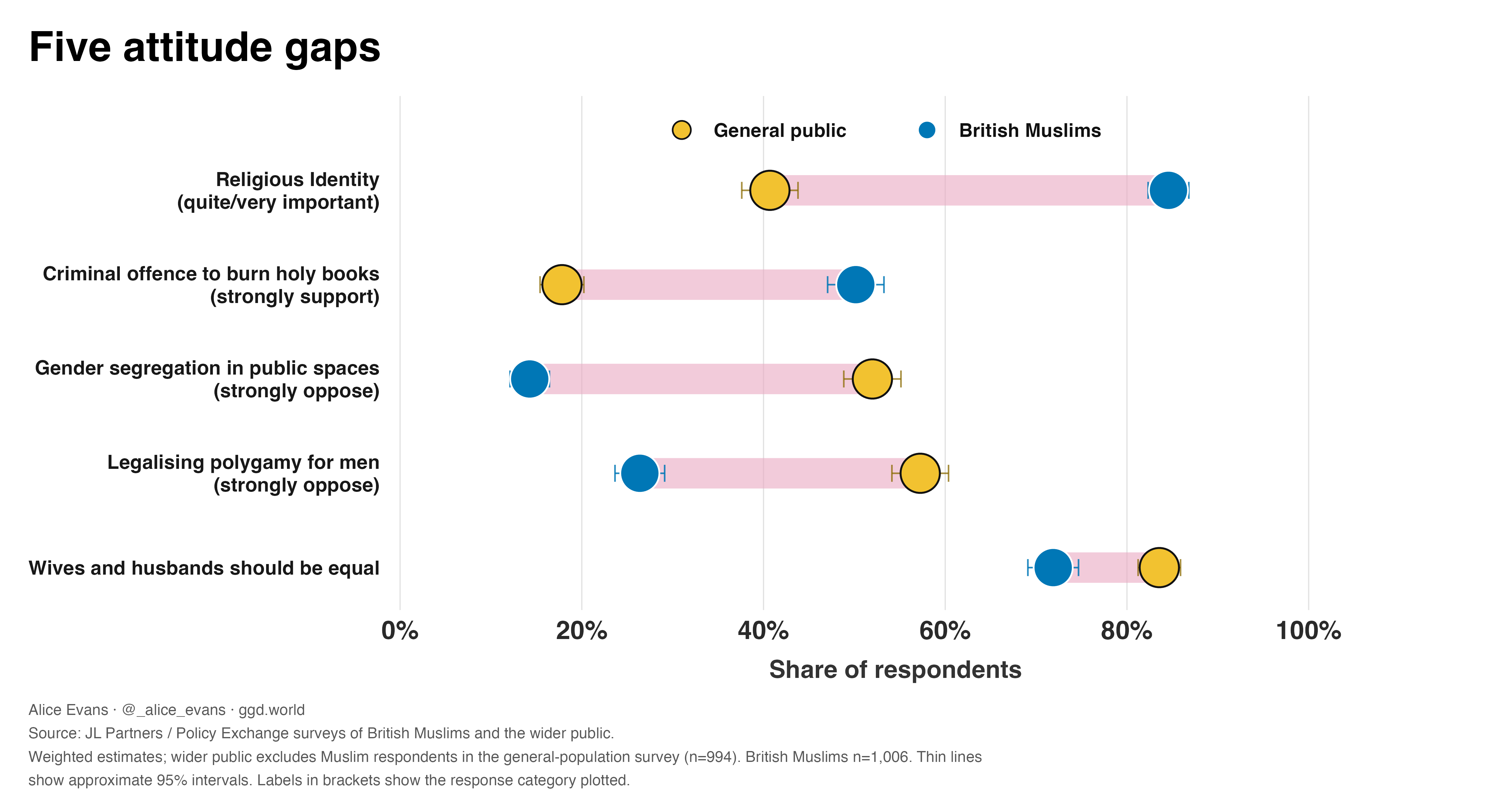
British Muslims have different beliefs to their compatriots
British Muslims tend to be much more religious and strongly support the criminalisation of burning holy books. Unlike the general public, they do not strongly oppose gender segregation nor do they strongly oppose the legalisation.
What caused the Global Islamic Revival?
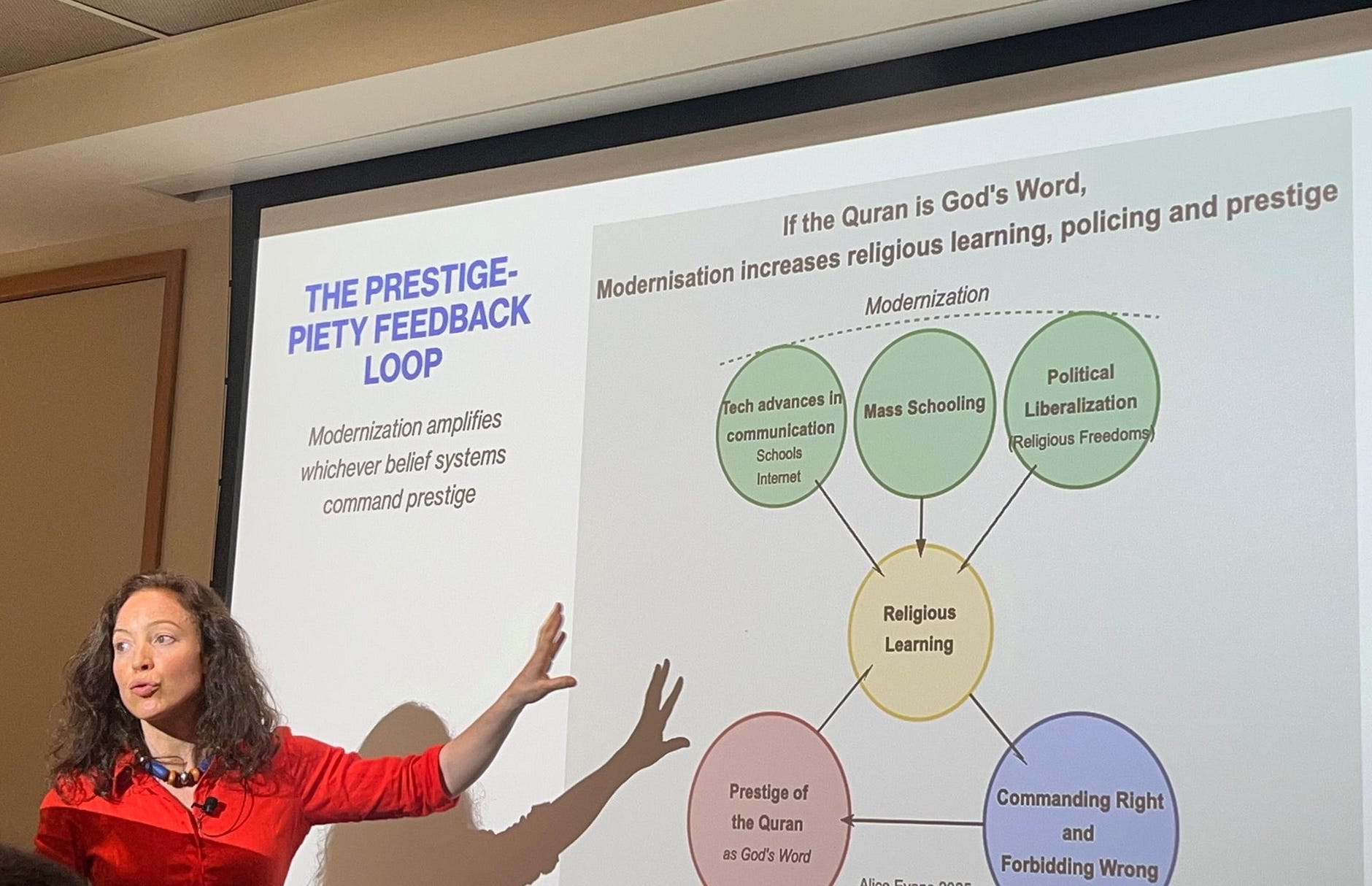
In my talk, I’ll discuss the competing explanations then offer a novel theory.
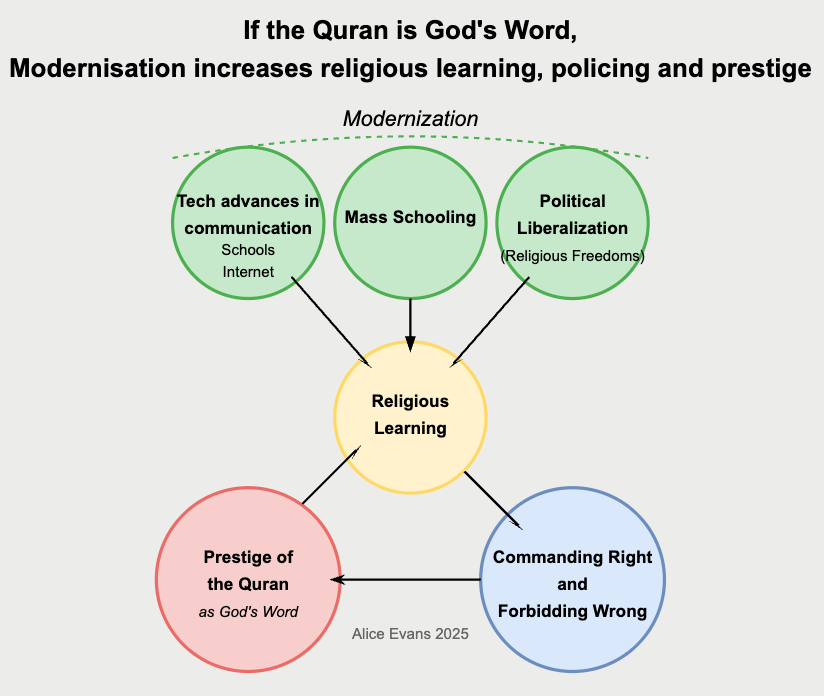
First, I argue that there was a crucial transformation in Muslim identity: from locally-based syncretism to state-attempted secular modernization to a reinvigoration of a transnational Muslim identity.
Second, I propose the Prestige-Piety Feedback Loop: modernization paradoxically amplified strengthened adherence to jurisprudential Islam and deference to credentialed religious authorities. As Muslims gained unprecedented access to jurisprudential knowledge, then piety and gender segregation became primary markers of status, with profound implications for women’s status.
Feedback is always welcome.
I attended the Zoom but there wasn't a way to ask questions, so I will ask here.
There is also a Hindu religious revival in India, and both a Christian & Muslim religious revival in many parts of sub-Saharan Africa. Are they really a separate phenomenon? Or instead, do Western Christianity & Communism lead to one way of reacting to globalization & modern technology, while South Asian/MENA/Sub-Saharan African cultures & histories lead to another?
This is not to dispute anything in your presentation; I think it's all correct! I just think maybe it's broader.
I think there is a simpler answer, and one that has been historically as influential in the rise and fall of Muslim religiosity: economics.
The rise tracks the economic power of particular Arab/Muslim nations, especially Saudi Arabia, Qatar, and the UAE; initially this was oil wealth, but then diversified into international investment.
But that investment is generally different when investing in Western big business vs. in the global Muslim world; the wealthy oil states do invest in buying up Western IP, fo example Saabic bought up a big chunk of DuPont’s plastic production business, and they do have some engagement in venture capital in Silicon Valley. There is also, however, a great deal of investment in the Muslim world on a global basis.
However, when investing in the Muslim world much of that money is invested not through western banking but through traditional Islamic banking. It also comes with the strings of Wahhabism; oil rich gulf states do not invest much with non-Wahhabi Muslims, they invest much more with fellow Wahhabis. There is definitely an investment filter for those who conform to the ultraconservative beliefs of Wahhabism.
So for example in Malaysia the practice of Islam was much more diverse and liberal around the founding of Malaysian independence, but today is much more ultraconservative in line with Wahhabi dominance; the same is true and gaining traction in Indonesia.
So it’s an economic lever; the wealthy families and communities are those who get patronage and investment from the gulf states Wahhabis; to get employment and secondary investment in the local economy local Muslims have to conform with Wahhabi sentiments if not fully Wahhabi practice.
In parallel, Western investment generally does not flow to Islamic peoples in Southeast Asia or North Africa; Wall Street is generally not piling in on Muslim-owned businesses operating using traditional accounting standards in conformance with traditional banking. Generally speaking in Southeast Asia the west invests in Han Chinese owned ventures using global accounting standards or other non-Muslim ethnically owned businesses. This is particularly true in Singapore, for example.
The same basically holds true for North Africa, which has an extreme dearth of Western investment and even in places like Morocco the division between traditional banking and global standard banking creates a strong division in who can get Western financing.
So for Sunni Muslim people at least, adoption of ultraconservative Islam becomes an economic imperative to get jobs and financing. It even influences immigration to an extent; the average poor Muslim man looking to work abroad to send money home will prefer stints in the gulf states rather than Europe or the US, though the raw size of these economies, and for Europe, geographic proximity to North Africa does produce significant immigration.
This can be seen more clearly in Sub-Saharan Africa, where there is more cultural diversity and in some countries modernization. In Subsaharan countries that are modernizing and adopting Western-style global practices, foreign investment is generally from the West or China, and these are not Muslim majority states. But in the Muslim majority states, international finance is generally coordinated with traditional banking and gulf states rather than Western investment.
What would be very interesting to see now would be a comparison of attitudes differentiating between Muslim majority states that are Shia majority vs. Sunni, and further still that break down the Muslim population by which school of jurisprudence is dominant (e.g., Hanafi, Shafai’i, Maliki, Hanbali). Turkey is primarily Hanafi, Kurds are predominantly Shafai’i) etc. Turkey has much more access to western capital, as do Kurds, and are also more liberal.
This is also probably impacted to some degree with the current Saudi royals separating from Wahhabism to create political distance from Wahhabi-associated terrorism, but that is recent and it’s not really clear what this translates to as Saudi Arabia takes baby steps to modernization.