


One could fill a small library with books on historical gender relations in Europe. Yet if I may lodge one small complaint, a revealing set of sources remains underused: non-Western travelers' observations of Europe. Outsiders often pick up on fascinating little details that members of that culture may regard as banal - such as French men surrendering their seats to women.
So here’s our line-up:
Evliya Çelebi, Ottoman Turkish explorer, born in 1611.
Aḥmad ibn al-Mahdī al-Ghazzāl, Moroccan ambassador to Spain in 1766.
Mirza Abu Taleb Khan, Iranian-Indian tax collector, toured Europe in 1799.
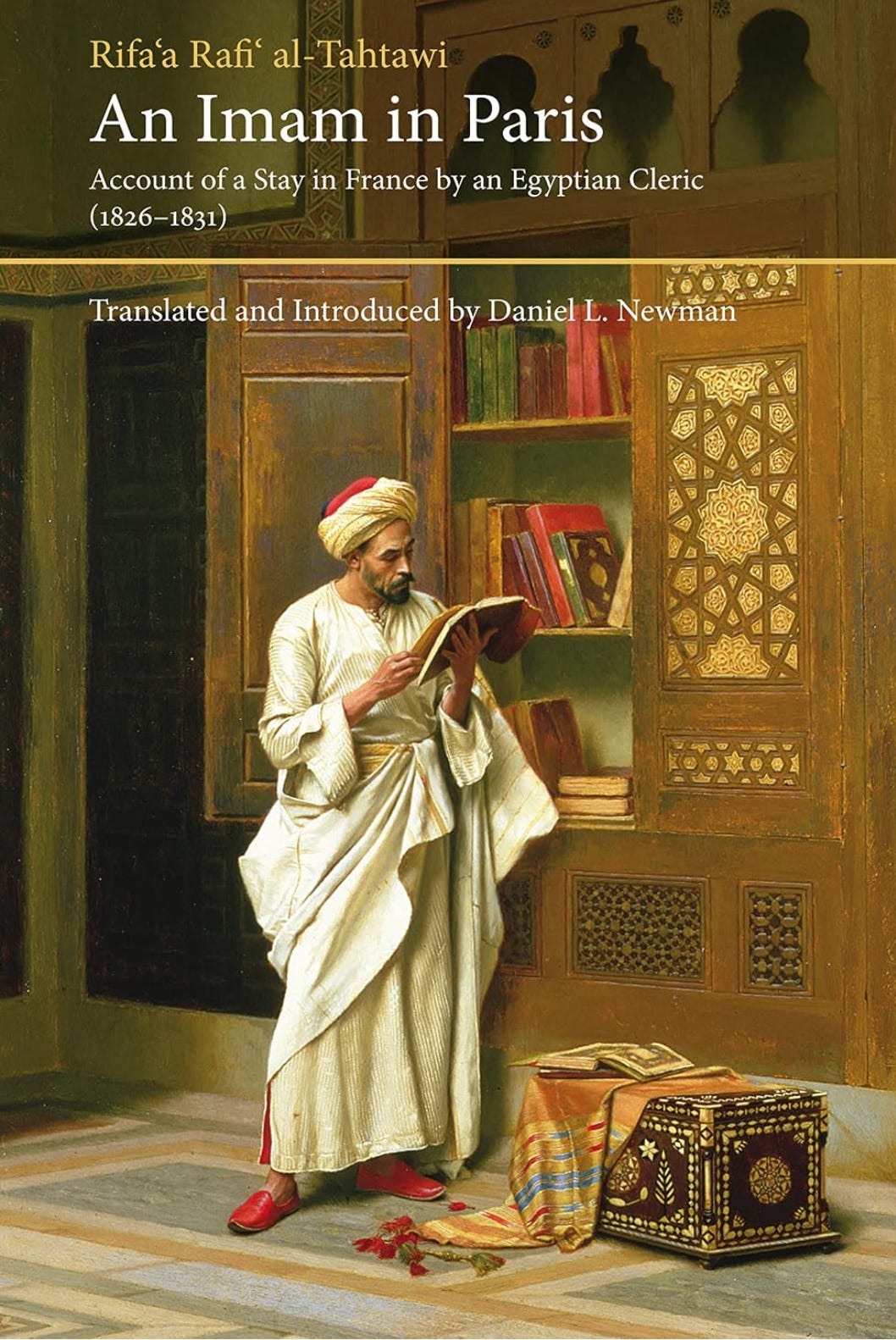
Rifa’a Rafi’ al-Tahtawi, young Egyptian cleric, sent to Paris from 1826 to 31.
Al-Saffar, a Moroccan jurist, accompanied an embassy to France in 1845-46.
Bin Chun and Zeng Jize, Chinese diplomats to Europe in 1866 and 1878.
Li Gui, a Chinese official who toured the US in 1876.
Nasir al-Din Shah Qajar, the Shah of Iran, toured Europe in 1873, 1878 and 1889.
Zeyneb Hanoum, Ottoman elite of French and Circassian descent, left in 1906.
Europe was Patriarchal
Mirza Abu Taleb Khan provides a superb synopsis of English patriarchy in 1800.
English women walked with “apparent liberty” and were treated with “politeness”, but were still subject to ‘salutary restraints’. Principally, “no woman of respectability ever walks out (in London), unless attended by her husband, a relation, or a confidential servant”. These safeguards prevented her from “acting improperly” (173).
English marriage law, as Mirza understood it, gave husbands sweeping powers:
He is “authorized by law to take away all her property and ornaments, to debar her from the sight of her children, and even to turn her out of the house; and if proof can be produced of her misconduct, he may obtain a divorce, by which she is entirely separated from him, and loses all her dower, and even her marriage portion…
By the laws of England, a man may beat his wife with a stick which will not endanger the breaking of a limb, or may confine her in a room, the women dare not even give their tongues too much liberty.
By the wisdom of their lawgivers, [English women are] confined in strict bondage..” (Mirza Abu Taleb Khan, 173).
Here, I agree with Mirza Abu Taleb Khan: both societies were patriarchal, but differed in one crucial respect:
“The Mohammedan women.. are prohibited from mixing in society, and are kept concealed behind curtains” (Mirza Abu Taleb Khan, 173).
China Upside-Down
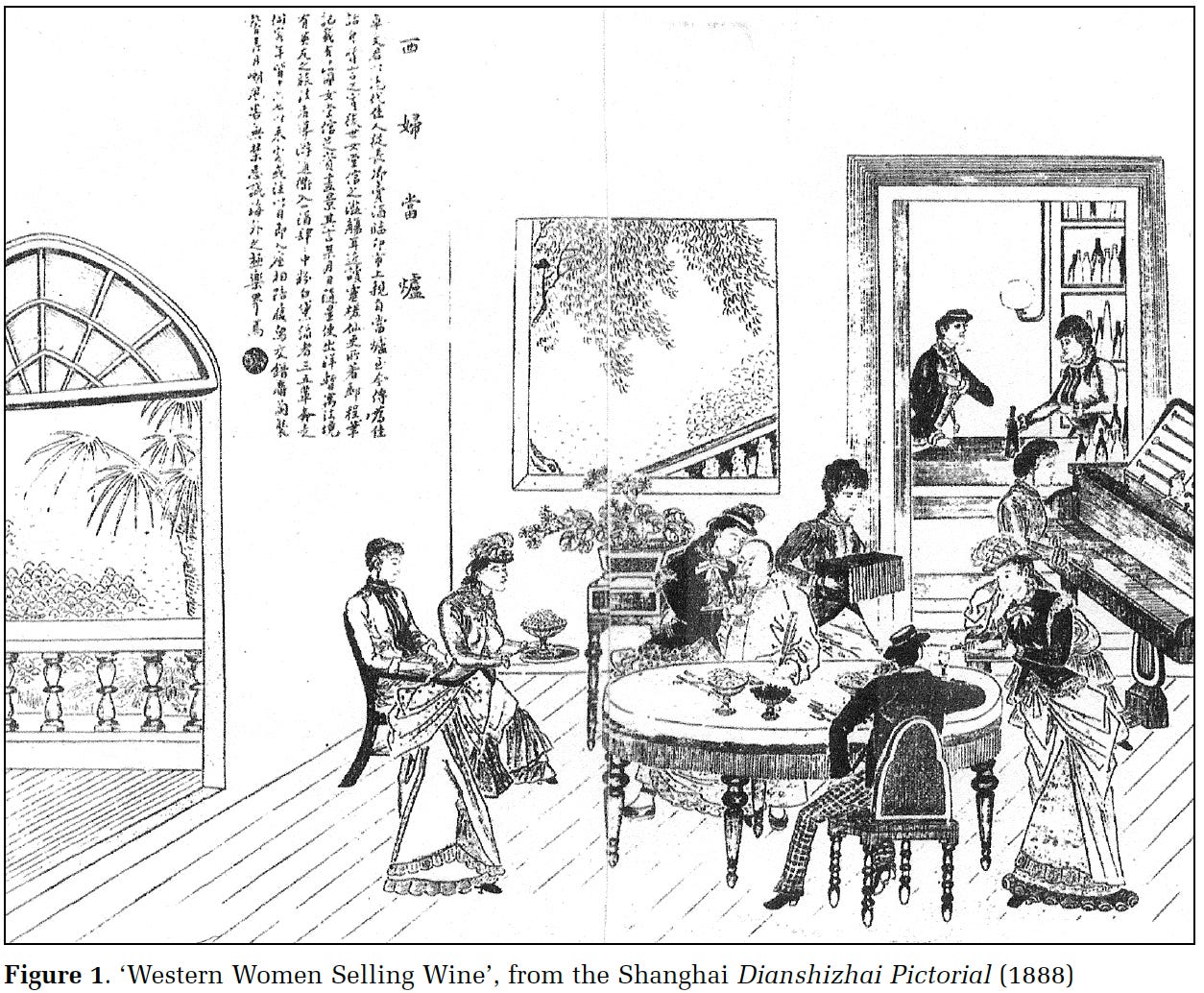
In the late 19th century, Chinese diplomats visited Europe and America. In reporting on this strange and distant realm, they often stressed the weirdness of Western women. Some viewed it positively, others played on male sexual fantasies, while others recoiled in absolute horror.
Bin Chun, a diplomat, relished gender mixing at banquet - likening the surreal experience of London’s Grand Ball to the underwater palace of the Dragon King.
Li Gui reported of America,
“these women do not have the manner of girls who are kept at home, but the spirit of men; I greatly respect and like them. Western friends accompanying me said that the Western custom was to treat men and women equally and to give women the same education as men; therefore women are quite capable of voicing opinions on large matters and performing great deeds (quoted in Teng 2008, 104).
Others, however, viewed Western egalitarianism with disdain, as if the cosmic order was out of whack. Everything was upside-down, perhaps due to England being on the opposite side of the world. Liu Xihong wrote in his private diary,
“Everything in England is the opposite of China. In politics, the commoners are above the king; in family regulations, the wife lords over the husband. (At home, the wife makes all the decisions and the husband follows her. At the dinner table, the wife takes the seat of honor while the husband sits in a humble position. In all matters of daily life, the husband serves his wife much as the most filial son in China serves his parents. Otherwise, people would laugh at him.) At birth, girls are esteemed but not boys.. This is because their country is located under the axis of the earth, so that heaven and earth are in reverse order” (Liu Xihong, quoted in Teng 2008, 108).
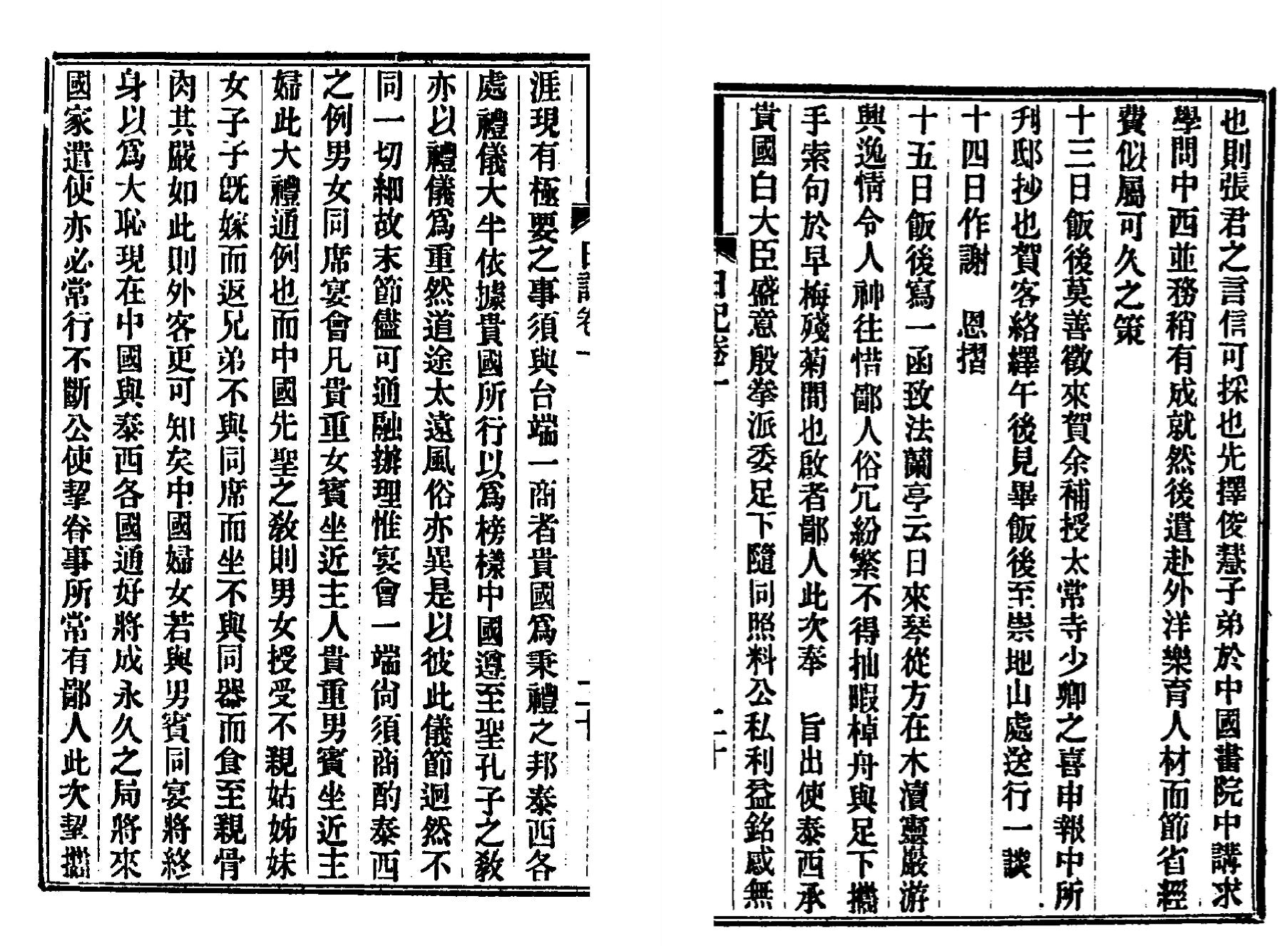
Zeng Jize absolutely refused and wrote a letter to the French diplomat with a very important request:
“By Western convention, men and women sit together at table.. But by the teaching of China’s ancient sages, men and women do not pass objects hand to hand. Paternal aunts, sisters, and daughters, once married, do not - even when they return home - sit on the same mat as their brothers, nor eat from the same vessels.
If such strictness governs even the closest flesh and blood, how much more so with outside guests! If a Chinese woman were to dine in company with male guests, she would count it a profound disgrace for the rest of her life…
My wife is accompanying me. I would ask you to convey my meaning tactfully to the high officials in your honoured country who deliberate on protocol, before [we arrive]: the family members of a Chinese minister can only occasionally exchange visits with Western lady guests. They need not exchange calls with gentlemen, and above all will not dine in company with gentlemen. Even on the rare occasion when a minister’s closest friend might be received by his wife and daughters, it would amount to no more than a modest bow — they will not perform the handshake”
(translated with Claude Fable, consistent with the summary provided by Yuan Gao).
Ladies First!
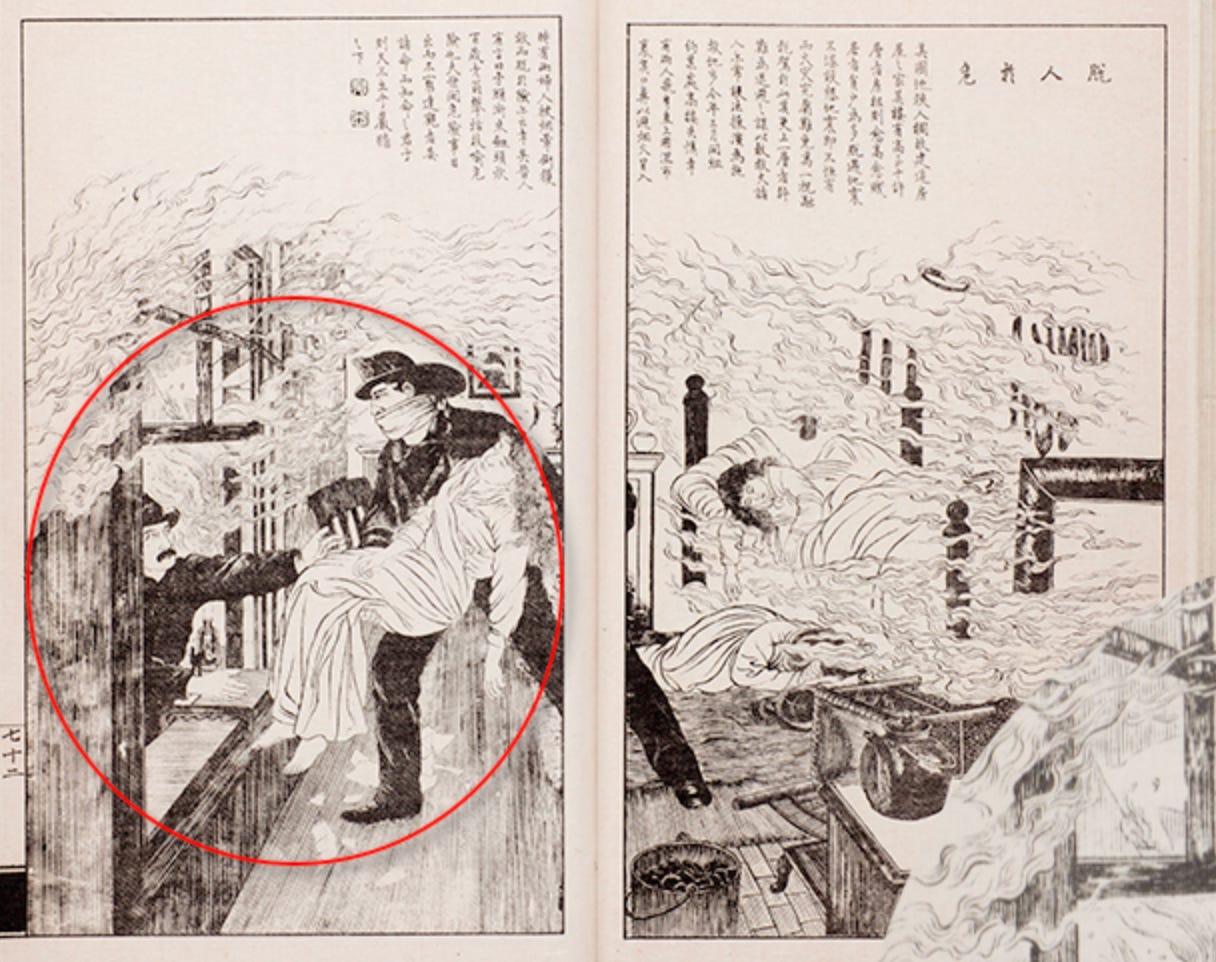
Ottomans were shocked by public deference to women and repeatedly reported on this with bemusement. In 1665, Evliya Çelebi joined the Ottoman peace embassy to Vienna and detailed,
“When the king comes across a woman while on the road, if he is mounted, he stops his horse and lets the woman pass. If the king is on foot, he stops and joins his hands in front of him; the woman greets him and the king shows respect to her by taking off his hat. The king again lets the woman pass.
In this land and other lands of the infidels, the word of say belongs to the women; women are so respected for the love of Virgin Mary” (quoted in Göcek 1987, 45).
In 1721, Mehmed Efendi, the Ottoman ambassador to Paris, noted that the city seemed more crowded than Constantinople because women came out onto the streets, where they were treated with respect:
“In France, esteem for women prevails among men. The women can do what they want and go where they desire. To the lowest, the best gentleman would show more regard and respect than necessary. In these lands, women’s commands are enforced. So much so that France is the paradise of women” (quoted in Göcek 1987, 45).
In the 19th century, al-Tahtawi likewise noted that women received “greater regard”:
“Balls always include men and women… it is mainly the women that sit down, and no man will ever sit down before all women have found a place; if a woman joins a company and there is no seat available, then one of the men will get up and offer her his seat. Conversely, a woman does not get up to give up her seat” (al-Tahtawi, 230).
He thought this absurd. Parisian men were too deferential to unrelated women, even those who were plain:
“the men are slaves to the women here, and under their command, irrespective of whether they are pretty or not”; they “do not have a bad opinion of women, despite their many faults”.
In justification, he cites Arab poetry: “be disobedient to women.. The man who hands women his halter will not prevail/ They prevent him from developing many of his virtues… Always think the worst of women” (Al-Tahtawi, 178).
Why was al-Tahtawi so disgruntled?
In honour cultures, a man cloisters his own women and owes little to anyone else’s. But in Europe, courtesy crossed the boundary of kin: unrelated women were owed respect. This had deep roots: in the absence of clans, Europeans cooperated with non-kin in guilds and markets. Unmarried women routinely left home to work as servants in strangers’ households. Commerce then redoubled the incentive to please strangers. By the 18th century, English essayists explicitly championed mixed-gender conversation as a mark of good manners.
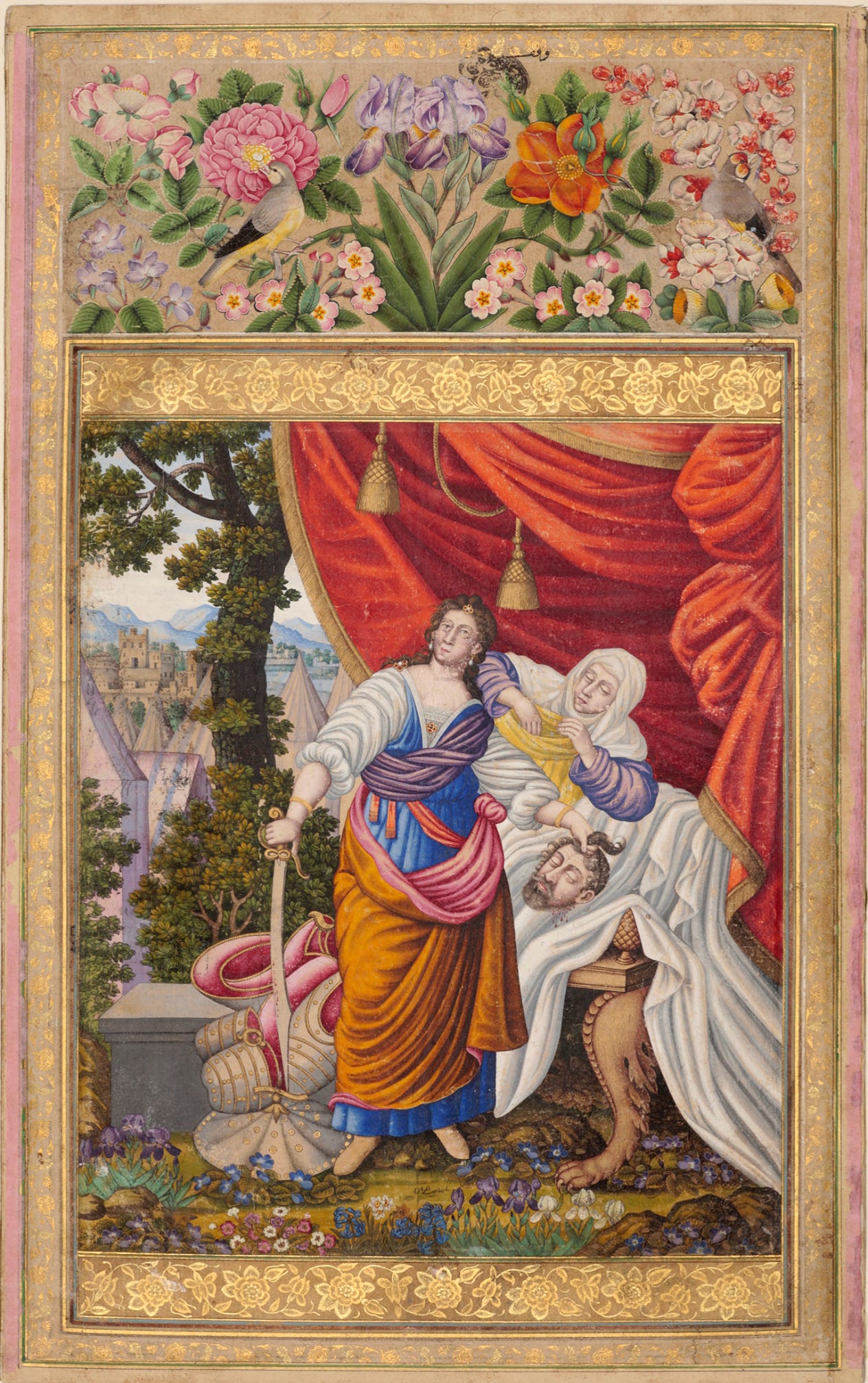
Mixed Gender Socialising
Near Vienna, Evliya Çelebi observed, “the men and women do not flee from one another”:
“The women sit together with us Ottomans, drinking and chatting, and their husbands do not say a word but rather step outside. And this is not considered shameful. The reason is that throughout Christendom women are in charge, and they have behaved in this disreputable fashion ever since the time of the Virgin Mary” (Evliya Çelebi, 225)
In 1766, al-Ghazzāl crossed the border to the Spanish port of Ceuta, observing:
“Their dwellings have windows overlooking the street, where the women sit all the time, greeting the passersby. Their husbands treat them with the greatest courtesy. The women are very much addicted to conversation and conviviality with men other than their husbands, in company or in private. They are not restrained from going wherever they think fit”.
Returning from a ball, “we implored the Almighty not to hold us accountable for our offense in conversing with them as the circumstances required” (Ghazāl, 12, 23)
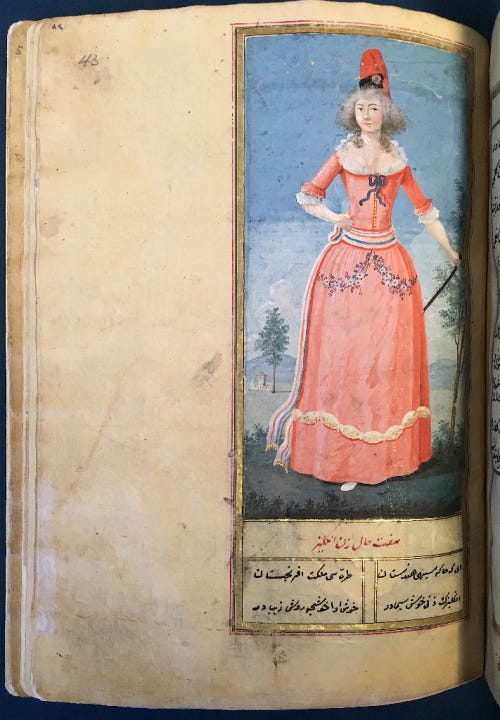
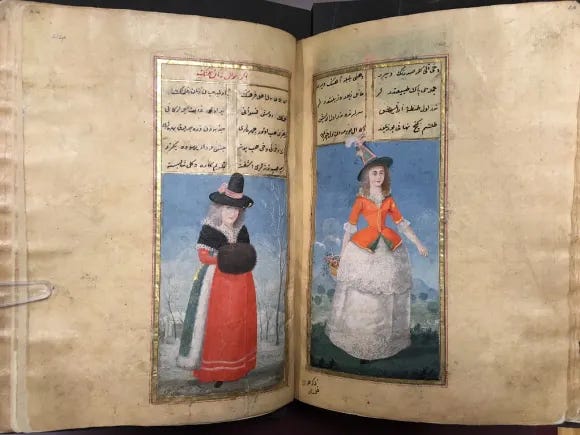
In France, Al-Saffar was bewildered. Staying on the Champs-Élysées in 1845, he was delighted by the sight of women - running shops, operating machinery (157, 203). Meeting King Louis Philippe and his family, he noted that
“Women talking to men is not considered shameful or harmful to one’s virtue. On the contrary, it is encouraged.. even if a woman is alone” (Al-Saffar, 178).
Al-Tahtawi, an imam who travelled to France in 1826-31, noted French men’s lack of jealousy and women’s far greater freedom of movement:
“Even women travel, either alone or accompanied by a man with whom they have entered into an agreement regarding the journey and whose expenses they pay for along the way.
Indeed, women also have a passion for knowledge, for discovering the secrets of beings and learning more about them.. They are like men in every respect” (Al-Tahtawi, 218).
He also described French balls - open to both sexes, with guests greeted by the mistress of the house. With some disapproval, he remarked that a woman could dance with multiple men. A man’s capacity to talk to women was even seen as a mark of refinement!
“The more a man talks with women and praises them, the more he is considered a man of good breeding… Everyone in France loves dancing, which is considered something distinguished and elegant, instead of morally depraved” (Al-Tahtawi, 231).
The Shah of Iran’s Displeasure
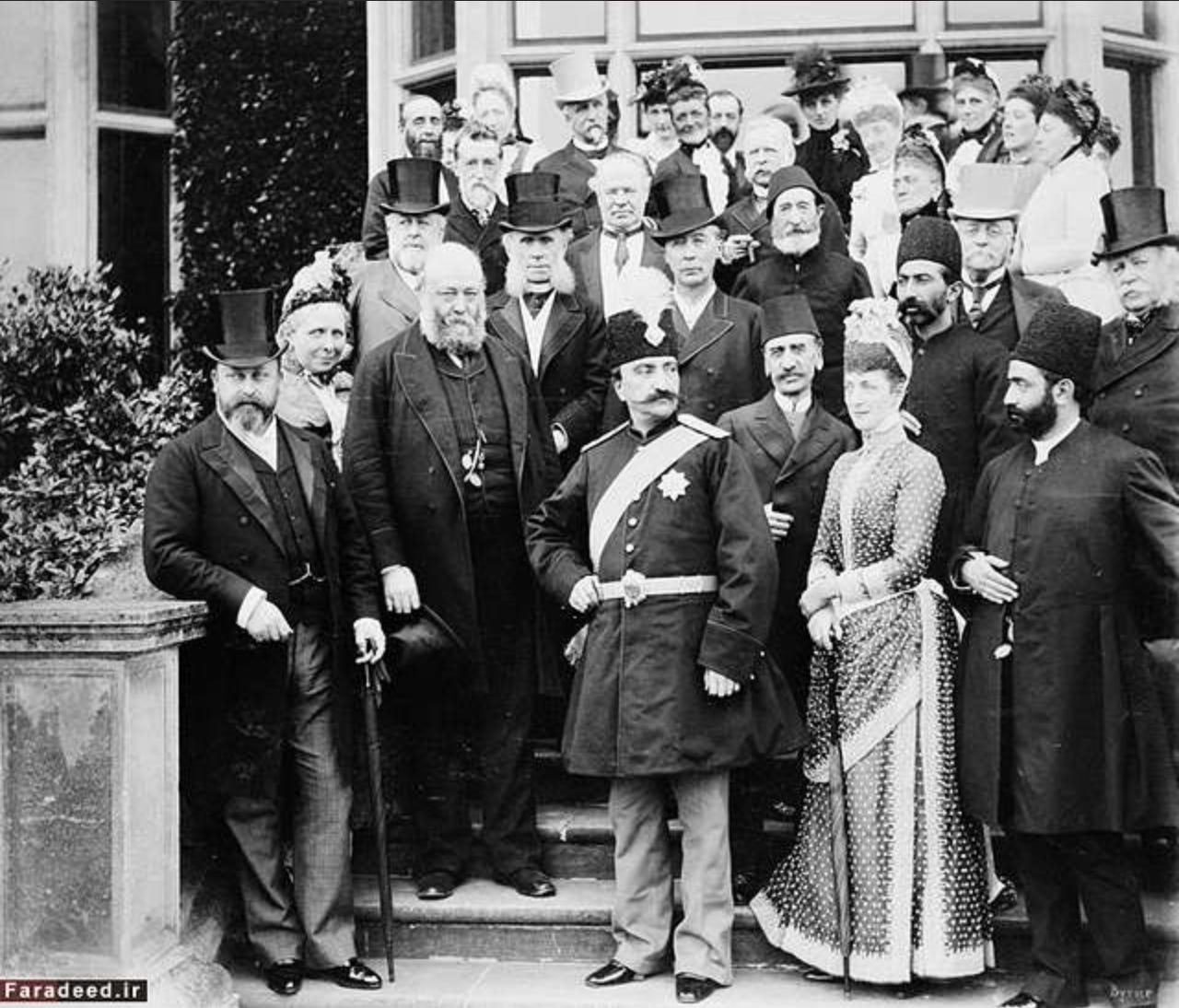
Nasir al-Din Shah toured Europe three times between 1873 and 1889 and repeatedly wrote diary entries about women’s visibility - at theatres, dinner tables, and even on his own arm at court banquets. In these entries, he sometimes expresses disgust and repulsion. According to a British diplomat, the Shah even pointed a finger at the Tsar’s Grande Maîtresse’s cleavage, saying:
“Old, ugly. Why naked?” [“Vieille, laide. Pourquoi nue?”].
Gender Segregation in Parliament
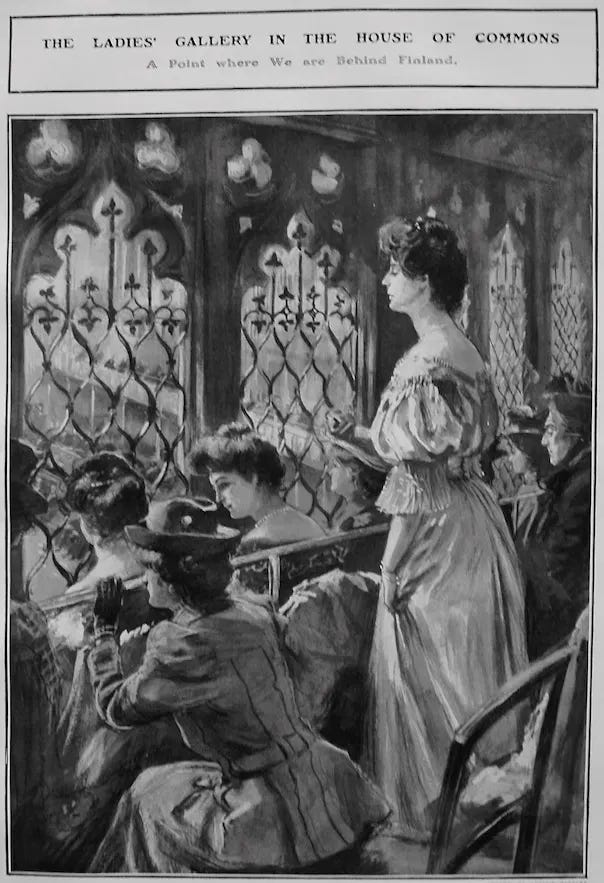
When the Palace of Westminster was built after a fire in 1834, a Ladies’ Gallery was installed - but with a poor view and grille panels to obscure women from the debating chamber. Suffragist Millicent Fawcett described it as a “grand place for getting headaches”.
Zeyneb Hanoum, who fled Istanbul with her sister in 1906, described the Ladies’ Gallery as another form of harem:
“But, my dear, why have you never told me that the Ladies’ Gallery is a harem? A harem with its latticed windows! No wonder the women cried through the windows of that harem that they wanted to be free” (Hanoum 1913, 194).
Europe’s Latent Assets
Together, these accounts capture what made pre-20th century European gender relations distinctive, yet still patriarchal. Mirza noted husbands’ legal authority, while Zeyneb saw women watch parliament through a grille.
Yet Europe had several latent assets.
Weak ideals of female seclusion. Chinese, Arab, Turkish, Indian and Persian travelers were repeatedly startled by men’s lack of sexual jealousy, alongside women’s public presence at shops, parks and banquets.
Courtesy to strangers. Unrelated women were owed respect, a habit forged over centuries of weak kinship and commerce.
Economic growth - the industrial revolution was creating jobs, ramping up demand for workers and generating revenue for public goods.
Liberal democracy, which could be leveraged to include women.
State capacity, to constrain and punish male violence.
Europe was becoming richer, stronger, and more democratic. Over the 20th century, feminists would seize the levers of state power and media persuasion to secure greater gender equality.
Watch out for my next essay on how Japanese, Korean, Turkish and Indian female travelers got inspired and pioneered reforms worldwide!!
There is another reason these travel accounts are so valuable: outsiders do not merely notice differences; they notice things insiders have stopped noticing.
A Frenchman is unlikely to record every occasion on which a man gives up his seat to a woman, because the behavior has already become ordinary. An Englishman is unlikely to note each time his wife speaks with an unrelated man. But a traveler arriving with a very different set of gender norms may find these behaviors astonishing, offensive, or even cosmically backwards—and therefore record them.
This suggests that the hardest parts of a culture to observe may be precisely its most stable ones. Once a norm becomes sufficiently established, participants stop experiencing it as a “norm” at all. It simply becomes the way things are.
That makes cross-cultural travel writing valuable for more than providing an alternative perspective. It can make a society’s invisible defaults visible again.
I would distinguish, though, between evidence for the difference and evidence for its cause. These accounts provide striking evidence that norms surrounding unrelated men and women differed. Explaining why those norms emerged—weak kinship, commerce, or something else—requires another layer of evidence.
Long ago, I read that a Muslim ruler sent a team to Europe to figure out why his domain was getting left behind in economics and science. The team came back with only observations about how the women mouthed off, or something. Put differently, apparently they couldn't "see" what was going on in the West post-Renaissance ...