


Conventional narratives about the Aztec are deeply misleading, argues Caroline Dodds Pennock. For while this 15th-16th century Mesoamerican empire was militaristic, women were nonetheless important in the domestic sphere - honoured in the image of deities, ritually significant, gloried for childbirth, economically vital, and socially influential.
Is she right?
More broadly, are scholars right to push back against narratives of imperial militarism, by instead stressing women’s agency and roles as hidden powers? Moreover, does progressives’ quest to support indigenous people’s struggles against racist oppression and past suffering mean that they themselves turn a blind eye to actually existing patriarchy?
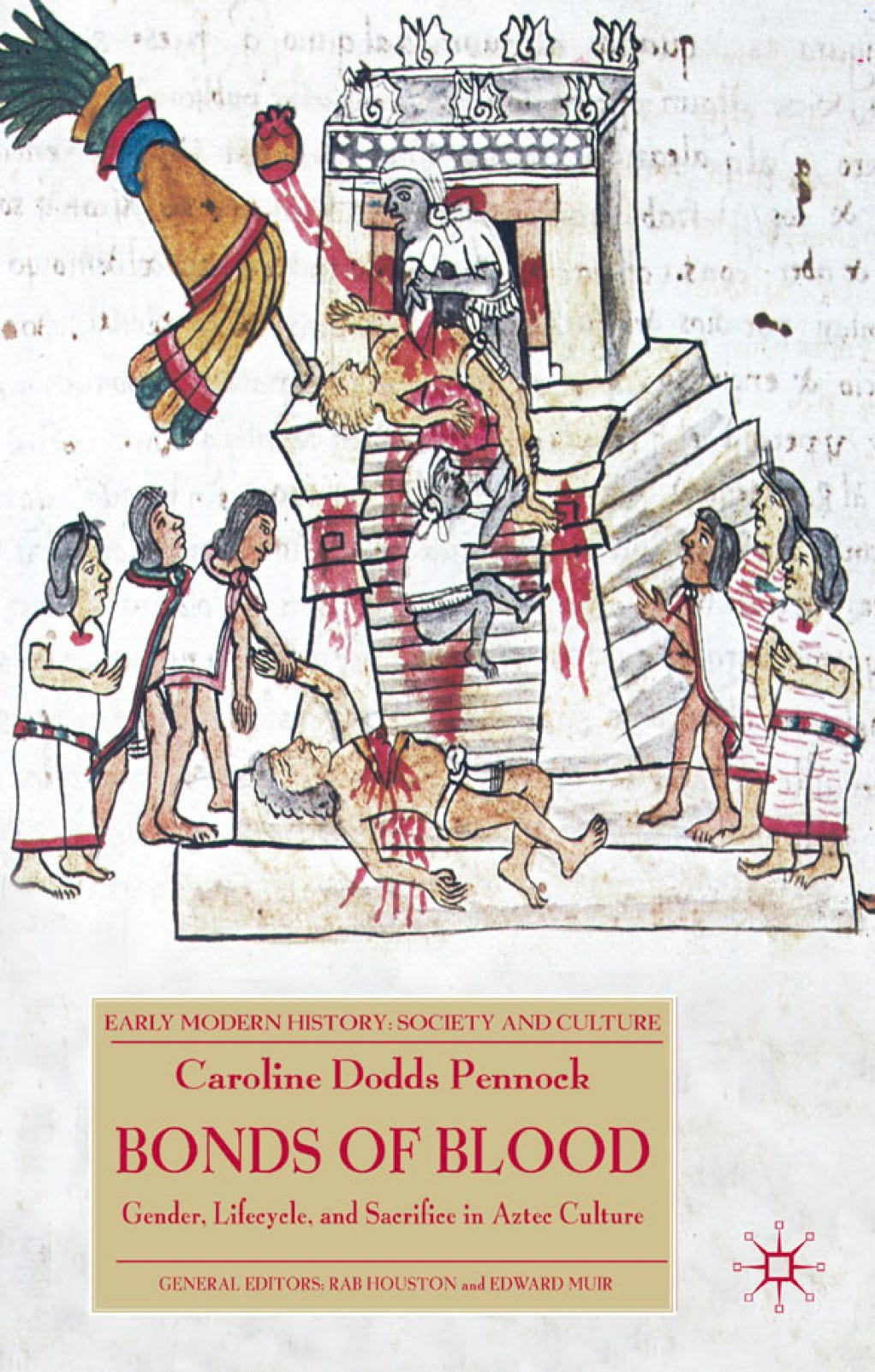
1. Valued work or hard graft?
Dodds Pennock argues that “[i]n the rigidly controlled and cooperative environment of Tenochtitlan, a system of dual organization ensured that men and women fulfilled very specific and very different roles, which were regarded as equally essential for the successful perpetuation of their culture.. Their roles were complementary, working together”.
Certainly, women’s work was hugely important to household survival and imperial wealth. Women were economically active: grinding maize, preparing tortillas for their families, selling the surplus at markets, and producing cloth as tribute.
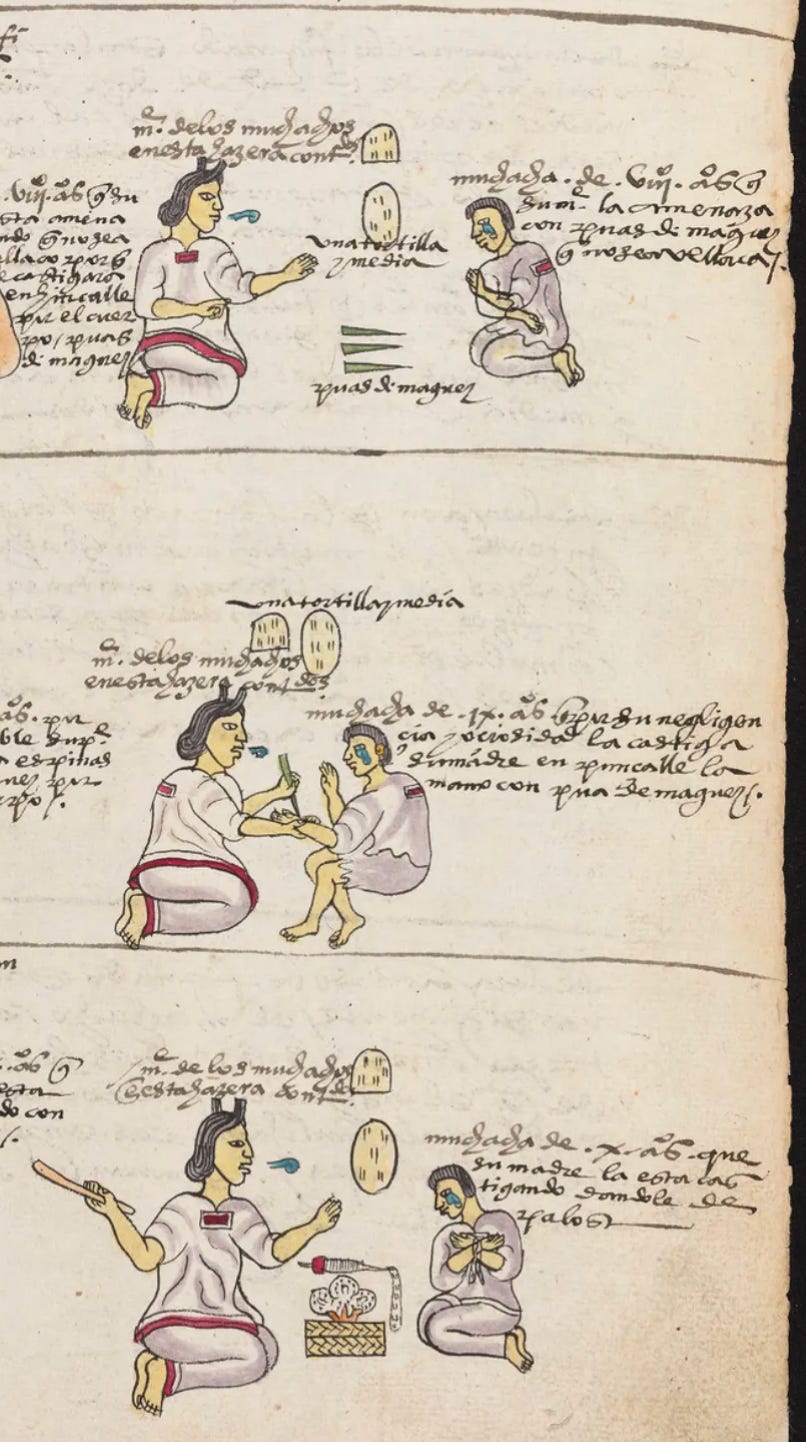
Mothers certainly instructed their daughters to perform this valuable labour, punishing negligence and laziness by beating them with sticks, or pricking them with maguey spikes. Yes, women’s work was absolutely fundamental, but hard graft does not necessarily advance women’s status.
2. Do sacrifices signify women’s importance?
Dodds Pennock writes that a single round of the Aztec religious calendar included 90 instances of human sacrifice. These are mostly vague as to the sex, but 37 ceremonies name the gender, and women feature in 16 instances. She further argues that the victims were ixiptla (impersonators) of the gods, embodying the deity the ceremony was supposed to honour.
Building on this, Pennock argues that female victims often embodied deities associated with earth, fertility, water, maize, salt, childbirth, disease and natural forces. “Women were bound up with the earth – and this connection gave both their lives and their deaths significance”.
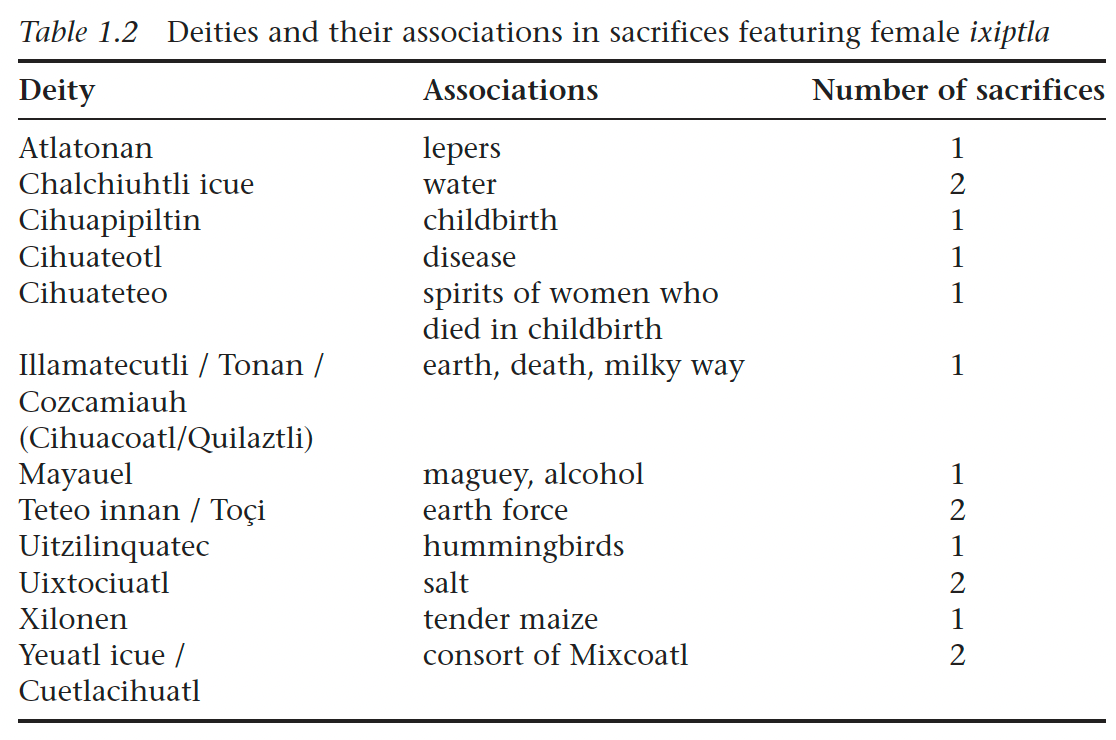
Curious to learn more about female ixiptla, I turned to the Florentine Codex.
Book 2, folio 8r, details that in the 11th month (Ochpaniztli), the Aztec would celebrate Toçi, the mother of the gods, by killing a woman dressed with the ornaments that depicted this goddess.
She would be accompanied by a number of female healers and midwives, celebrating for four days, while ensuring that the intended victim would not discover she was about to die or else she would become sad - a bad omen. So instead, they would say they were taking her to a great lord, and covertly cut off her head, skin her, and a young man would dress himself in her skin. (This evokes the Mexica origin myth).
Just as Dodds Pennock states, the Florentine Codex certainly details that the Aztecs performed sacrifices to other goddesses, such as Uixtocihuatl (the goddess of salt).
Female ixiptla clearly had ritual significance. But I suspect that many readers may want further evidence that this actually signified women’s status. Did it really correlate with how women in general were perceived and treated in everyday life? In Classical Athens, men gave (non-human) sacrifices to Athena, but kept their own women in seclusion and male guardianship. I, for one, am unconvinced that sacrificial victims (even those signifying the deities) are hugely informative about women’s status.
3. Does self-sacrifice demonstrate ‘agency’?
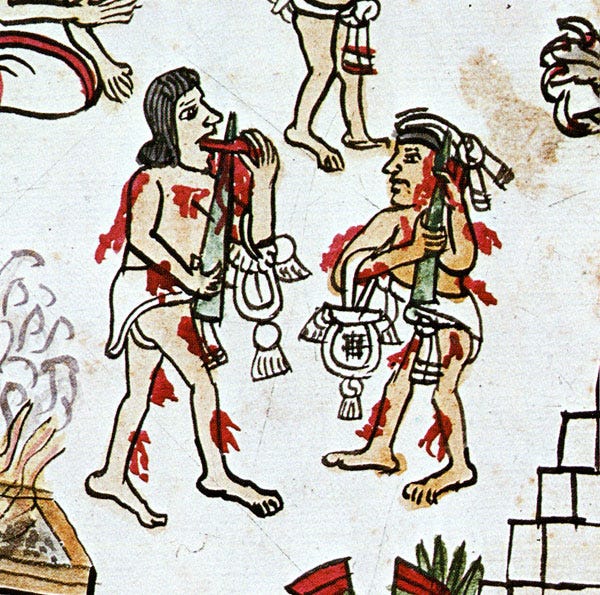
Dodds Pennock further argues that female worshippers were not passive, but actively chose to pierce their own skin, thereby demonstrating agency.
‘Among ‘ordinary people’, both men and women used cactus spines to pierce their ears, arms and the tip of their tongues, suffering the sharp pain as the drops of blood were squeezed from their flesh. The ‘most devout, both men and women, had their ears and tongues torn’, offering their own blood to succour the gods…
For each person this seems to have been an individual choice.. [F]or women it was an individual offering, an issue for personal resolution” (p. 32).
Ever since the 1970s, counter-cultural revolution, many people have used the language of ‘individual choice’ to render any action inherently important.
But if ‘agency’ just refers to any choice given the circumstances, this becomes rather trivial. Aren’t we all demonstrating agency all the time? If every action qualifies as ‘agentic’, even self-laceration, it seems rather uninformative.
Everyone tries to improve their welfare, prosper or gain broader esteem, given the available trade-offs and community pathways to prestige. As Marx insisted, ‘men make history but not in circumstances of their own choosing’. If revered priests and peers celebrate and participate in auto-sacrifice, one might well follow suit.
To abstain from religious practices in an extremely religious society, where everyone attends religious schooling, would surely be extremely risky, if not dangerous! The Aztecs are not renowned for their tolerant liberalism…
4. Do childbirth myths imply status?
The Aztec priests taught that most people would spend the afterlife in Mictlan, a place under earth, full of misery and deprivation. But Dodds Pennock details that this could be avoided by dying in battle, as a priestly sacrifice, or in childbirth.
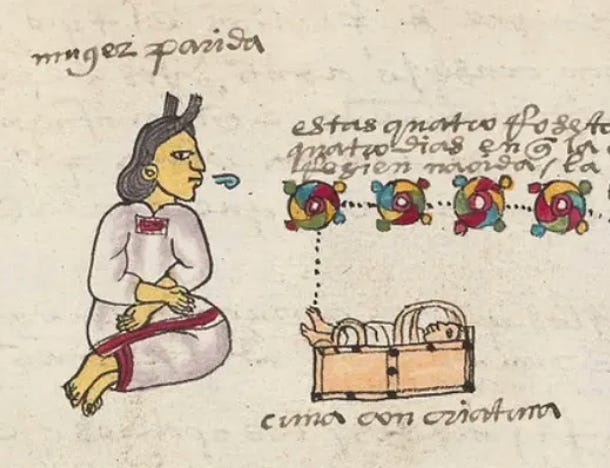
During childbirth, women were believed to be possessed by the Earth Mother, via her guise as Cihuacoatl (Woman Snake). If she happened to die, the Aztecs said that she gained the goddess Cihuacoatl’s power. For four nights after burial, grieving relatives would guard her corpse lest young warriors steal her fingers, hair or forearm. (To me, such mutilation indicates a brutal disregard of other people’s bodies).
Even if these deaths were revered, Dodds Pennock acknowledges that a subsequent divergence. Dead warriors accompanied the Sun to its glorious resplendence at noon, whereas women bore the dreadful responsibility of carrying it down to the people of Mictlan. (Aztecs feared the Sun would not rise).
After four years of accompanying the Sun, the souls of men would become beautiful dancing butterflies, while the souls of women would become demonic tormentors, bringing suffering and affliction.
After sharing these details, Dodds Pennock concludes, “Childbirth was a powerful and meaningful act, which infused women with importance and influence, in both the practical and spiritual spheres.”
I suspect that readers may be unconvinced by this logic.
Studying the global history of gender, I realize that many societies glorified both men’s military sacrifice and women’s childbearing, because these were absolutely vital for social reproduction and imperial expansion, yet extremely dangerous. Before the advent of modern medicine, becoming pregnant was extremely dangerous. Spiritual rewards potentially encouraged women to keep pumping out babies. Any society that failed to make a convincing case would surely contract - as in South Korea today.
Moreover, even if childbearing was celebrated, the overwhelming majority of Aztec mothers woke early, spent five hours a day grinding maize for tortillas, scrubbing their children’s clothes. Head to any impoverished community in South Asia or Africa: childbirth is celebrated with a big party, but everyday life as a mother is tough.
5. What did priestesses do?
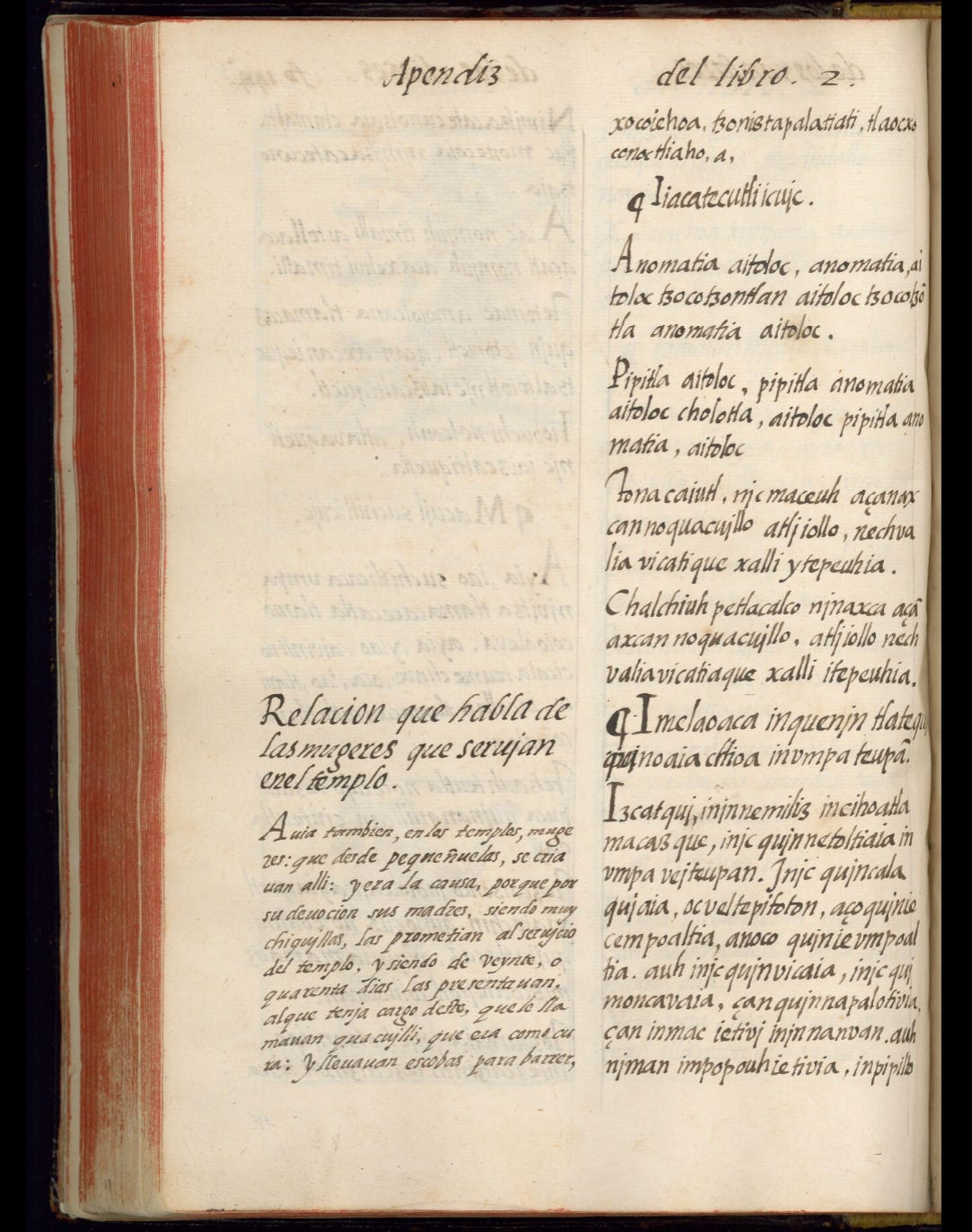
Girls could become priestesses, typically only briefly in adolescence; their primary roles included sweeping and making cloth for the deities’ images. Once they reached the marriageable age (around 15), they would marry and start families, like all other young women (Florentine Codex Book 2: 144r, 144v, 145r).
Dodds Pennock affirms this same account, but refers to this as women playing ‘key roles… as priestesses’. Here, I think it’s important to distinguish between women making important contributions (producing children, cloth, tortillas), and actually being seen as knowledgeable authorities. One does not entail the other, especially not for 14 year old girls. In my own interviews in small town Oaxaca, young women told me that older generations would see them as servants, to serve and obey, not as people whose autonomy should be respected or whose words carry weight. They worked, men governed.
6. ‘Intimacy’ or Child Marriage?
Dodds Pennock’s account of marriage omits that Aztec girls were typically wed at 15. The new couples were usually barely acquainted, then spent four days in seclusion to,
“establish familiarity, consideration and compassion... This is a vital element of the ritual, a time for compassion and intimacy. For both of the young couple, but perhaps the woman in particular, who was likely the younger and more innocent partner”.
This emphasis on compassion and consideration seems an odd gloss on a 15 year old entering into marriage, which was arranged with a man she barely knew, but had completed intensive military training at the telpochcalli or calmecac, where he was trained for conquest and aggression.
Today, child marriage is often associated with increased risk of abuse. So why presume this was avoided in the past?
Dodds Pennock repeatedly emphasises that elderly matchmakers and midwives commanded ‘social authority’, and that’s true. They were respected, but I think it’s important not to overstate their importance. Their roles were to ensure social reproduction: marriage and safe births. Outside state-run educational institutions, they lacked the powers of wider ideological persuasion or contestation. They did not collectively mobilise to advance women’s status, or abate male violence. So even if individually significant, there was little they could do to challenge male supremacy.
While I greatly appreciate Dodds Pennock’s careful examination of women’s work and authority, there’s clearly a delicate tightrope in not understating actually existing patriarchy.
Getting Real about Patriarchy
If I may summarise my own reading of the primary sources (in translation) and wider academic research, it seems that:
Aztec society was militaristic, male aggression was glorified, and surrounding city-states were at risk of attack, possibly becoming human sacrifices, or sending tribute.
State power and prestige were dominated by male priest-warriors. They ran the temples and schools, which instilled discipline. Women lacked an equivalent means of mass ideological persuasion.
Aztec women entered arranged marriages at 15, then performed a huge volume of domestic drudgery.
Spanish conquistadors seized land and power - bringing diseases, instilling brutal labour coercion, and racist hierarchy. Indigenous peoples were then over-ruled and oppressed.
Going beyond the Aztec, I would now like to suggest some ways we might rethink our approach to gender history:
Broadly, the post-1970s has heralded a reaction against narratives that centre male military might, and instead centre ‘weapons of the weak’. But these groups so often were indeed weak and marginal. Our task as historians is to surely recognise that oppression.
The fixation with ‘agency’ is also unhelpful. If anyone trying to better their lot is seen as ‘agentic’, the concept is so trivial as to be uninformative. This does not imply that women were ‘passive’ (a classic straw man). Clearly, they joined collective festivities, worshipped, and pierced their own skin with maguey thorns. But they were nevertheless hugely constrained, by pervasive conflict, ecological precarity, poverty and religious dogma.
Spanish imperialism was truly oppressive, and over subsequent centuries they derided indigenous peoples as savage barbarians. In reaction to this racism, post-colonial scholars and activists have often tried to support indigenous communities’ quests for dignity and self-governance by minimising their own oppression, but this actually papers over indigenous patriarchy. Get real: the entire world was patriarchal!
Moving forward, it would be more empirical to trace how power and prestige were actually won, even if that means an overwhelming focus on male military coalitions, legitimised by religious persuasion.
Once we recognise that the entire world was patriarchal, then we can also realise the triumph of contemporary progress. Over the past century, Mexico has become radically more gender equal - with women gaining economic independence, supporting female leaders, and condemning male violence. Getting real, we should also recognise major challenges, most notably violence.
Another excellent analysis :) Why are so many researchers trying to "prove" that the past was a better, less oppressive place, while there's every evidence that it wasn't ?
I enjoy your summing up. The white washing of indigenous cultures in the Americas often makes me blush. I think the whole world being patriarchal (while clearly true, even of our primate relatives), offends the political alliances of the left, which are often anti-colonial/women's rights/immigrant/anti-traditionalist/non-christian. Given this repeating pattern throughout the world, the 'only white Europeans were patriarchal' myth is extremely useful politically, and due to a lack of writing throughout much of the world, relatively easy to convince people of.
A second point, it is very easy to argue that patriarchy is natural. This is a conclusion many people want to avoid for the above reason. Inventing "primordial cultures" who are supposedly older (again, mostly untrue) helps prevent folks from coming to that conclusion.
Thank you again.