

If everything can be learnt with Generative AI, what’s the point of university? When new concepts, methods and empirical evidence instantly appear upon prompting, is traditional teaching now obsolete?
It would be easy to dig in our heels and reaffirm the status quo, but others may soon become sceptical. Personally, I think it’s worth reflecting on how universities can best add value in an age where information is free.

Beyond Knowledge
Frankly, I see little point in replicating what is already available with AI. Instead, it’s useful to identify key limitations and work creatively to finesse complementary human skills.
1. Independent Analysis
AI is certainly remarkably intelligent, but presently struggles to analyse competing hypotheses. Consider the Middle East and North Africa’s plummeting marriage and fertility. Claude falters - for it is trained on existing data and struggles to connect the dots. Given the economic implications, that’s a serious omission..
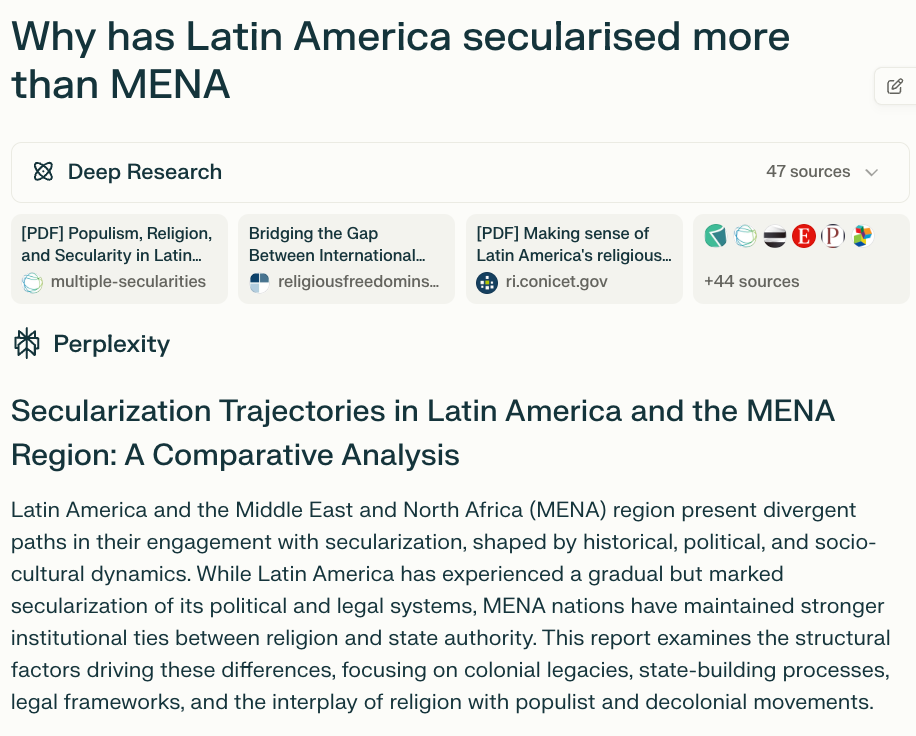
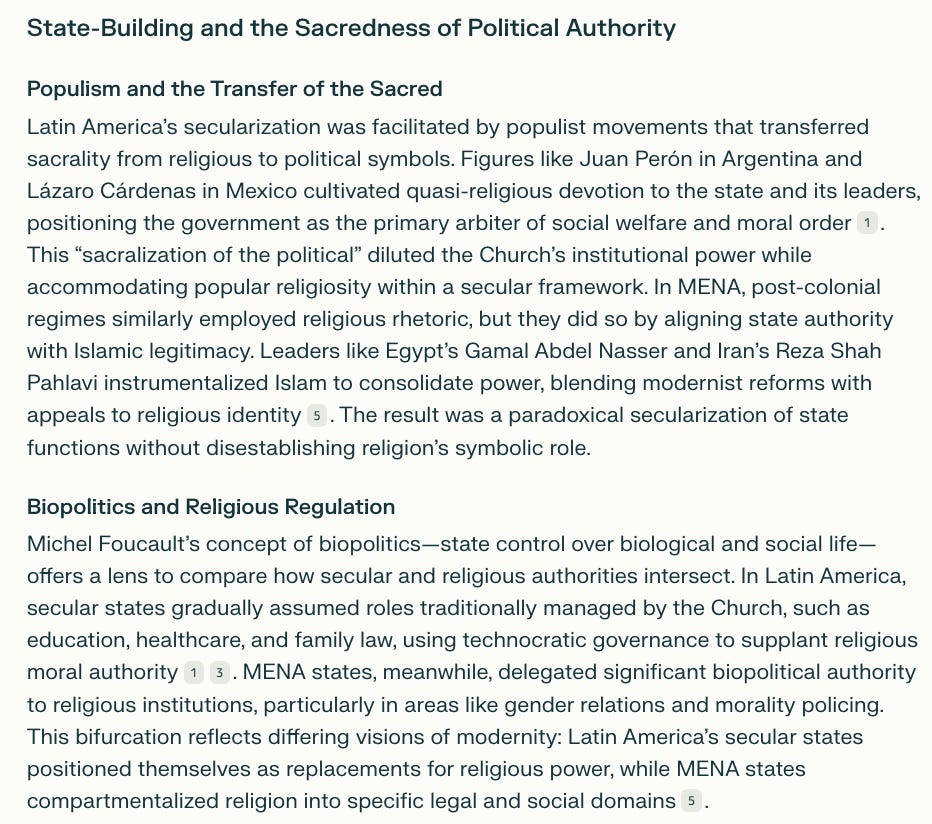
Have you tried “Perplexity Deep Research”? When asked “Why has Latin America secularised more than MENA?”, it gives a very plausible set of reasons, which may satisfy rote learners. Yet anyone with deep historical knowledge may be left unsatisfied. Why were Latin America’s modernisers more successful, without strong backlash?
This isn’t to be dismissive! Rather, AI will likely be used more productively by those trained to develop independent knowledge and rigorous scepticism.
2. Creative Problem-Solving
Graduates are more likely to thrive in the job market if they can harness AI while using their intellect to probe deeper. Technological literacy combined with innovative thinking is super valuable.
Everyone (myself included) comes with their own set of priors about how the world works and what matters. Innovation (across all realms) requires carefully thinking through vast swathes of empirical data, considering alternative hypotheses, and exploring new frontiers. That’s a skill!
3. Networking & Persuasion
Through my interviews worldwide, I realise that change (of all kinds) occurs when people incrementally question the conventional wisdom, speak up, and persuade their peers.
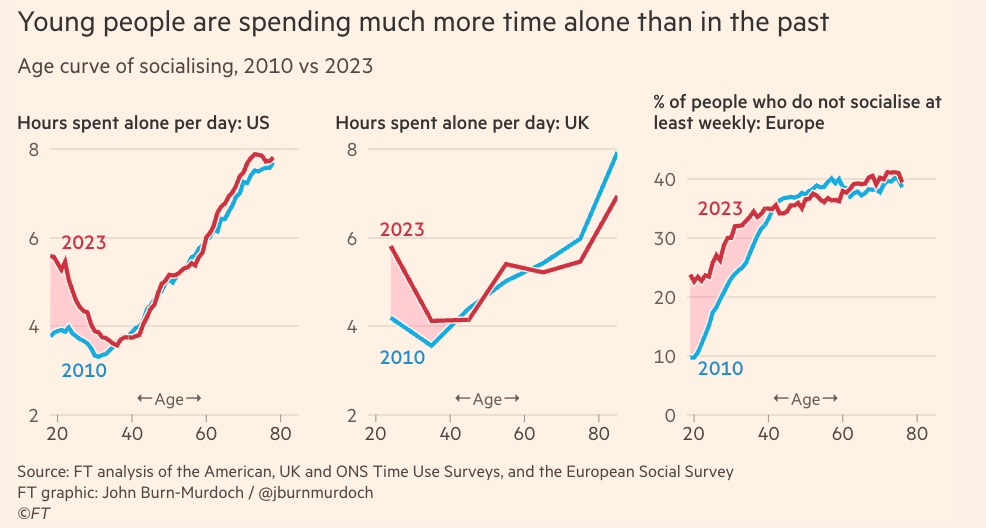
A Large Language Model won’t necessarily be able to teach you how to build trust, rapport and camaraderie. Digital isolation may even scupper our confidence to mix and mingle, bond and charm.
4. Breaking Echo Chambers
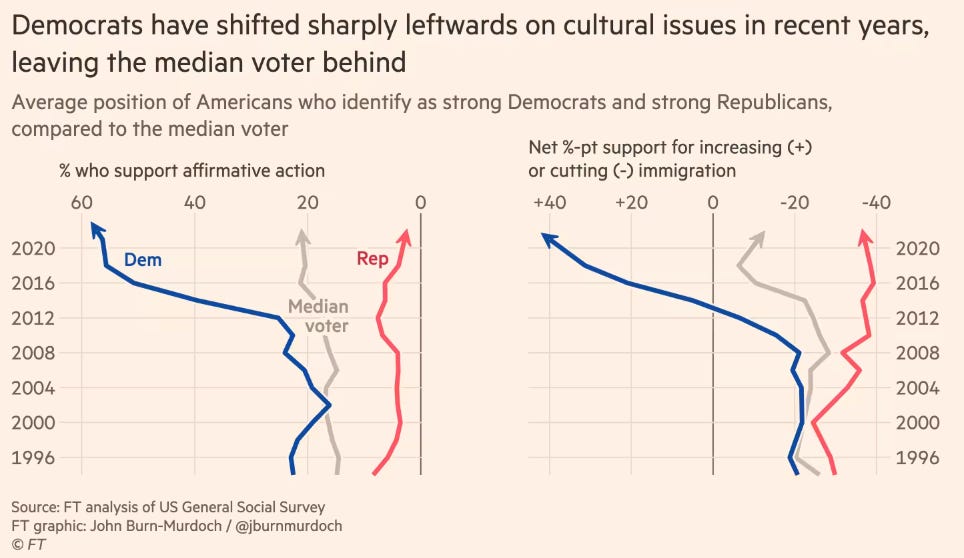
Smart phones might also be exacerbating illiberalism. Unlimited power to curate our own echo chambers means we can immerse ourselves in group think, only ever engaging with like-minded others, who champion our same values. This can create serious blinkers.
Talking to an American lawyer, I recently shared the graph below. Shocked, she had no idea that affirmative action and immigration were so unpopular with the median voter.
To remove these blinders, we might all benefit from a more exploratory, curious mindset, which revels in different perspectives, thinking through alternative hypotheses.
5. Liberal Education
Meng (a Chinese postgraduate studying in the UK) shared why she likes my rather provocative classes, rife with debate! Her experience reflects the limits of learning by rote and AI:
“Everything [Chinese universities] can teach me, I can learn by myself - like I can learn economic courses and machine learning though GPT. But critical thinking is powerful, and Chinese universities can’t engage me in such thinking. They just say how the world is, but we can’t judge the world is, even the professors can’t do it either…
When I use ChatGPT, I suffered from two stages… The first stage, I rely on everything it provides me, I just take it for granted. Every time I absorbed information.Then in your lesson you countered this argument. Then I realised some issues under the AI model… The data can be fake, or outdated. And AI can combine information A and B, but it can’t create C”.
Universities 2.0: A New Educational Model?
Responding to the technological revolution, I plan to improve my teaching by supporting students to strengthen their:
Critical thinking - and how to identify AI’s limitations,
Mastery of AI - harnessing technology to build constructive improvements,
Social charisma and persuasion.
Tyler Cowen made similar suggestions (getting students to grade and correct AI models). Now let me suggest how this might be done in lectures.
Practical Implementation
Let’s suppose I’m lecturing on trade. Previously, I would present about 50 lecture slides in two hours, while pausing every ten minutes to invite discussions on key questions.
This approach may now be outdated. Why treat students like infants, unable to find information independently? By next semester, most information may well be accessible via AI.
So here’s an alternative. Welcoming the class, I might say “use AI to understand how trade liberalisation had different effects in different parts of the world”. Let them investigate for 15 mins, discuss in pairs, while I move round the class to provide personal support. Then, everyone could anonymously upload their answers on a Google document for me to review and provide commentary. If their answers are partial, I could turn to relevant pre-prepared slides or my textbook.
My students should be in the driving seat, harnessing the latest technology to investigate, learn and explore - just as they might in future careers. Playing devil’s advocate, I like to push back - challenging their priors, other considerations, and more nuanced analysis.
Hopefully, this strategy will help students master AI, while recognising its limitations, and always demanding higher standards in the ongoing quest for truth.
Podcasts!
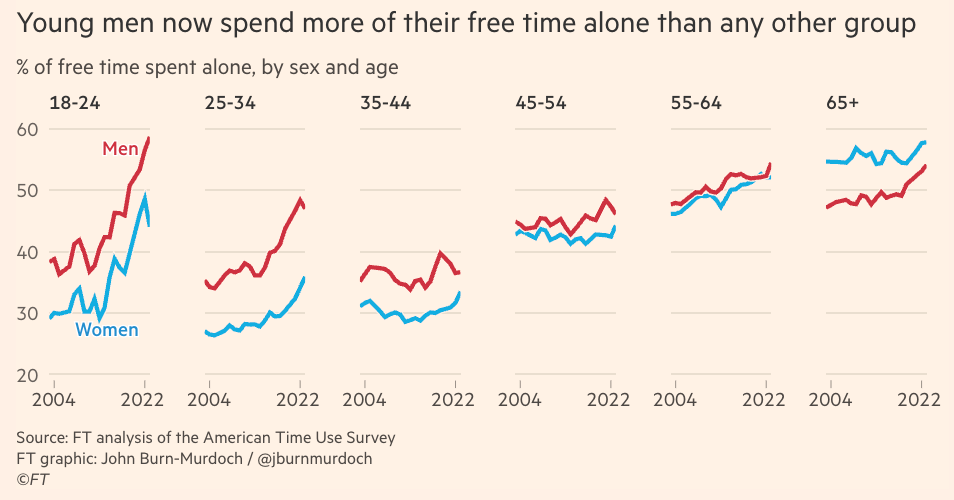
Most of our careers are pretty social. Charismatic oratory, savvy networking, and ideological persuasion are all ginormously valuable skills. Yet these may be being lost, as teens retreat into digital solitude. A young American guy is spending more time alone than a pensioner..
Universities can help bridge the gap - teaching students the forgotten arts of charm, networking and persuasion! My next initiative will be to teach students how to research and produce two-person podcasts. Let’s put the ‘social’ back into social science.

What kind of education is valuable in a world of AI?
I don’t pretend to have all the answers, nor to have finessed the balance. But I do want to innovate and give my students a valuable education for a changing world. So to recap my strategy:
Critical thinking - and how to identify AI’s limitations,
Mastery of AI - how to build constructive improvements,
Social charisma and persuasion.
What do you think? Critique and feedback are always welcome. If any AI firm wishes to give me access to their latest models, so I can experiment, please hook me up!
Right, I must return to my interviews in Costa Rica! Hasta luego.