
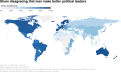

Over the 20th century, the entire world became more gender equal. Or so I thought. But Pakistan has rocked my priors. Female employment has slightly risen. Meanwhile, young Pakistani women are more sexist than their grandmothers. What is going on?
Female employment is well below the global average - in Pakistan, Bangladesh and India
Women are far less likely to participate in the labour market than women in similarly wealth countries. This was true in both 1995 and 2019.
Although Pakistani female labour force participation is low, it has risen slightly.

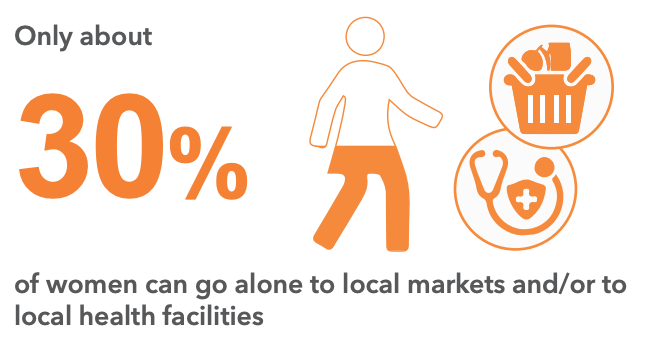
Punjab is Pakistan’s most densely populated province. Women rarely work outside agriculture. The overwhelming majority of Punjabis are also strongly opposed to female leaders, and in some villages there are restrictions on female voting.

Across Pakistan, women report major restrictions
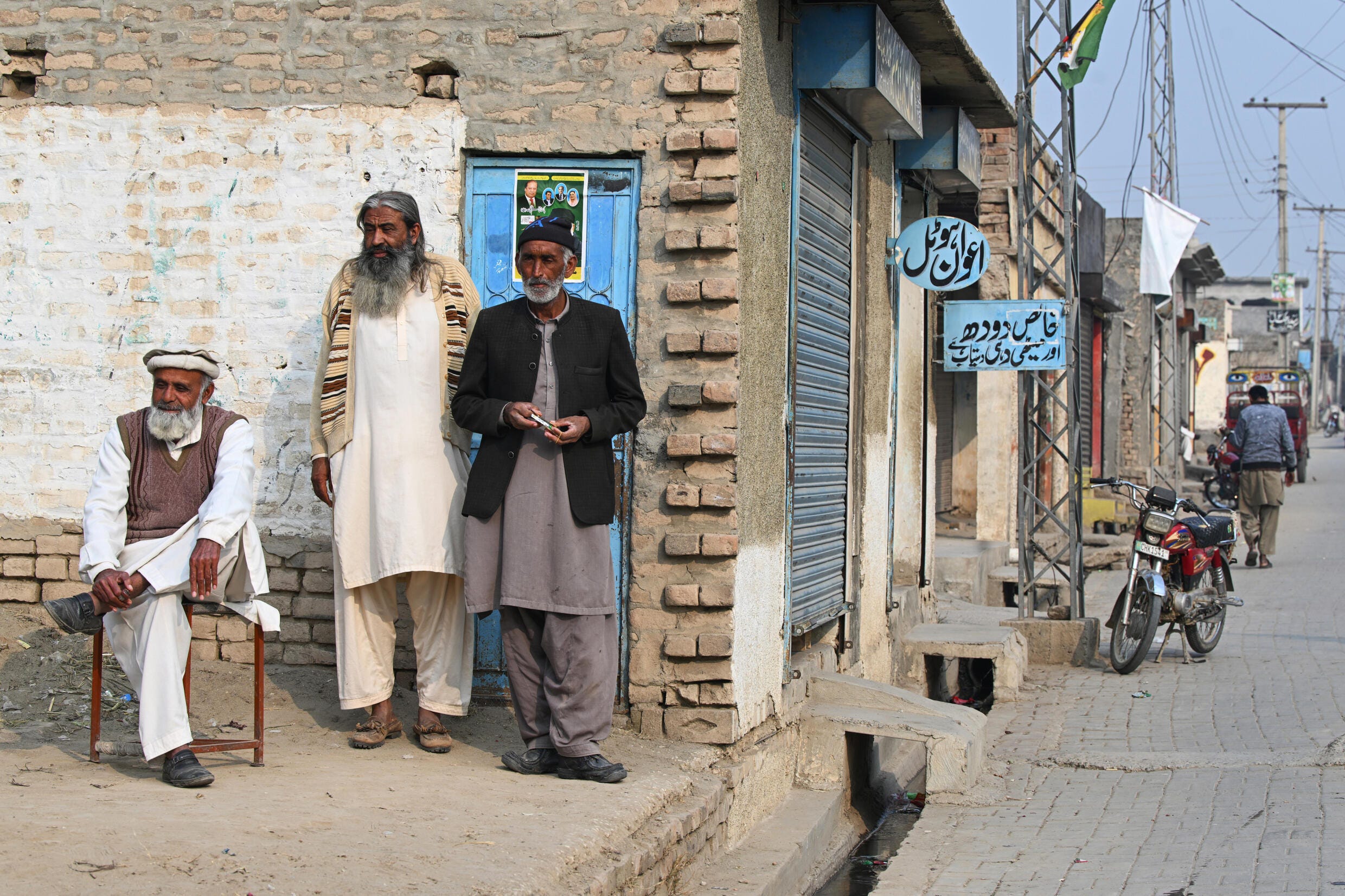
Only 30% of female respondents to the 2013 Labor Skills Survey said they could go to local markets or health clinics alone. One fifth of women reportedly never go to the local market. Women who are not allowed to venture outside the home are also much less likely to work.
Fear and discrimination constitute further impediments. Most Pakistani women say they do not feel safe in public places. Surveyed Pakistani firms have usually expressed strong resistance to hiring women.
Female labour force participation has risen, slightly
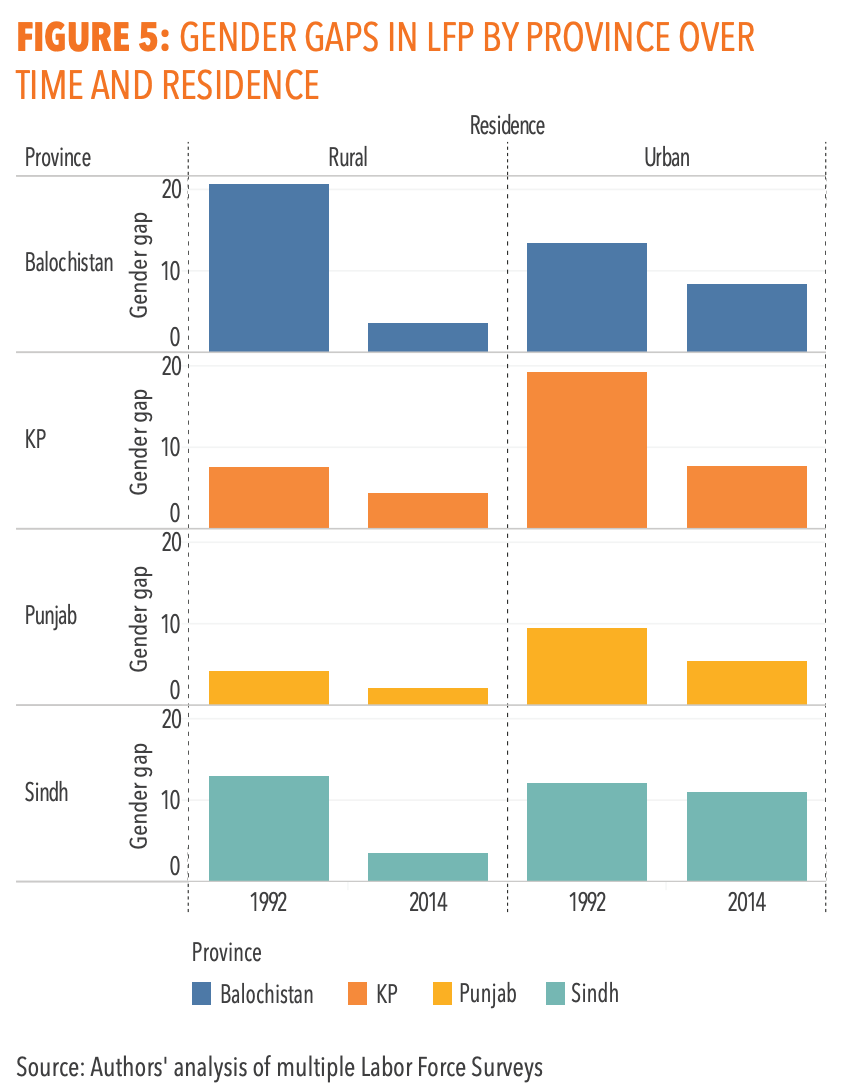
Even though Pakistan remains extremely patriarchal, gender gaps in labour force participation have actually fallen. In every province, rural and urban women are now more likely to work. This indicates that restrictions are loosening.
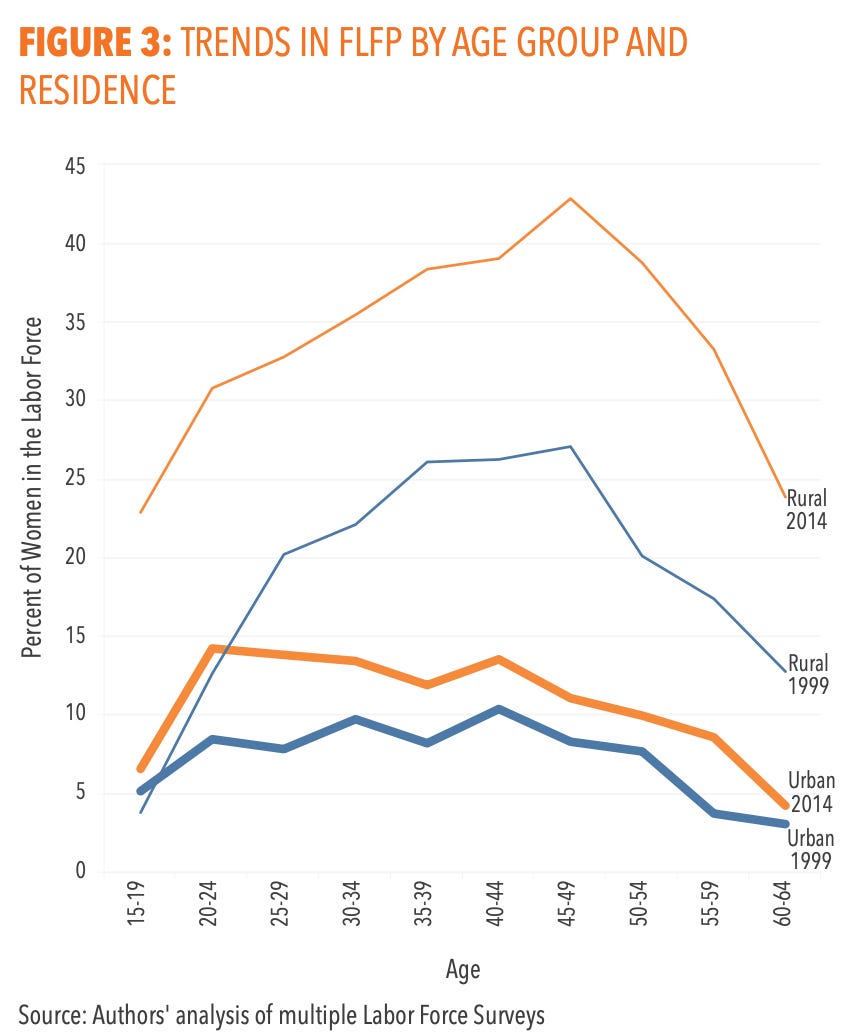
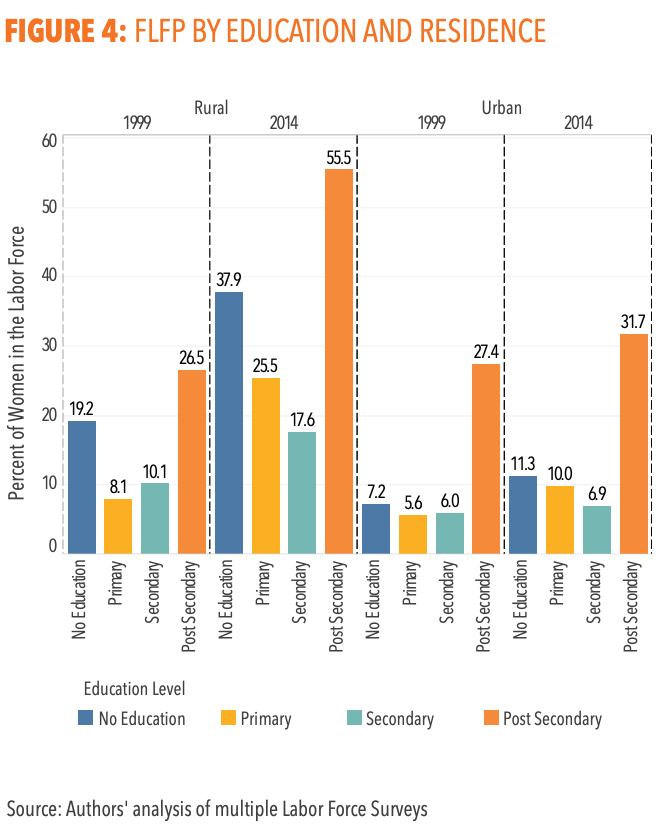
In rural Pakistan, women of all levels of education are much more likely to work. In towns and cities, employment has risen amongst university graduates. Skilled employment is both better paid, culturally esteemed and psychologically rewarding.
Is Pakistan becoming more patriarchal?
Even though female labour force participation has slightly risen, young Pakistani women appear much more sexist.
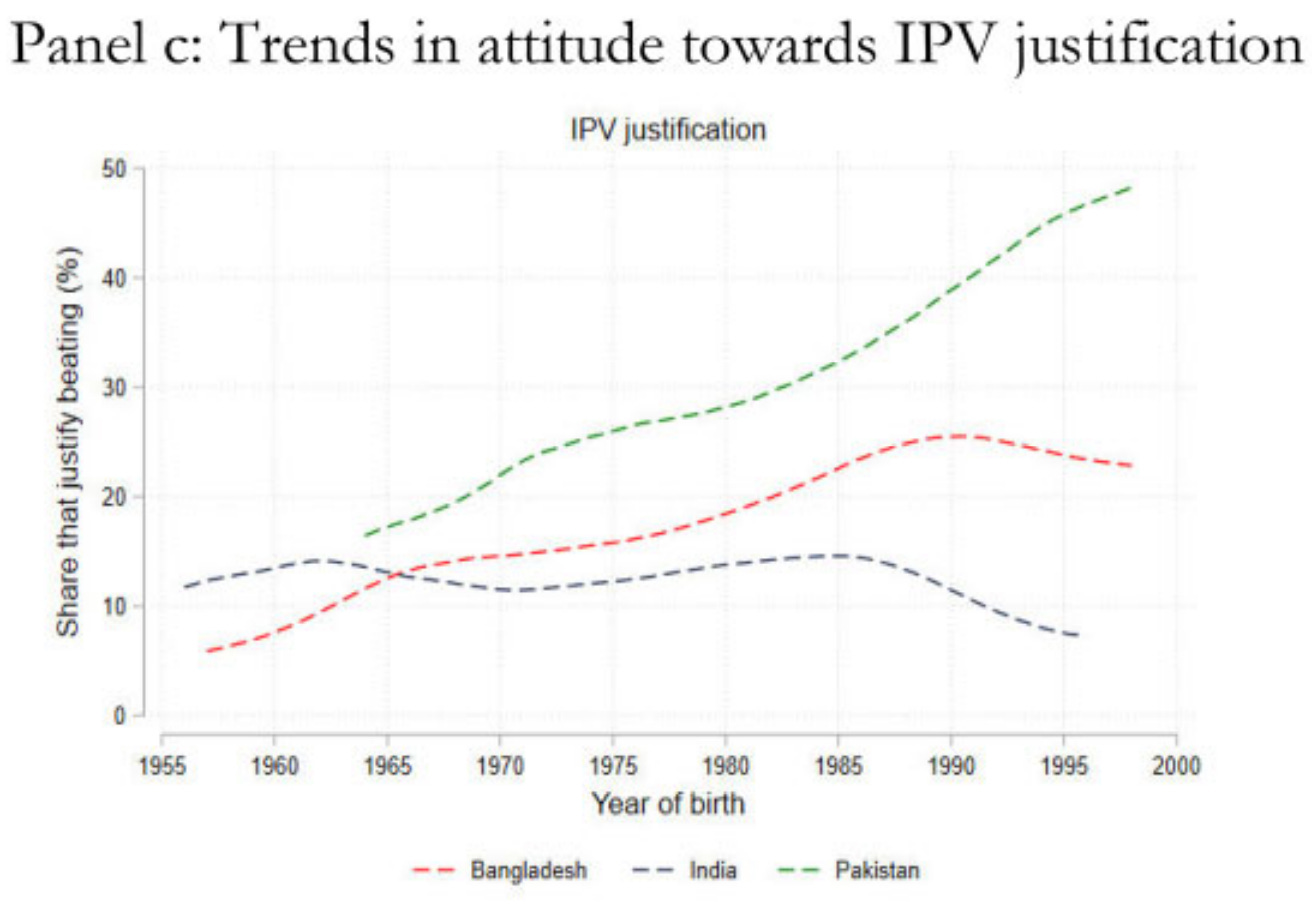
Intimate partner violence is more justified by the young
Wife-beating is justified by almost half of young women in Pakistan - find Bussolo and colleagues. Grandmothers are much more opposed. This bucks a global trend, since younger generations are usually more supportive of gender equality. In neighbouring India, attitudes are at least stable across generations.
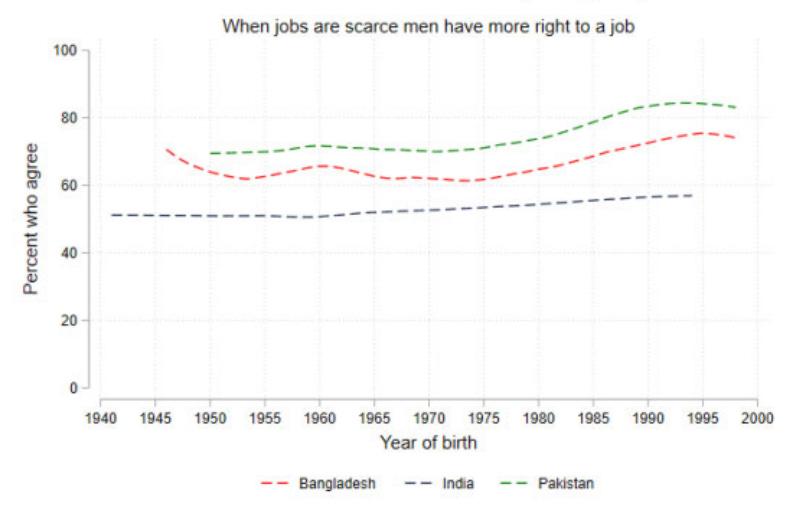
“When jobs are scarce, men have more right to a job”
The overwhelming majority of young Pakistani women say that when jobs are scarce, men have more right to a job. Compared to their grandmothers, young women are actually more sexist.
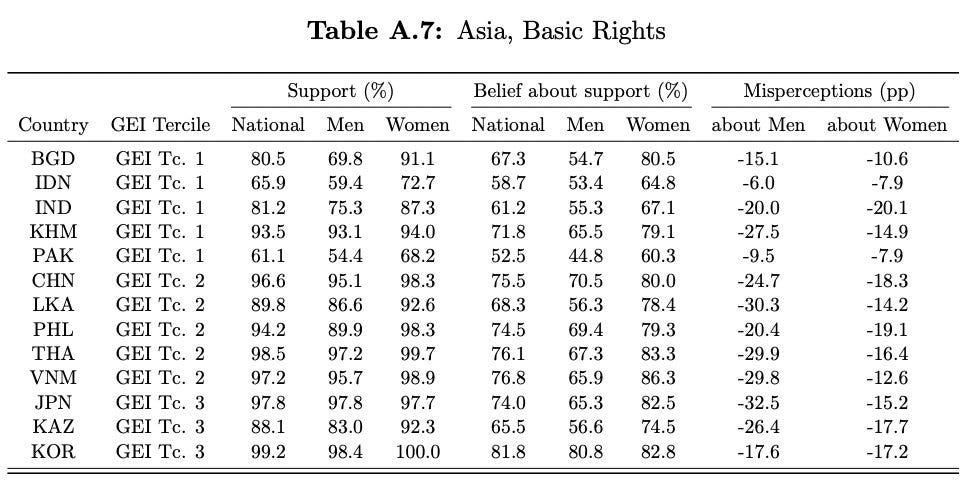
Hostility is corroborated in a recent survey by Leonardo Bursztyn and colleagues. Only 54% of Pakistani men say that women have the right to work outside the home.
“University education is more important for a boy”
60% of young Pakistani women say that university education is more important for boys. Only 40% of their mothers’ generation concurs.

“Both partners should contribute to household income”
Pakistan is in deep economic crisis. But younger people are far less likely to say that both partners should contribute to household income.

Women’s participation in household decisions
The vast majority of young Pakistani women say that they have no say in household decisions, their preferences are overlooked and ignored. Whereas in India, women of all ages usually have their say.

Is Pakistan becoming more patriarchal?
Something unusual is clearly going on in Pakistan.
On the one hand, female employment has risen slightly (though remains well below the global average, even compared to similarly poor countries). On the other hand, younger women are more likely to justify wife-beating, endorse male bias, and say their preferences are ignored.
We lack panel data on attitudes, so it’s impossible to say whether Pakistani youth are always more sexist or whether something new is impacting the current generation of young women.
Both of these trends are surprising! Elsewhere in the world, younger women are the strongest proponents of gender equality. Furthermore, rising female employment usually fosters support for gender equality. But both are flipped in Pakistan.
I share this data to motivate wider inquiry:
Are young Pakistanis becoming more patriarchal?
If so, what’s driving sexist attitudes?
Why has urban female employment slightly risen, while ideologies remain so sexist - in terms of education, employment, gender-based violence and household decision-making?
How can this (possible) trend of rising sexism be averted?
What explains the Pakistani paradox?

Hypotheses for rising patriarchy:
President Haq (1978-88) strengthened religious laws, institutions and madrasahs;
Saudi funding and labour migration has encouraged Wahhabism;
Does the incongruence of behaviour and attitudes indicate backlash? As slightly more women enter the workforce, are conservatives preaching that men have the authority to make decisions and beat their wives?
Have instability, insecurity, and economic crises fostered what Michele Gelfand terms “cultural tightening”? Threats (like neighbouring Afghanistan) may make people less culturally permissive.
Keen to understand the drivers of change over time, I’m heading to Lahore and Karachi for a month for qualitative research.
I am very keen to learn from Pakistanis. Please do email me (alice.evans@kcl.ac.uk) if you’d like to meet. Thank you!
So much to discuss from this article! Would have loved to meet you if I was back in Lahore. I grew up, and my family still lives, in a "lower-class" area of the city. Pakistan is a very paradoxical country and I often find myself checking myself when making statements about it. I wish we had more statistics that took urban/rural or economic class into account. For example, a very common story I've heard from domestic labour (house maids, cleaners etc.) is that the men in their family are not really earning or just don't earn enough so they have to do all the labour.
Some more thoughts:
There is just a very pervasive trend of Islamic conservatism in society that cuts across the economic divide. Pakistani media personalities also tend to all have a religious bent. The ones who don't have to check themselves. The most common exhortation I notice across social media is that we aren't religious enough, and our lack of religion is the main reason for the deterioration of our society. The most popular leader, Imran Khan, also had a very explicit religious bent. I'm sure this leads to what your findings say. I'm not at all surprised by them. This has largely been my anecdotal experience.
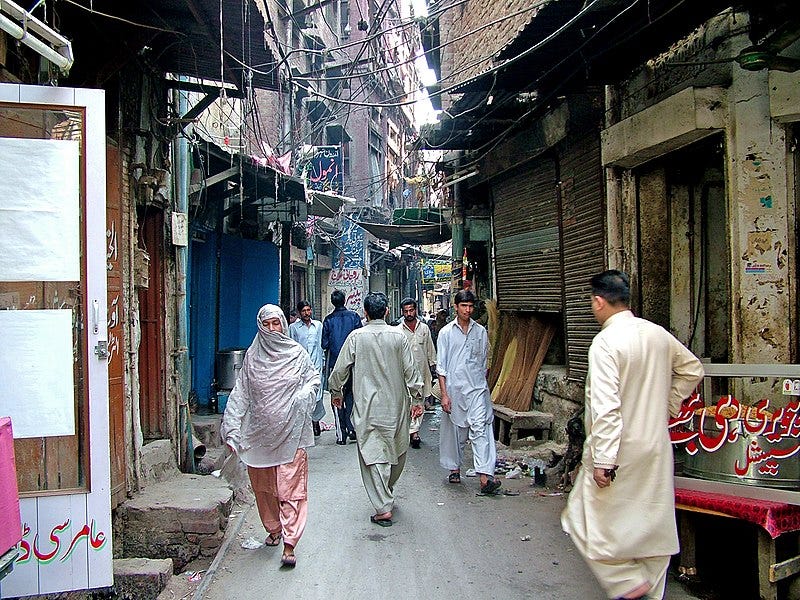
Women don't really venture out of their houses for leisure so much, yes. When you go to Lahore, you will see huge swathes of people in public areas, but exceedingly few women. This may wary depending on the place though. You will find majority women in clothing markets like Liberty Market, but rarely any in the markets of Hall Road for example. Societal expectations play a huge role in this. It's not considered "proper" for women to be out and about. My house has a small park in front of it. They even designated it a "ladies park" some time ago. I never see any ladies in it. Ugh, I can go on and on with personal anecdotes here.
Not surprised by employers not preferring women either. Men will largely keep working because they have to but there is the expectation that women often drop out once they get pregnant, or maybe their household (they largely live with the husband's family) would object one day to their working and they would have to leave their job. You will find women who've finished med school staying at home, because their in-laws don't want them to work.
This is all anecdotal of course.
I read almost all of blogs. But as a Pakistani woman living in Pakistan, I think the trends have started to reverse, from my personal experience primarily because of social media. Women in urban upper middle and even middle are starting to become more progressive and feminist. Recently, Pakistanis saw this wave of femicide and child abuse cases. Cases like the murder of Hina Javed and Sana Yousaf, sparked conversation. Sana yousaf's murderer was senctence to death. Hopefully, we will get the same for Hina's case. But yes, I must testify unlike how American tradwife culture is just a niche and controversial thing. Alot of Pakistani women romanticize this life and consider it a norm.
A major factor in deciding a woman's life in Pakistan is her family's attitude and their socioeconomic status. From my experience, I found it odd when when my friend told me she has never gone to the side market all ny herself, mostly with her brothers. One of my friend told me that when she asked her mom to take her to the market, she replied, "Ab mein tumhein galiyon mein lekye phiron gi?" (Translation: Will i make you walk around on streets now with me?"(in a sort of angry, mocking tone). Whereas, I regularly go alone to the market or bus stop to uni, sometimes without telling anyone because my mother used to talk me to the market regularly and when I was learning to drive, my father took everywhere, even in places where I was the lone woman (like the printer repair shop or auto shop). Even though, I could see people feeling a bit odd for me being there, my father always took me.
Though, it also depends on the area you are in. Despite Punjab is still pretty abhorrent as compared to global standards, it is much better than NWFP or Balochistan when it comes to women venturing out and women leadership.
Anyways, I really enjoy reading your blogs, Alice, and I am a really big proponent of feminism and an egalitarian society. Also, I read your article on MENA low birth rate and somewhat high divorce rate. Despite the fact that Pakistan is a Muslim country, we still have this werid culture of thinking divorce is the end of a woman's life. I think this is because in Pakistan, despite the fact that people say they are proud muslim, are still connected to their cultural vedic roots. This the most ironic and frustrating thing about Pakistan.